Blue Origin Pursues Record Capital Round After New Glenn Explosion
Jeff Bezos's rocket maker seeks $10 billion from institutional backers months after a test failure grounded its flagship vehicle, signaling a shift from founder-only funding to external capital.
A Turning Point in Private Space Capital
Blue Origin has opened its cap table to institutional investors for the first time, pursuing $10 billion in fresh capital at a pre-money valuation of $130 billion, according to figures disclosed by The New York Times. Coatue Asset Management is leading the round with roughly $4 billion, while founder Jeff Bezos himself is committing another $2 billion. The remainder will come from additional large backers who have not been publicly identified.
The fundraise represents a strategic inflection for a company that has, until now, relied entirely on Bezos's personal fortune. At DailyTechWire, we've tracked the widening gap between founder-funded ventures and those that tap institutional capital in the space sector; Blue Origin's move suggests even the deepest individual pockets eventually require external validation and velocity when hardware timelines slip and competitive pressure mounts.
Timing and Context: Rebuilding After Setback
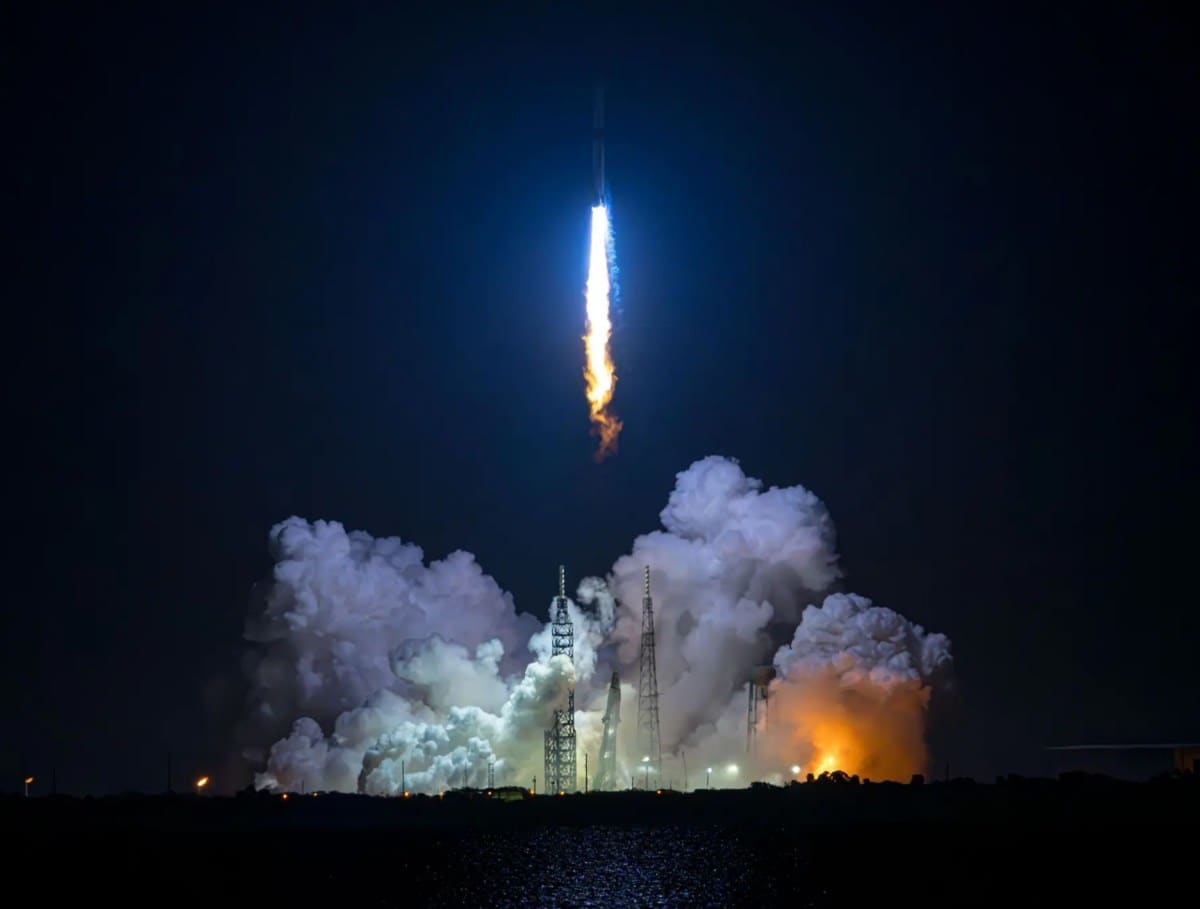
The capital raise follows a high-profile setback in late May, when New Glenn, the company's heavy-lift rocket, exploded during ground testing at Cape Canaveral. The vehicle was being prepared for what would have been its fourth launch. As of last week, Blue Origin had not publicly identified the root cause of the failure, though the company has stated its intention to resume flight operations later this year.
New Glenn is one of the most powerful launch vehicles currently under development, designed to compete directly with SpaceX's Falcon Heavy and eventually Starship. The explosion not only destroyed the test article but also damaged the launchpad, the only facility currently configured to support New Glenn's unique architecture. Rebuilding that pad is now a critical path item, and the fresh capital will almost certainly be allocated toward accelerating that reconstruction.
The timing of the fundraise, coming so soon after a major failure, underscores both the urgency of Blue Origin's ambitions and the confidence of its backers. Coatue, a firm with deep experience in scaling capital-intensive technology businesses, appears to be betting that the company's long-term trajectory outweighs near-term execution risk.
Strategic Refocus: Artemis and Beyond
Blue Origin has recently narrowed its operational focus, concentrating resources on supporting NASA's Artemis program, which aims to return astronauts to the lunar surface and establish a sustained presence there. The company holds a contract to develop the Human Landing System, a lunar lander variant, and that work has become the centerpiece of its crewed spaceflight efforts.
This pivot away from broader ambitions like space tourism and toward government contracts reflects a pragmatic recognition of where revenue certainty lies in the current market. Artemis timelines are ambitious but funded, and Blue Origin's role as a primary contractor positions it to capture multi-year revenue streams that can underwrite the cost of developing and operating New Glenn.
At the same time, the company has not abandoned commercial ambitions. Blue Origin revealed plans earlier this year for a satellite internet constellation aimed at enterprise, government, and data center customers. Unlike consumer-focused networks, this architecture is designed for high-throughput, low-latency links to support cloud computing workloads and secure communications. The capital infusion will likely accelerate the deployment timeline for that constellation, which requires not only satellites but also ground infrastructure and regulatory approvals across multiple jurisdictions.
Orbital Data Centers: A Longer Bet
Among the more speculative elements of Blue Origin's strategy is its interest in launching and operating data centers in orbit. The concept, still in early stages across the industry, envisions placing compute and storage capacity in space to take advantage of abundant solar power, natural cooling via radiation, and proximity to satellite networks that generate massive volumes of data.
Several startups and established aerospace firms are exploring variations on this theme, but no one has yet demonstrated a commercially viable orbital data center at scale. Blue Origin's involvement signals that it sees this as a potential demand driver for launch services, not just a standalone business. If orbital computing takes off, the company would be well positioned to capture both the launch revenue and the operational revenue from hosting infrastructure.
The $10 billion raise provides runway to experiment with these longer-horizon bets without jeopardizing core programs. For a company that has historically moved cautiously, the willingness to deploy capital across multiple verticals, including speculative ones, suggests a new tempo.
Competitive Landscape: Post-SpaceX IPO
The fundraise comes weeks after SpaceX completed a blockbuster initial public offering that valued the company at $1.75 trillion and raised more than $85 billion. That event reshaped the valuation landscape for space companies, establishing a new ceiling and creating pressure on competitors to demonstrate comparable scale and ambition.
Blue Origin's $130 billion valuation, while a fraction of SpaceX's, still places it among the most highly valued private aerospace firms globally. The valuation reflects expectations not just for launch services but for the integrated stack the company is building: launch, lunar landers, satellite networks, and potentially orbital infrastructure.
Coatue's involvement is particularly notable. The firm has historically concentrated on software and internet businesses, but its move into deep-tech hardware, first with AI infrastructure and now with space, signals a broader reallocation of venture and growth capital toward physical assets with long development cycles. This is a departure from the software-centric playbook that dominated the last decade, and it reflects a belief that the next wave of category-defining companies will require patient, large-scale capital to build.
Financial Implications and Path Forward
At a $130 billion pre-money valuation, the round would bring Blue Origin's post-money valuation to $140 billion, assuming the full $10 billion closes. That figure implies significant growth expectations, particularly given that the company has yet to generate meaningful revenue from New Glenn or its satellite network.
Bezos's $2 billion commitment is a strong signal of confidence, but it also highlights the scale of capital required to compete in modern aerospace. Even for one of the world's wealthiest individuals, the cost of developing heavy-lift rockets, lunar landers, and satellite constellations in parallel exceeds what can be comfortably self-funded without diluting other investments or philanthropic commitments.
For Blue Origin, the fundraise buys time and optionality. It allows the company to rebuild its launchpad, iterate on New Glenn's design, accelerate satellite production, and invest in emerging areas like orbital computing, all without the existential pressure that comes from cash constraints. Whether that capital translates into market share and revenue will depend on execution in the months ahead, particularly the successful return to flight of New Glenn and the pace at which the company can scale production and launch cadence.
The broader question for the space industry is whether the capital now flowing into the sector, both through public markets and private rounds, will be met with commensurate demand. Launch capacity is expanding rapidly, but the customer base, outside of government contracts and satellite internet, remains uncertain. Blue Origin's bet is that by building across the stack, from launch to orbit to surface, it can create and capture demand rather than simply competing for existing contracts. The $10 billion round is a down payment on that vision.