Bengaluru's Runable Raises $21M to Turn AI Agents Into Growth Engines
The Indian startup is moving beyond website and app creation to help small businesses find customers, run campaigns, and scale with minimal technical overhead.
From Infrastructure to Outcomes
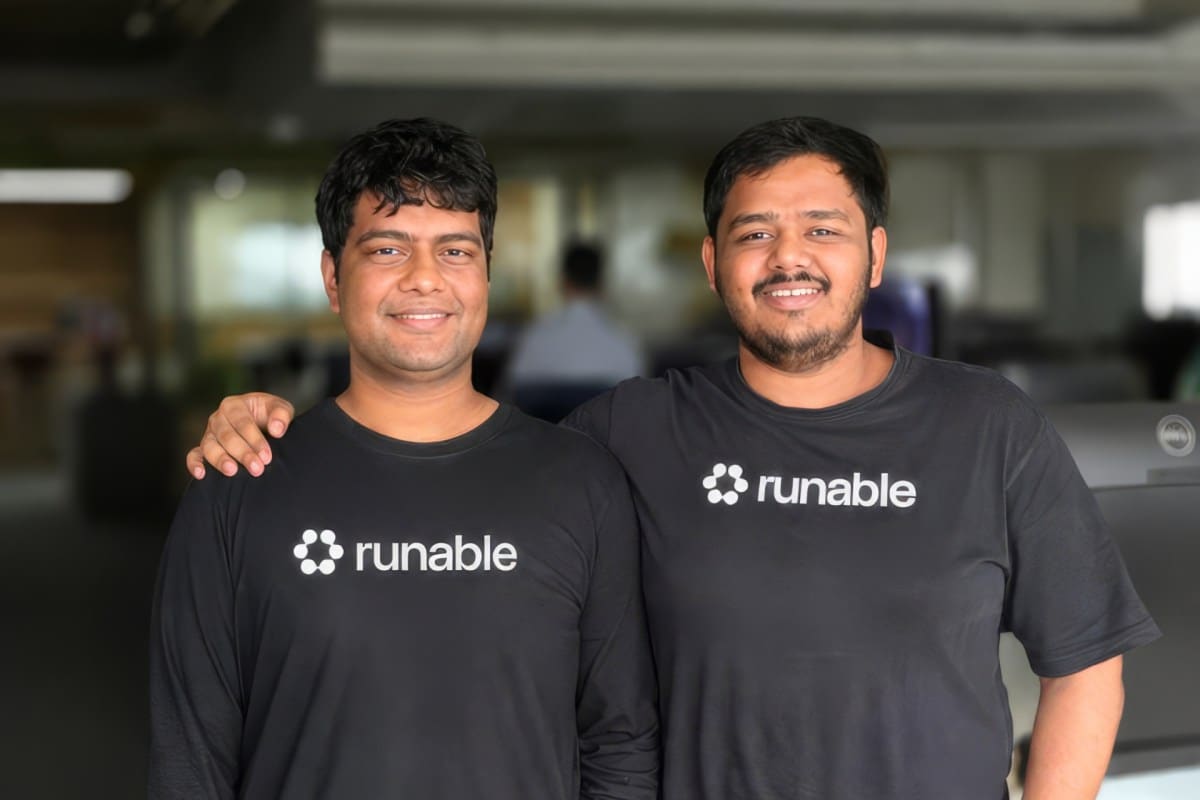
Runable landed $21 million in Series A funding this week, a vote of confidence in its bet that small businesses care less about the technical magic of AI code generation and more about tangible results: customers, revenue, and growth. Susquehanna Venture Capital and Nexus Venture Partners co-led the round, with participation from Together Fund and Array VC. The all-equity investment values the fifteen-person Bengaluru company at $65 million post-money, according to co-founder and CEO Umesh Kumar.
Founded in 2025, Runable initially set out to build browser automation infrastructure for large-scale data scraping. But user behavior pushed the founders in a different direction. Customers kept asking the browser-based agent to generate slide decks, websites, and other content. Co-founders Kumar and Saksham Sarda took note and pivoted toward a general-purpose AI agent that handles the full stack of launching and scaling a small business.
The shift paid off quickly. Within three weeks of introducing payments in March, Runable hit a $2 million annualized revenue run rate. The platform now claims 1.7 million registered users, with the United States, United Kingdom, and Japan forming its core markets. Kumar expects Japan to rival the U.S. as a top market within weeks.
The Build-and-Grow Thesis
Most AI coding tools stop at deployment. Runable wants to go further. The platform already lets users spin up websites, apps, and presentations through natural language prompts, managing deployment and analytics infrastructure behind the scenes. Now the startup is pushing into what it calls the "grow" side: running ad campaigns, managing social media, optimizing search visibility, and even positioning businesses inside AI chatbot results.
Kumar frames the value proposition around delegation, not technical prowess. A small business owner should be able to tell Runable to deliver a hundred customers, he argues, without manually configuring ad accounts, analytics dashboards, or marketing funnels. The vision is an agent that owns the outcome, not just the artifact.
In practice, execution remains a work in progress. When we tested Runable by asking it to build a coffee subscription website, deploy it, set up analytics, and attract the first hundred visitors on a $25 ad budget, the agent built the site and drafted a campaign but stopped short of running ads. It required us to connect an external advertising account first. A parallel test on Cursor produced similar friction: the tool prepared a Meta Ads campaign but needed account credentials and a third-party deployment service.
Runable does handle more infrastructure natively, including hosting and analytics, which reduces the number of external dependencies. The startup says it can already run ads on ChatGPT without requiring customers to connect their own accounts, thanks to unnamed partnerships it describes as a "soft wedge" into the advertising layer. Whether those partnerships extend to Google, Meta, or other major ad platforms remains unclear.
Competing in a Crowded Field
Runable enters a market thick with competitors. Anthropic, OpenAI, Cursor, Lovable, and Replit all offer tools that generate and deploy code. Kumar acknowledges the overlap but argues Runable is targeting a different user: the nontechnical small business owner who wants results, not a development environment. For developers working with local files or writing custom code, he concedes that tools like Anthropic's Claude or OpenAI's Codex may be better fits.
The startup sees general-purpose agents such as Manus and Genspark as closer rivals, given their focus on end-to-end business workflows rather than pure code generation. Runable's differentiator, Kumar insists, is the emphasis on customer acquisition and growth, not just creation.
Still, the competitive moat is narrow. The very AI model providers Runable depends on are building their own agents. If Anthropic or OpenAI decide to bundle infrastructure, analytics, and ad management into their platforms, Runable's advantage shrinks. Kumar's counterargument rests on integration depth: stitching together models, hosting, analytics, and distribution without forcing users to juggle multiple services.
Economics and Scale
Runable currently operates with negative gross margins, a reality Kumar attributes to subsidizing AI usage for customers. Over the past ninety days, users consumed more than one trillion tokens, with paying customers accounting for sixty to seventy percent of that volume. The startup is working with a mix of third-party models while developing its own, betting that falling inference costs will eventually flip the unit economics.
Kumar sees a path to delivering the same inference quality at one-tenth the current cost, a projection that hinges on both model efficiency gains and Runable's ability to optimize its own stack. Whether that timeline aligns with the startup's cash runway and growth targets will determine how long it can afford to subsidize usage.
The funding gives Runable room to test its thesis. The question is whether small businesses will pay for an agent that promises to handle growth, or whether they will continue to rely on the fragmented but familiar stack of ad platforms, analytics tools, and freelance marketers. If Runable can close the gap between building a website and landing the first hundred customers without requiring users to wire up half a dozen external accounts, it may carve out a defensible position. If not, it risks becoming another layer in an already complex toolkit.