Middle-Mile Autonomy Attracts $200M as Gatik Proves Commercial Viability
The box-truck specialist now runs dozens of driverless vehicles across multiple U.S. markets, with $600 million in contracted revenue and backing from sovereign wealth and institutional capital.
The Middle-Mile Bet Pays Off
While much of the autonomous vehicle industry chased either consumer robotaxis or long-haul trucking, one Santa Clara startup quietly built a business around a less glamorous segment: shuttling snacks between warehouses and retail stores. That focus is now drawing serious institutional capital.
Gatik announced a $200 million funding round led by Qatar Investment Authority and Koch Disruptive Technologies, with participation from Millennium Management, ARK Invest, and Intact Private Capital. The raise brings the company's total capital to roughly $500 million since emerging from stealth in 2019, though the firm declined to disclose its current valuation.
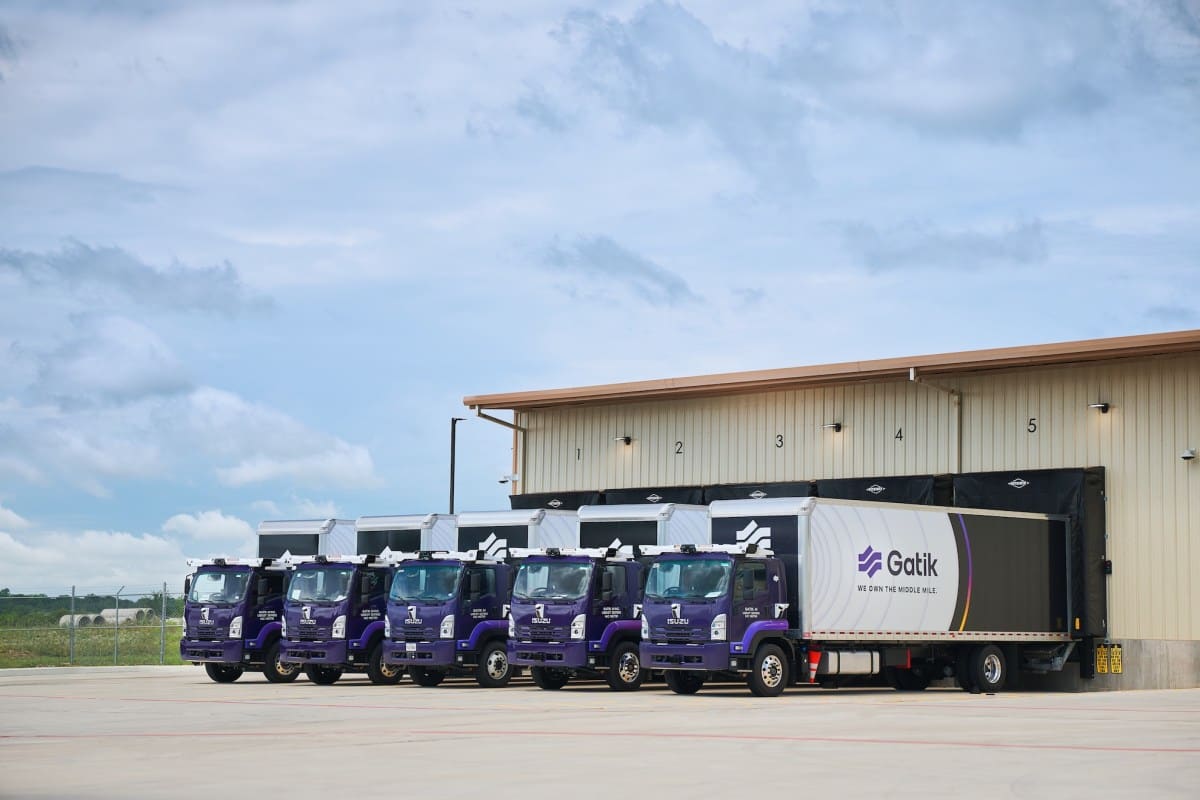
The timing follows a significant commercial agreement with PepsiCo, inked just two months earlier, under which Gatik operates 41 driverless box trucks moving Frito-Lay products across Dallas, Phoenix, and Northwest Arkansas. According to Gautam Narang, co-founder and CEO, the company has secured $600 million in contracted revenue across its customer base, a figure that underscores the shift from proof-of-concept to sustained commercial deployment.
"These are all long-term investors," Narang noted, emphasizing that the capital is intended to support multi-year expansion rather than near-term experiments. For a sector that has seen high-profile stumbles and shutdowns, the composition of the investor syndicate matters: sovereign wealth funds and institutional managers typically demand clear paths to profitability, not just technology demos.
Why Short Hauls, Not Long Hauls
Gatik's niche sits between last-mile delivery robots and interstate big-rig automation. The company manufactures its fleet using Isuzu Motors chassis, outfitting them with proprietary autonomy stacks designed for fixed and dynamic routes spanning up to 400 miles. Early deployments were conservative, limited to under 10 miles on predictable paths. Over time, the operational envelope expanded to include dozens of pickup and drop-off points, surface streets, highways, and varying weather conditions.
The middle-mile segment offers distinct advantages. Routes are more predictable than urban robotaxi environments, yet complex enough to require robust perception and planning. Vehicles operate in commercial settings with lower public scrutiny than passenger services, and customers are enterprises with clear return-on-investment metrics, not consumers experimenting with ride-hailing apps.
That positioning has allowed Gatik to avoid direct competition with well-capitalized players like Waymo or Cruise in the robotaxi space, and with TuSimple or Aurora in long-haul freight. Instead, the company has become the dominant provider in a category it largely defined.
Removing the Safety Driver
Last year, Gatik reached what Narang describes as a critical operational milestone: pulling the safety driver from behind the wheel on commercial routes. The company now operates dozens of fully driverless trucks across several U.S. markets, a transition that required regulatory approval, insurance underwriting, and customer confidence.
The third generation of Gatik's autonomy stack operates around the clock on surface streets and highways, handling light rain and snow. That capability is essential for commercial viability. Enterprise customers demand uptime and reliability, not technology that only functions in ideal conditions. A fleet that can run through varied weather and traffic scenarios commands higher contract values and longer commitments.
The company's customer roster includes Walmart, its first disclosed partner from six years ago, along with Canada's Loblaws, Kroger, and Tyson Foods. While Gatik declined to share precise fleet numbers or name all customers, the PepsiCo deployment represents its largest public partnership to date. Moving Cheetos and Doritos may lack the futuristic allure of passenger autonomy, but it generates recurring revenue and operational data at scale.
Capital Allocation and Headcount
The $200 million will fund fleet expansion, geographic growth, and hiring. Gatik currently employs around 350 people, a modest headcount relative to some autonomous vehicle peers that ballooned to thousands before scaling back. Narang indicated the company plans to add engineers and operational staff, as well as expand into new markets or deepen presence in existing ones.
The hiring strategy reflects a maturing business model. Early-stage AV companies often prioritized research scientists and algorithm developers. Gatik's current needs skew toward operations, fleet management, and customer integration, roles that support revenue generation rather than pure R&D.
Geographic expansion remains on the table, including potential moves outside North America. However, Narang emphasized that growth will be methodical, guided by customer demand and regulatory frameworks rather than land-grab ambitions. The company's long-term investors, he suggested, align with that measured approach.
The Broader AV Landscape
Gatik's progress stands in contrast to the broader autonomous vehicle sector, which has experienced consolidation, down rounds, and high-profile exits. Several robotaxi ventures have struggled to achieve commercial scale, while long-haul trucking automation faces regulatory and technical hurdles around interstate operations and complex loading-dock scenarios.
Middle-mile logistics, by comparison, benefits from shorter routes, controlled environments, and customers willing to pay for predictable cost savings. Labor shortages in logistics and rising freight costs have made automation more attractive to enterprises, creating tailwinds that passenger-focused AV companies do not enjoy.
At DailyTechWire, we've tracked how autonomy investments have bifurcated: consumer-facing services draw venture capital and strategic corporate backers, while B2B logistics applications increasingly attract institutional and infrastructure-focused investors. Gatik's syndicate reflects that trend. Sovereign wealth funds and diversified asset managers are betting on operational cash flow, not exit multiples driven by consumer adoption curves.
What Remains Uncertain
Despite the progress, questions linger. Gatik has not disclosed profitability metrics, and $600 million in contracted revenue over an undefined time horizon does not clarify unit economics. The company also faces potential competition from in-house automation efforts by large retailers and logistics providers, some of which have the capital and operational footprint to build proprietary solutions.
Regulatory risk persists as well. While Gatik has secured approvals for driverless operations in its current markets, expanding to new states or countries will require navigating varied frameworks. Any high-profile incident involving a driverless commercial vehicle could trigger policy reversals or heightened scrutiny.
Finally, the technology itself continues to evolve. Handling light rain and snow is progress, but heavy weather, complex construction zones, and rare edge cases remain challenges for the entire industry. Gatik's ability to scale will depend on how quickly it can harden its stack against those scenarios while maintaining cost structures that justify automation over human drivers.
A Defined Path, Not a Guarantee
Gatik's $200 million raise and $600 million in contracted revenue suggest the middle-mile thesis is gaining traction with both customers and capital allocators. The company has moved beyond pilot programs into sustained commercial operations, a transition many AV startups have failed to make.
Yet the path from dozens of trucks to hundreds, and from a few markets to national or international scale, will test execution as much as technology. The funding provides runway, but the real validation will come from fleet uptime, contract renewals, and whether the unit economics hold as operations expand. For now, the box trucks shuttling Doritos through Dallas represent one of the clearer use cases for autonomy outside of hype cycles and future promises.