Voice AI Startup Ringg Adds $10M to Push Beyond Simple Phone Calls
The Bengaluru company is moving from high-volume outbound calling to complex enterprise workflows like KYC and appointment booking, now handling 20 million monthly call attempts.
From Text-to-Speech Lab to Enterprise Voice Stack
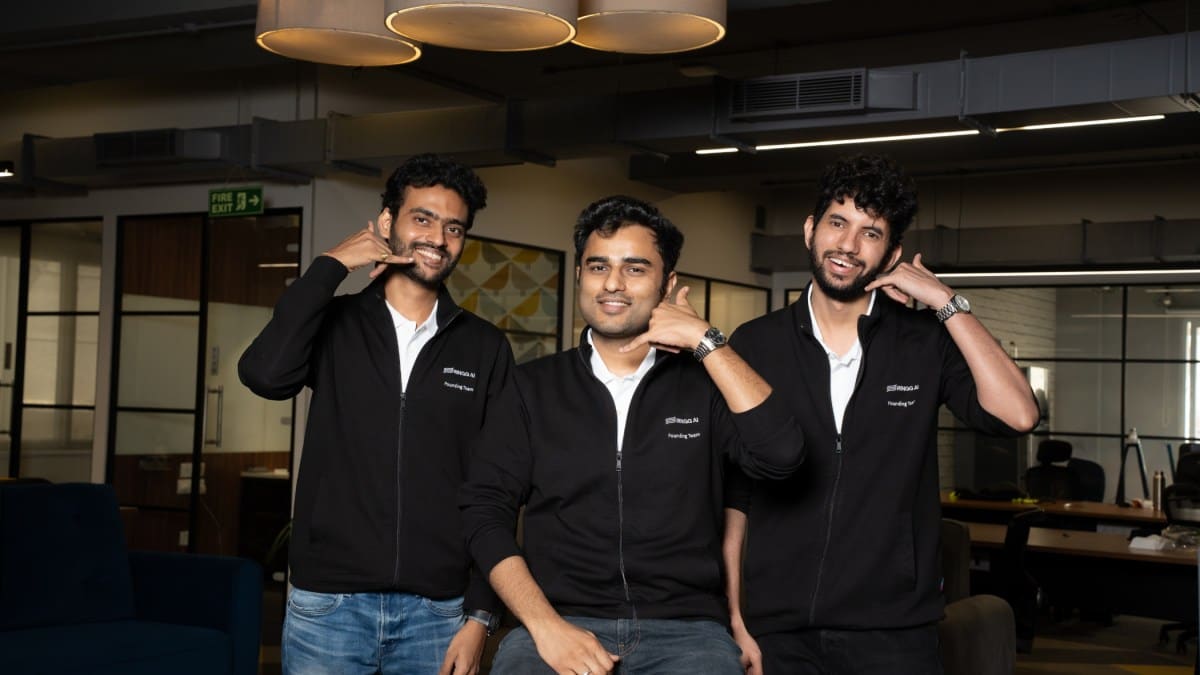
Ringg started building speech models in-house under the name DesiVocal, but training proprietary text-to-speech infrastructure proved too capital-intensive. Co-founder Siddharth Tripathi and his team pivoted, moving up the value chain to orchestrate voice AI agents for large enterprises instead of selling raw models. Indian fintech Cred became the first customer, validating the approach. The company now processes 20 million call attempts each month for clients including Flipkart, Practo, Groww, and Policybazaar.
Peak XV Partners just extended Ringg's Series A with $10 million, bringing the round's total to $15.5 million after an initial $5.5 million close earlier this year. The fresh capital reflects a bet that voice remains the dominant channel for customer interaction in India, where more than three-quarters of consumers still prefer phone calls when dealing with businesses, according to data from Truecaller.
Climbing the Complexity Ladder
Early use cases centered on outbound calling, lead qualification, and loan collections. Tripathi describes those workflows as "high-volume, low-complexity" and ultimately not sticky; clients can switch providers on price alone. Ringg has since shifted focus to tasks that require multi-step logic and tighter integration with back-end systems: appointment scheduling for healthcare, abandoned-cart recovery for e-commerce, and know-your-customer checks for fintech apps.
At Practo, a healthcare platform, Ringg's voice agent now operates across 1,200 clinics, handling patient appointment bookings and post-visit follow-ups. The automation frees clinic staff to handle in-person care while the agent manages scheduling conflicts, insurance verification, and reminder calls. Tripathi says these higher-value workflows generate stronger retention because they sit deeper in the customer's operational stack.
Voice calls still account for more than 70 percent of Ringg's business, but the company has begun routing tasks to chat interfaces and WhatsApp. For Shell, it automates browser-based support requests. "We are trying to position ourselves as a platform for agents that bring outcomes or get things done rather than voice agents for enterprises," Tripathi explained.
Model Economics and the Orchestration Layer
Ringg builds its own speech recognition and generation models, a legacy of its DesiVocal origins. The technical depth allows the team to fine-tune latency, accent handling, and domain-specific vocabulary for industries like healthcare and finance. Tripathi says the long-term vision is to own the full voice stack, from inference to deployment infrastructure, but the capital required makes that impractical today. Instead, Ringg functions as an orchestration layer, routing tasks to different models depending on use-case requirements and cost profiles.
Rishen Kapoor, a principal at Peak XV, argues that the research-lab DNA gives Ringg an edge in complex enterprise workflows. "Because of the technical capabilities, they can actually do these hard-won enterprise workflows end to end. They can complete these higher-value tasks like merchant onboarding, like L1 and L2 support, with quality and with consistency," he noted.
The economics of voice AI in India hinge on two variables: the cost per minute of inference and the willingness of enterprises to pay for outcome-based contracts rather than seat-based SaaS. Ringg is hiring researchers focused explicitly on driving down model costs, a priority as the company scales from dozens of enterprise clients to hundreds.
A Crowded Stack, From Models to Applications
Voice AI in India has become a layered battlefield. Model providers like Deepgram, ElevenLabs, and Cartesia compete with local players including Sarvam and Smallest.ai for the foundation layer. Orchestration-focused startups such as Bolna and Blue Machines occupy the same middleware territory as Ringg. Vertical specialists like Gnani and Arrowhead concentrate on finance-heavy use cases, where regulatory requirements and fraud detection add complexity.
At DailyTechWire, we've tracked this stack separation across the region: the real defensibility increasingly sits with whoever owns the customer relationship and the outcome metric, not the model weights. Ringg's bet is that enterprises will pay more for an agent that completes a KYC flow or recovers a cart than for raw API access to a speech model, even if that model benchmarks well on word-error rate.
Most of Ringg's customers operate in India, with a handful in the Middle East and the United States. The company is not pursuing direct sales to U.S. enterprises; instead, it plans to partner with global capability centers, the offshore hubs that multinationals use for back-office and support operations. The pitch is to bundle automation capacity with human agents, letting GCCs scale support without proportional headcount growth.
Hiring for Forward-Deployed Engineers
Ringg currently employs 40 people, adding more than 15 in the past three months. The company is recruiting for forward-deployed engineer roles that blend technical implementation with product management, embedding engineers at customer sites to customize workflows and troubleshoot integration issues. It is also hiring researchers to optimize model inference costs, a recurring theme in conversations around voice AI economics.
The hiring pace reflects both the new capital and the operational reality of serving enterprise customers in India: implementations are rarely plug-and-play. Each client brings legacy systems, unique compliance requirements, and workflows that evolved over years of manual operations. Ringg's strategy is to absorb that complexity into the platform rather than force customers to rewrite their processes.
The Outcome Economy in Voice
The shift from simple outbound calling to multi-step workflows mirrors a broader transition in enterprise software: from selling tools to selling outcomes. Ringg charges based on completed tasks, whether that means a booked appointment, a verified identity, or a recovered transaction. The model aligns revenue with customer value but also exposes the company to execution risk. If the agent fails to complete a workflow, Ringg does not get paid.
Tripathi sees that risk as a feature, not a bug. It forces the team to obsess over task completion rates, error handling, and escalation paths to human agents when the AI hits a dead end. The company tracks metrics like first-call resolution, average handle time, and fallback frequency, all borrowed from traditional contact-center operations.
India's preference for voice as a primary interface creates a structural advantage for companies like Ringg. While chat and email dominate customer support in the United States and Europe, phone calls remain the default in markets where smartphone penetration outpaces desktop usage and where trust in digital-only channels is still building. That preference gives voice AI startups a larger addressable market and more tolerance for incremental improvements in agent quality.
The $10 million extension will fund deeper integrations with enterprise resource planning systems, customer relationship management platforms, and payment gateways. It will also support expansion into adjacent channels like WhatsApp, where conversational commerce is growing faster than web-based e-commerce in several Indian cities. Ringg's roadmap includes tighter hooks into Salesforce, Zoho, and other CRM systems popular among Indian mid-market companies, allowing the voice agent to pull customer history and update records in real time.
As the voice AI stack matures, the line between model providers, orchestrators, and application-layer companies will continue to blur. Ringg's origin as a research lab gives it optionality: it can build models when differentiation matters and buy them when commoditization sets in. That flexibility may prove more valuable than owning any single layer outright.