Heavy Trucking May Finally Crack the EV Equation With Battery Swap Hubs
Octopus Energy and CATL are betting swap infrastructure can sidestep the weight penalty that has kept long-haul trucks tethered to diesel - and turn idle batteries into grid assets.
The Rocket Equation Problem
Heavy trucking has always represented the hardest edge case for electrification. The physics are unforgiving: moving a forty-tonne load requires substantial energy, and lithium-ion packs add hundreds of kilograms more to the rig. The result is a vicious cycle familiar to aerospace engineers - the rocket equation, where every increment of mass demands additional propulsion, which in turn demands more fuel or battery capacity, which adds more mass. For long-haul operators running tight margins on fuel and time, the calculus has kept diesel entrenched.
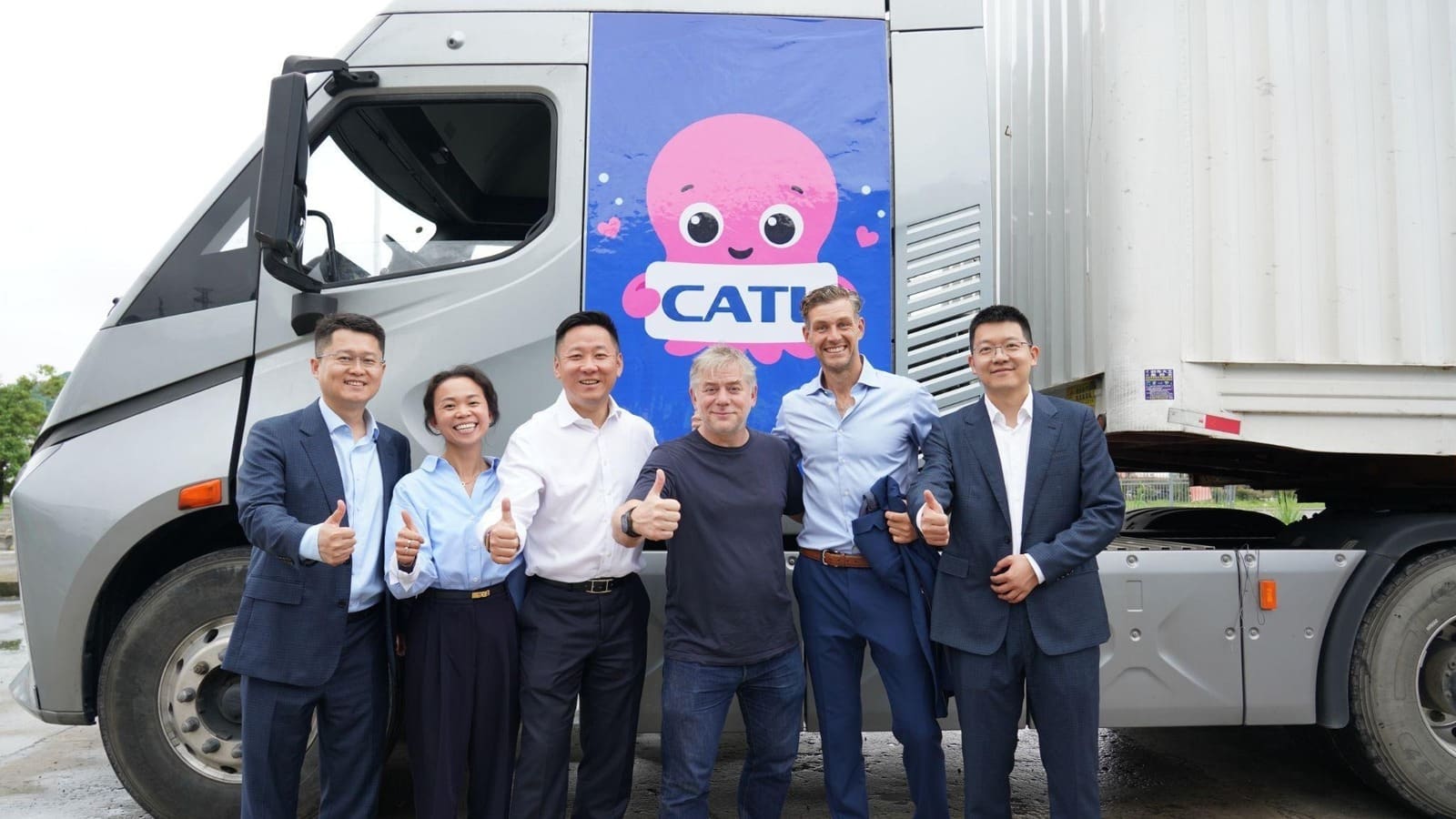
A new joint venture between Octopus Energy, the United Kingdom's largest energy provider, and Contemporary Amperex Technology Co. Limited, the world's leading battery cell manufacturer, believes it has found a way to break that loop. The partnership, operating under the name Swaptopus, intends to deploy a network of battery swap mega hubs across Europe beginning in 2027. The facilities will target electric trucks specifically, replacing depleted battery packs with fully charged units in a matter of minutes - potentially faster than a conventional diesel fill and at a fraction of the operating cost.
At DailyTechWire, we've tracked swap infrastructure projects from Taipei to Shenzhen, and the common thread has been segmentation. Consumer passenger vehicles have largely abandoned the model, but commercial fleets operating predictable routes with centralized depot charging have found the economics compelling. What Octopus and CATL are proposing is the European extension of a model already operating at scale in China, adapted for the continent's logistics backbone.
Why Swap Works for Trucks but Failed for Cars
Battery swapping has cycled through hype and disappointment in consumer EVs. A decade ago, even Tesla piloted a swap station in California before shelving the concept in favor of Superchargers. The obstacles were straightforward: high capital costs for battery inventory, complex mechanical systems prone to wear, and the lack of standardization across vehicle platforms. Automakers were unwilling to cede control over battery design, and consumers were skeptical about trusting third-party cells in their personal vehicles.
Heavy trucking, however, presents a different set of constraints. Fleet operators care about uptime and total cost of ownership, not brand loyalty to a particular battery chemistry. Routes are often fixed, making it feasible to guarantee swap station availability at known intervals. And crucially, the weight penalty of carrying oversized battery packs becomes prohibitive at commercial scales. Smaller, swappable packs allow trucks to shed mass, extend range per kilogram, and avoid the multi-hour charging sessions that would erode utilization rates.
The model has already demonstrated viability in Asia. CATL partnered with Sinopec, one of the region's largest oil and petrochemical conglomerates, to deploy swap infrastructure across China in 2025. Taiwanese scooter manufacturer Gogoro has built a vast network of swap kiosks for two-wheelers, and automaker Nio operates consumer-facing stations for passenger vehicles. The operational data from these deployments suggest that swap times of under five minutes are achievable with mature hardware, and battery cycle life remains within acceptable bounds when charging is managed intelligently.
Swaptopus is essentially importing this playbook into a regulatory and infrastructure environment that has historically favored charging over swapping. The question is whether European logistics operators, accustomed to diesel's ubiquity and predictability, will commit capital to a nascent network before critical mass is reached.
Grid Flexibility and the Hidden Revenue Stream
One of the more intriguing aspects of the Swaptopus model is its dual function as distributed energy storage. According to William Rowe, CEO of the joint venture, the swap hubs will charge their battery inventory during periods of low grid demand or high renewable generation - effectively acting as demand-side flexibility assets. When wind or solar output spikes and wholesale electricity prices drop, the hubs can absorb surplus power. Conversely, during peak demand windows, those same batteries could theoretically discharge back into the grid, generating ancillary revenue.
This positions the infrastructure not merely as a service for trucking fleets but as a grid-scale storage play. Octopus Energy has built its reputation on dynamic tariffs and smart grid integration, and CATL controls enough global battery production capacity to make procurement and lifecycle management economically viable at scale. The combination gives Swaptopus a structural advantage over pure-play logistics startups that lack either the energy market expertise or the cell supply chain.
There is, however, a potential misalignment of incentives. Fleet operators renting battery packs may not appreciate their cells being cycled for grid services, which incrementally degrades capacity and shortens useful life. Rowe's framing - charging "when the grid needs it" - glosses over the fact that maximizing grid revenue might not align with maximizing battery longevity for the trucking customer. The commercial terms of the swap agreements will need to address cycle life guarantees, capacity fade thresholds, and whether fleet customers share in grid service revenues or simply bear the degradation cost.
If structured poorly, this could become a friction point. If structured well - say, with transparent degradation metrics, revenue sharing, or discounted swap fees in exchange for grid flexibility - it could become a competitive differentiator. The devil, as always, will be in the service-level agreements.
The Infrastructure Chicken-and-Egg
Heavy truck procurement operates on multi-year decision cycles. Fleet managers do not buy vehicles on spec; they require confidence that refueling or recharging infrastructure will be available across their operating corridors for the life of the asset, often a decade or longer. This creates a classic coordination problem: truck manufacturers hesitate to produce swap-compatible models without guaranteed station coverage, and infrastructure investors hesitate to build stations without a committed fleet customer base.
Swaptopus enters this dynamic with two significant advantages. CATL's scale and existing relationships with commercial vehicle manufacturers in China and Europe give it a credible path to standardizing battery form factors and mounting interfaces. Octopus Energy's footprint in the UK market and its regulatory relationships provide a foundation for site permitting, grid connection, and offtake agreements. The combination lowers the risk premium for early fleet adopters.
The first UK mega hubs are slated to open in 2027. The timeline is aggressive but not implausible, given that much of the core technology is already deployed elsewhere. The real test will be whether major logistics operators - DHL, Maersk's trucking arm, or regional hauliers - commit to purchasing or leasing swap-compatible electric trucks in parallel. Without that commitment, even the most elegantly engineered swap station becomes a stranded asset.
One plausible path forward is for Swaptopus to sign anchor tenant agreements with one or two large fleets, guaranteeing minimum swap volumes in exchange for preferential pricing or co-investment in hub buildout. This would de-risk the rollout and signal to other operators that the infrastructure is bankable. It would also provide real-world operational data - swap throughput, battery degradation curves, grid integration performance - that can inform expansion into other European markets.
Hydrogen's Shadow
It would be incomplete to discuss heavy trucking electrification without acknowledging hydrogen fuel cells, the technology many industry observers have long assumed would dominate this segment. Hydrogen offers energy density closer to diesel and refueling times measured in minutes, making it superficially attractive for long-haul applications. Several European truck manufacturers have prototype fuel-cell models, and there is political momentum behind hydrogen as a decarbonization vector, particularly in Germany and the Netherlands.
Yet hydrogen infrastructure remains sparse, expensive, and energy-inefficient. Producing green hydrogen via electrolysis, compressing it, transporting it, and converting it back to electricity in a fuel cell involves multiple conversion steps, each shedding efficiency. Round-trip efficiency for hydrogen pathways hovers around thirty to forty percent, compared to over eighty percent for battery electric systems when charging losses are included. For fleet operators focused on operating cost per kilometer, that efficiency gap translates directly to higher fuel expense.
Battery swapping, by contrast, leverages the same lithium-ion supply chain already scaling for passenger EVs and grid storage, benefits from improving cell energy density, and can monetize grid services. The operational complexity shifts from hydrogen production and distribution to battery logistics and charging orchestration - a trade-off, but one that plays to the strengths of companies like CATL and Octopus.
The outcome is unlikely to be winner-take-all. Hydrogen may find niches in ultra-long-haul routes or applications where weight constraints are especially severe. But for regional and medium-haul trucking - the bulk of freight movement in Europe - battery swap infrastructure offers a more immediate, capital-efficient path. Swaptopus is effectively placing a bet that the latter category is large enough to support a viable network, and that early-mover advantage in building that network will compound.
What Success Looks Like
If Swaptopus executes well, the European heavy trucking landscape in 2030 could look markedly different. Imagine motorway service areas along the M1, A7, or E40 corridors equipped with swap bays where electric trucks pull in, automated gantries lift out depleted packs, and fresh cells slot into place in under five minutes. Behind the scenes, those hubs charge hundreds of batteries overnight when wind generation peaks, sell frequency response services to grid operators during the day, and provide backup power during demand spikes.
Fleet total cost of ownership drops below diesel parity, driven by lower energy costs, reduced maintenance, and revenue sharing from grid services. Truck OEMs converge on standardized battery mounting architectures, much as the industry standardized trailer hitches and axle configurations decades ago. The swap network becomes infrastructure in the same sense as fuel stations - ubiquitous, interoperable, and essential.
That vision depends on solving the coordination problem, managing battery degradation transparently, and delivering on the 2027 timeline. It also depends on regulatory support, both for grid connection and for incentives that level the playing field between diesel and electric drivetrains during the transition period. The European Union's emissions standards for heavy-duty vehicles, which tighten significantly through the end of the decade, provide tailwinds, but implementation at the member-state level remains uneven.
The alternative scenario is that Swaptopus builds a handful of hubs, attracts only a small cohort of early adopters, and struggles to reach the utilization rates necessary to justify further expansion. Battery costs remain high, grid revenue proves harder to capture than projected, and fleet managers default to the familiar certainty of diesel or wait for hydrogen infrastructure to mature. The venture becomes a footnote in the long list of promising but premature infrastructure bets.
At this stage, the fundamentals - CATL's manufacturing scale, Octopus's grid expertise, proven swap technology from Asia, and tightening emissions regulations - tilt toward the optimistic case. But infrastructure plays are won or lost on execution, not fundamentals. The next eighteen months, as Swaptopus moves from announcement to construction to operation, will reveal whether Europe's heavy trucking sector is ready to swap diesel for electrons.