Anthropic Tightens the Loop Between Claude Design and Code
The San Francisco AI lab's latest update lets its design assistant read local codebases and hand off work directly to the coding agent - a workflow shift that could finally make generative UI tools useful inside real engineering pipelines.
A Workflow That Actually Talks to Itself
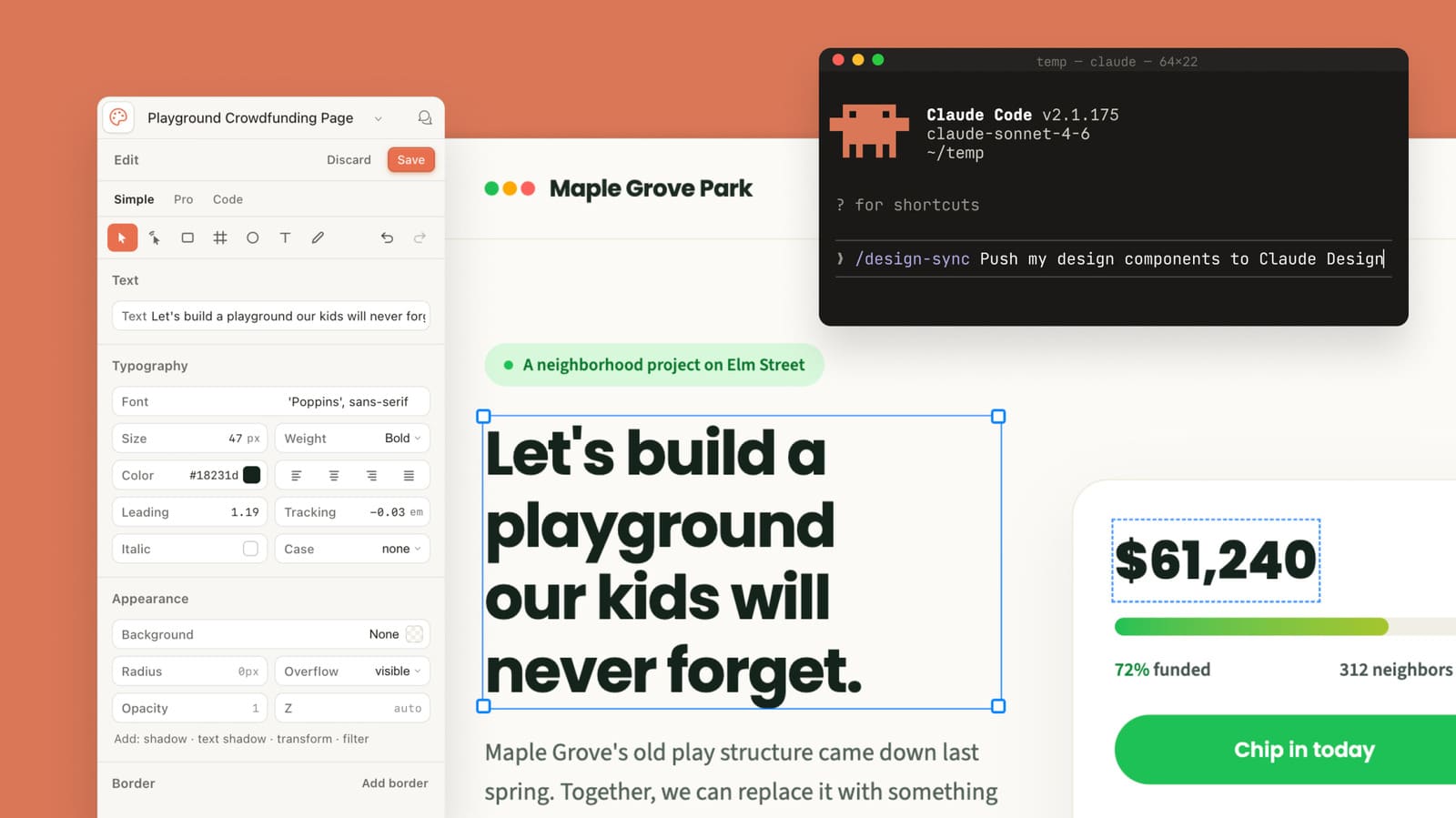
Two months into the preview window, Anthropic has shipped a batch of updates to Claude Design that answer the loudest complaint from early users: the tool lived in a silo. The latest build can now ingest a local codebase, meaning any interface mockup it generates will reuse the design tokens, components, and naming conventions already in production. Once a design is ready, it can be handed directly to Claude Code, which can scaffold the implementation without the usual ritual of uploading screenshots, writing out intentions, or manually syncing design systems.
For teams running continuous-delivery pipelines, that handoff matters. At DailyTechWire, we have tracked a steady stream of generative UI tools launched over the past eighteen months, from Vercel v0 to GitHub Copilot Workspace to Replit Agent. Almost all of them stumbled on the same problem: they assumed greenfield projects. Real front-end work happens inside monorepos with bespoke component libraries, strict design-system rules, and hundreds of existing assets. A tool that cannot read those constraints ends up producing mockups that look fine in isolation but require hours of manual reconciliation.
Anthropic's solution is straightforward. Claude Design can now import entire design systems from GitHub or from raw file uploads. Once ingested, the assistant uses those components as building blocks, checks its own output against the system's constraints, and corrects mismatches before presenting a draft. The coding agent then receives a structured handoff rather than a flat image, which reduces the token overhead and the error rate during implementation.
The company has also added a terminal shortcut: typing /design inside Claude Code will spin up the design assistant inline, collapsing what used to be a context switch into a single command. For developers who prefer to stay in the editor, that shortcut may prove more important than the feature list itself.
Import, Lock, and Share Usage Caps
Beyond the inter-app plumbing, Anthropic has refined the tooling around collaboration and control. The import pipeline now handles bulk ingestion of design assets, which means teams can onboard a Figma export, a Storybook instance, or a folder of React components and get a working design system inside Claude Design without manual tagging. Once imported, an admin role can approve changes and lock down certain elements, a governance layer that enterprises will expect if they plan to route production work through the tool.
On the interface side, the built-in image editor has been tuned for precision. Users can now manipulate positioning, sizing, and alignment at a more granular level, which matters when a mockup needs to match pixel-perfect specs or when a design system enforces strict spacing rules. The editor is still generative, prompting Claude to reflow a layout when you ask, but the new controls let you override the model when its suggestions drift.
Anthropic has also unified usage limits across Claude Design, Claude Code, and the standard chat interface. Previously, heavy use of the design assistant could exhaust your monthly allocation even if you had barely touched the other products. The consolidated cap means that most users will hit their ceiling less often, and token efficiency improvements inside the design assistant further stretch the allowance. The company has not published new per-tier token budgets, but the shift suggests it is preparing to move Claude Design out of preview and into general availability.
The Lawsuit Shadow and the Million-User Threshold
Usage caps have become a friction point for Anthropic. A Washington DC resident recently filed suit alleging that the company's Max plan marketing misled subscribers about how quickly limits would be reached, a case that highlights the tension between flat-rate branding and metered reality. Anthropic has not commented on the litigation, but the timing of this week's efficiency update and the consolidated cap structure suggests the company is aware that user frustration over throttling has become a retention risk.
Meanwhile, the company disclosed that more than one million people used Claude Design during its first week of availability. That figure, while impressive for a preview release, does not break out how many were active beyond the initial trial or how much of that traffic came from Pro versus Team versus Enterprise tiers. Still, it signals that demand for AI-native design tooling is high, even when the feature set is incomplete.
The broader question is whether generative design assistants can graduate from prototyping toys to production dependencies. Figma remains the system of record for most product teams, and Adobe has been layering generative features into XD and Photoshop. Anthropic's advantage is vertical integration: because it controls the model, the design tool, and the coding agent, it can optimize the handoff in ways that third-party plugins cannot. But that advantage only matters if teams trust the output enough to skip the manual review step, and trust in generative tooling remains fragile.
What It Means for Front-End Velocity
If the new workflow holds up under production load, it could compress the time between concept and deployed interface. The traditional cycle involves a designer mocking up screens in Figma, exporting assets, annotating interactions, handing off to a developer, and then iterating through several rounds of QA. Claude Design's codebase ingestion and direct handoff to Claude Code collapses at least two of those steps, and if the design system checks are reliable, it may eliminate some of the back-and-forth over spacing, color tokens, and component naming.
The risk is that teams become dependent on a closed toolchain. Anthropic does not yet offer export to Figma or Sketch, which means designs live inside Claude's ecosystem. For shops that have invested heavily in existing design ops tooling, that lock-in may be a dealbreaker. For startups or teams willing to adopt a new stack, the velocity gains may outweigh the migration cost.
We are also watching how Anthropic prices this capability once it exits preview. The current model bundles Claude Design into Pro and Team subscriptions, but the token cost of generating and iterating on full design systems is nontrivial. If usage caps tighten or if Anthropic introduces a separate SKU for design work, adoption could stall.
The Bigger Bet on Agent Interoperability
The update is part of a broader thesis that Anthropic has been building toward: AI agents should compose. Rather than one monolithic model that does everything poorly, the company is shipping specialized agents, design, code, research, that can hand off context to one another. That architecture mirrors how software teams actually work, and it gives Anthropic a differentiation angle against OpenAI's ChatGPT and Google's Gemini, both of which have remained more conversational and less workflow-oriented.
The challenge is making the seams invisible. Right now, users still need to understand which agent to invoke and when, and the handoff between Claude Design and Claude Code requires some awareness of what each tool expects. As the product matures, Anthropic will need to automate those transitions so that a single prompt, "build me a settings page that matches our design system", can route through design generation, code scaffolding, and validation without manual orchestration.
Other labs are pursuing similar agent-mesh strategies. Microsoft's Copilot stack is moving in that direction, and startups like Replit and Cursor are experimenting with multi-agent pipelines for code generation. The race is not just to build the best individual model but to build the best orchestration layer, and Anthropic's advantage is that it owns the full vertical.
What Comes Next
Anthropic has not announced a timeline for moving Claude Design out of preview, but the pace of iteration, two major updates in as many months, suggests the company is close. The addition of admin controls and the consolidation of usage limits are both signals that enterprise pilots are underway. If those pilots succeed, expect a general-availability launch before the end of the third quarter, along with pricing that separates casual users from teams running production workloads.
The longer-term question is whether design itself becomes a commodity. If generative tools can produce interface mockups that are indistinguishable from human work, and if those mockups can be implemented without manual translation, then the bottleneck shifts from creation to taste and strategy. That shift would redefine what product designers do, moving them upstream into problem framing and brand articulation while the tactical execution gets automated.
We are not there yet. The design systems that Claude ingests still need to be built by humans, and the judgment calls around hierarchy, flow, and accessibility remain hard to encode. But the gap is narrowing, and Anthropic's latest update is another step toward a world where shipping an interface is faster, cheaper, and more tightly integrated with the code that powers it.