AMD's $4,000 Gamble on Local AI Workstations Arrives a Year Late
The Ryzen AI Halo promised accessible machine learning hardware for developers, but memory shortages and dated silicon have turned convenience into a costly compromise.
The Timing Problem
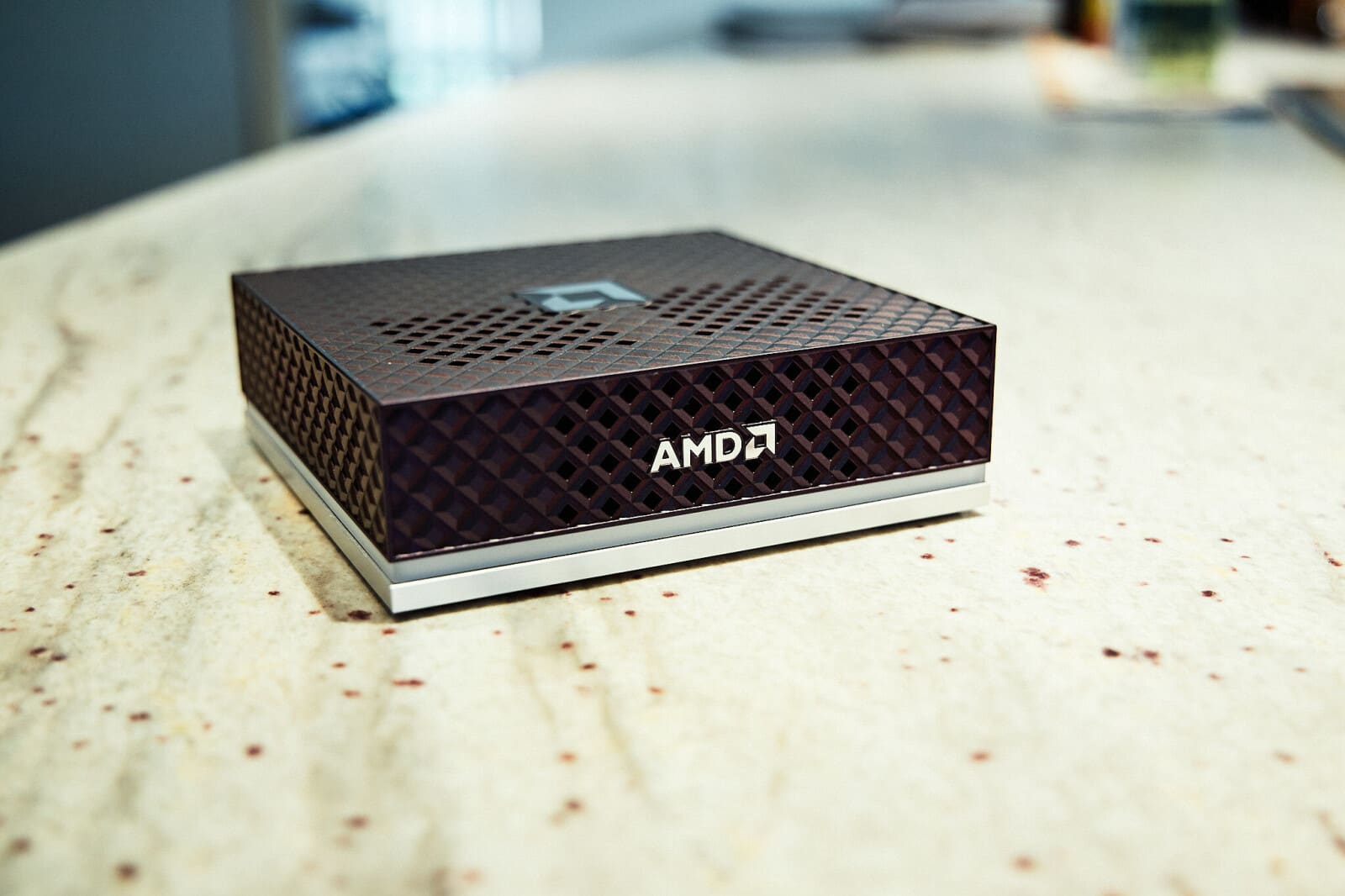
AMD has launched the Ryzen AI Halo, a compact AI workstation designed to bring enterprise-grade machine learning capabilities to developers and researchers working outside cloud infrastructure. The system ships with 128 GB of unified memory, pre-configured software stacks, and detailed documentation for running models locally. But the $3,999 price point tells a different story than AMD likely intended when planning this product.
Twelve months ago, the same hardware configuration sold for approximately $2,000 in early Strix Halo systems. The global memory shortage has since pushed prices upward across consumer electronics, and the AI Halo arrives at nearly double that earlier cost. It still undercuts Nvidia's competing DGX Spark, which now retails at $4,699, but the value proposition has narrowed considerably. For developers who secured earlier Strix-based machines, the new packaging offers little beyond software conveniences they can replicate through existing AMD playbooks.
The core tension is straightforward: AMD is selling year-old silicon at today's inflated prices. The company has invested heavily in refining the user experience, bundling validated configurations with pre-installed dependencies, but the underlying hardware reflects a previous generation's capabilities. In fast-moving AI infrastructure, that lag matters.
What 128 GB Actually Buys
Memory capacity remains the primary constraint for local AI work. Model inference at 16-bit precision requires roughly 2 GB per billion parameters; at 4-bit quantization, that drops to 512 MB per billion. Most consumer GPUs top out at 32 GB of VRAM, which limits practitioners to heavily quantized models or small parameter counts. The AI Halo's 128 GB allocation changes that calculus, enabling full-precision work on models approaching 70 billion parameters or fine-tuning runs that would otherwise require cloud resources.
The system allocates up to 96 GB of its LPDDR5X memory to GPU workloads out of the box, with Linux configurations supporting near-total allocation. That memory connects via a 256-bit bus delivering approximately 256 GB/s of bandwidth. For comparison, the RTX 5090 achieves 1.7 TB/s, but only across 32 GB. The trade-off is clear: the AI Halo sacrifices bandwidth for capacity. Token generation in large language models scales directly with memory speed, so inference will lag behind dedicated GPUs for models that fit within smaller VRAM envelopes. But for workloads that exceed 32 GB, no amount of bandwidth on a consumer card helps.
Fine-tuning workloads illustrate the constraint. A full fine-tune of a 7 billion parameter model can consume over 100 GB of memory when accounting for optimizer states, gradients, and activations. That workload is simply impossible on consumer graphics hardware, regardless of compute performance. Systems like the AI Halo exist in the narrow band where capacity matters more than speed.
The Software Layer
AMD ships the AI Halo with either Windows 11 or a customized Debian build. The Linux variant includes ROCm 7.13, the 6.18 kernel, and pre-installed frameworks including ComfyUI and vLLM. A startup wizard handles initial configuration, and the Ryzen AI Developer Center provides access to 19 playbooks covering LLM inference, image generation, and agent deployment.
The playbooks represent AMD's real investment here. They walk users through validated workflows, from basic model serving to building agents with OpenClaw. Most execute with minimal troubleshooting, though PyTorch fine-tuning scripts required debugging during testing. The vLLM documentation, however, falls short. AMD provides a wrapper that abstracts container deployment, but guidance on model selection and configuration is sparse. For a production-grade inference server widely used in the field, that gap is notable.
One standout inclusion is Lemonade Server, a pre-installed model runner tuned for AMD hardware. It integrates multiple backends including vLLM, Llama.cpp, Whisper.cpp, and Stable Diffusion.cpp, with selective support for the system's NPU. The interface resembles LM Studio or Ollama, offering a familiar entry point for users transitioning from Nvidia tooling.
For developers already comfortable with AMD's HIP and ROCm stacks, the software layer adds limited value. The same configurations can be assembled manually on any Strix Halo system. But for first-time users of AMD's ecosystem, the pre-validation reduces setup friction considerably. Dependency wrangling remains messy across both AMD and Nvidia platforms; the AI Halo's value is in minimizing that overhead.
Hardware Realities
The Ryzen AI Halo measures 5.9 x 5.9 x 1.79 inches, closely mirroring the DGX Spark's form factor. The chassis features a textured top cover with an LED light bar, intake vents along the sides, and rear exhaust. Connectivity includes four USB-C ports (one for power, one USB 3.2, two USB 4.0), HDMI 2.1b, a 10 Gbps RJ45 Ethernet port, and WiFi 7. Notably absent are QSFP ports for high-speed clustering; the DGX Spark includes a 200 Gbps ConnectX-7 SmartNIC. The AI Halo supports multi-system clustering over standard networking, but the performance impact remains untested without access to multiple units.
At the heart sits the Ryzen AI 395 Plus, previously known as Strix Halo. The SoC integrates 16 Zen 5 cores clocking up to 5.2 GHz and an RDNA 3.5 GPU with 40 compute units, delivering approximately 56 teraflops of FP16 performance under optimal conditions. The architecture dates back over a year, and its limitations show in precision support. RDNA 3.5 lacks native FP8 and FP4 capabilities, supporting only FP16, BF16, and INT8 (upcast to FP16). That means no performance gains from lower-precision quantization, a significant handicap as model optimization increasingly relies on sub-16-bit arithmetic.
By comparison, the GB10 in the DGX Spark delivers roughly double the FP16 throughput, triple at FP8, and double again at FP4. In compute-bound tasks like batch image generation or fine-tuning, that gap translates to 2x to 3x faster execution. The AI Halo's architecture wasn't designed for this use case; it's a high-end consumer APU repurposed for machine learning, and the seams show.
Performance Across Workloads
In memory-bound inference, the AI Halo performs competitively. Hanging memory off the GPU rather than the CPU provides an advantage in token generation, and the system matches or narrowly exceeds the DGX Spark in these scenarios. Inference throughput depends more on memory bandwidth and capacity than raw compute, and the AI Halo's 256 GB/s is sufficient for models within its 128 GB envelope.
Compute-bound workloads expose the hardware's age. Fine-tuning, image generation, and batch processing all favor the GB10's superior FP16 performance and native support for lower-precision formats. The lack of FP8 and FP4 on RDNA 3.5 is a critical gap. As frameworks increasingly default to mixed-precision training and optimized inference, the AI Halo will fall further behind. AMD's datacenter GPUs support these formats, but the consumer-derived silicon in the AI Halo does not.
The system's primary audience is developers and researchers who need memory capacity more than peak compute. If your workflow involves fine-tuning models beyond 30 billion parameters, running multi-agent systems locally, or experimenting with large context windows, the AI Halo provides access that consumer GPUs cannot. If your bottleneck is training speed or batch throughput, the dated architecture will frustrate.
The Market AMD Is Chasing
AMD positions the AI Halo as an alternative to cloud API expenses. The company claims software developers using AI coding assistants could save $750 per month compared to cloud-based LLM costs. That math assumes full-time usage of models like Qwen 3.6-35B-A3B, which recent benchmarks suggest can rival larger proprietary models for specific coding tasks. The argument hinges on whether local models have closed the quality gap enough to replace cloud services.
For AI agent workflows, the case is stronger. Running frameworks like OpenClaw locally offers security and isolation benefits, especially given the elevated permissions these systems require. The AI Halo's memory capacity supports larger, more capable models than typical consumer setups, reducing the quality compromise. Organizations wary of sending proprietary code or data to external APIs will find the local-first approach compelling, even at a $4,000 entry point.
The comparison to earlier pricing remains unavoidable. At $2,000, the AI Halo would have been a straightforward recommendation for serious hobbyists and small teams. At $4,000, it competes with used datacenter hardware, multi-GPU consumer builds, and short-term cloud contracts. The memory shortage has compressed the middle market, and AMD is navigating a narrower path than it likely anticipated.
What AMD Faces Next
The AI Halo's challenges reflect broader issues in AMD's consumer AI roadmap. The company's datacenter products support modern precision formats and deliver competitive performance, but its consumer and prosumer lines lag in architectural features that matter for AI workloads. RDNA 3.5 is a capable gaming architecture; it is not optimized for machine learning. Until AMD brings FP8 and FP4 support to its consumer GPUs and APUs, systems like the AI Halo will struggle in compute-intensive tasks.
The memory shortage complicates every product launch in this category. Prices may stabilize or decline over the next year, but AMD cannot control the DRAM market. If costs remain elevated, the AI Halo's value proposition will continue to erode relative to alternatives. If prices fall, AMD will face pressure to lower its own pricing or risk looking overpriced for older hardware.
For now, the AI Halo occupies a specific niche: developers who need more than 32 GB of memory, prefer local infrastructure, and prioritize capacity over cutting-edge compute performance. That audience exists, but it is smaller and more price-sensitive than the market AMD might have captured a year earlier. The company has built a polished product with strong software integration, but the hardware underneath is already showing its age. In AI infrastructure, timing is everything, and the AI Halo has arrived at the wrong moment.