Agentic AI Meets Supercomputing: Nvidia Rolls Out New Stack for Science
Los Alamos labs will debut autonomous agent-driven clusters as GPU maker unveils Vera Rubin platform, three software tools, and a pitch to turn research into always-on workflows
The Agent-Driven Cluster Arrives
Los Alamos National Laboratory is installing two supercomputers designed to run autonomous AI agents alongside traditional simulation workloads. The Mission and Vision systems will deploy thousands of Vera Rubin GPUs and Vera CPUs when they go live later this year, representing the first production deployments of what Nvidia calls "agentic AI supercomputers."
At DailyTechWire, we have tracked the steady industrialization of large language models in enterprise settings over the past eighteen months. What distinguishes this wave is the explicit architectural commitment: these machines are built from silicon upward to support agents that plan experiments, write simulation code, and orchestrate data analytics without human intervention between steps.
Nvidia introduced the stack at ISC High Performance 2026 in Hamburg, framing the announcement around a simple premise. Most scientific computing today operates in discrete phases: a researcher formulates a hypothesis, writes or adapts simulation code, submits jobs to a cluster, waits hours or days for results, then analyzes output. The company argues that autonomous agents can collapse those phases into continuous loops, running around the clock and querying vast corpuses of published research to inform next steps.
Whether that vision materializes depends on software maturity, researcher adoption, and whether foundation models prove reliable enough to operate unsupervised in domains where errors can invalidate months of work. But the hardware is shipping, and the early deployments offer a window into how AI inference and floating-point simulation might share the same racks.
Three Tools, Three Bottlenecks
Nvidia announced three domain-specific software packages designed to accelerate scientific workflows on GPU-heavy clusters.
ALCHEMI targets chemistry and materials science. It uses a microservice architecture to simulate molecular structures at scale, a task that has historically required researchers to queue jobs on shared clusters and wait for compute slots. The tool is designed to handle millions of candidate molecules in parallel, a brute-force approach that becomes viable only when inference and simulation engines can be co-located on the same nodes.
DAQIRI addresses a different constraint: data acquisition at particle colliders and other high-throughput instruments. At CERN's ATLAS experiment, less than two percent of collision data can be stored under current trigger pipelines. Nvidia's software introduces a GPU-accelerated filtering layer that runs deep learning models in real time, allowing field-programmable gate arrays to handle low-latency routing while GPUs decide which events merit permanent storage. The result is a higher fraction of useful data retained without expanding storage infrastructure.
cuPhoton is built for astronomy. Large sky surveys generate petabytes of imaging data; processing that volume with traditional CPU pipelines can take months. Nvidia tested cuPhoton on 32 Grace Blackwell nodes simulating output from the Vera C. Rubin Observatory. The company reported image-loading speeds 15,000 times faster than baseline and signal-processing acceleration of up to 8,000 times.
These are not general-purpose frameworks. Each tool is engineered for a specific scientific bottleneck, and each assumes that GPU capacity is abundant and co-located with data. That assumption holds in a handful of national labs and well-funded research consortia; it does not yet hold in most university computing centers.
Vera Rubin: Memory Bandwidth as the New Compute
Nvidia's next-generation platform, Vera Rubin, is scheduled to ship in the fourth quarter of 2026. A single NVL rack will house up to 144 GPUs and deliver five petaFLOPS of FP64 floating-point performance.
The headline number is memory bandwidth. Many high-performance computing workloads are memory-bound rather than compute-bound, meaning that arithmetic units sit idle while waiting for data to arrive from DRAM. Vera Rubin addresses this with 41 terabytes of HBM4 memory per rack, achieving three petabytes per second of aggregate bandwidth. That represents a 2.8-fold increase over Blackwell, Nvidia's current flagship.
The architecture reflects a broader shift in cluster design. A decade ago, scientific supercomputers were built around CPU nodes with GPUs added for specific acceleration tasks. Today's deployments invert that hierarchy: GPUs become the primary compute fabric, and CPUs handle orchestration, storage I/O, and workloads that resist parallelization.
Mission, the larger of the two Los Alamos systems, will field 2,160 Rubin GPUs and 1,080 Vera CPUs. Vision will deploy 1,298 Rubin GPUs and 648 Vera CPUs. A third system, Veritas, will use 576 Rubin GPUs and 288 Vera CPUs. All three rely on Quantum InfiniBand networking to move data between nodes at speeds that keep GPU memory fed.
These configurations suggest that agent-driven workflows require substantial inference capacity even when the bulk of compute cycles go to simulation. Foundation models consume memory and bandwidth; running them alongside physics codes on the same cluster demands hardware that can serve both workloads without bottlenecking either.
The Case for Autonomous Science
The pitch for embedding AI agents in research workflows rests on scale and continuity. Agents do not require sleep, can ingest and cross-reference thousands of published papers, and can execute parameter sweeps or exploratory runs that human researchers might defer because of time constraints.
Nvidia envisions scientists supervising teams of agents that operate continuously, proposing experiments, running simulations, analyzing results, and iterating. The agents draw on foundation models and large language models, accessing domain-specific tools and datasets to perform tasks that span astrophysics, materials science, genomics, and climate modeling.
The counterargument is straightforward: much of scientific progress emerges from intuition, serendipity, and the ability to recognize anomalies that formal models miss. Agents trained on existing literature may excel at optimization within known paradigms but struggle to identify the questions that open new fields.
Nvidia's response is pragmatic. Agentic AI is not required to conduct research, but it can extend the reach of human scientists by handling labor-intensive tasks - data filtering, code generation, parameter tuning - that consume weeks of researcher time. Whether that productivity gain translates into faster discovery or simply faster execution of conventional workflows remains an empirical question.
Europe's Cluster Buildout
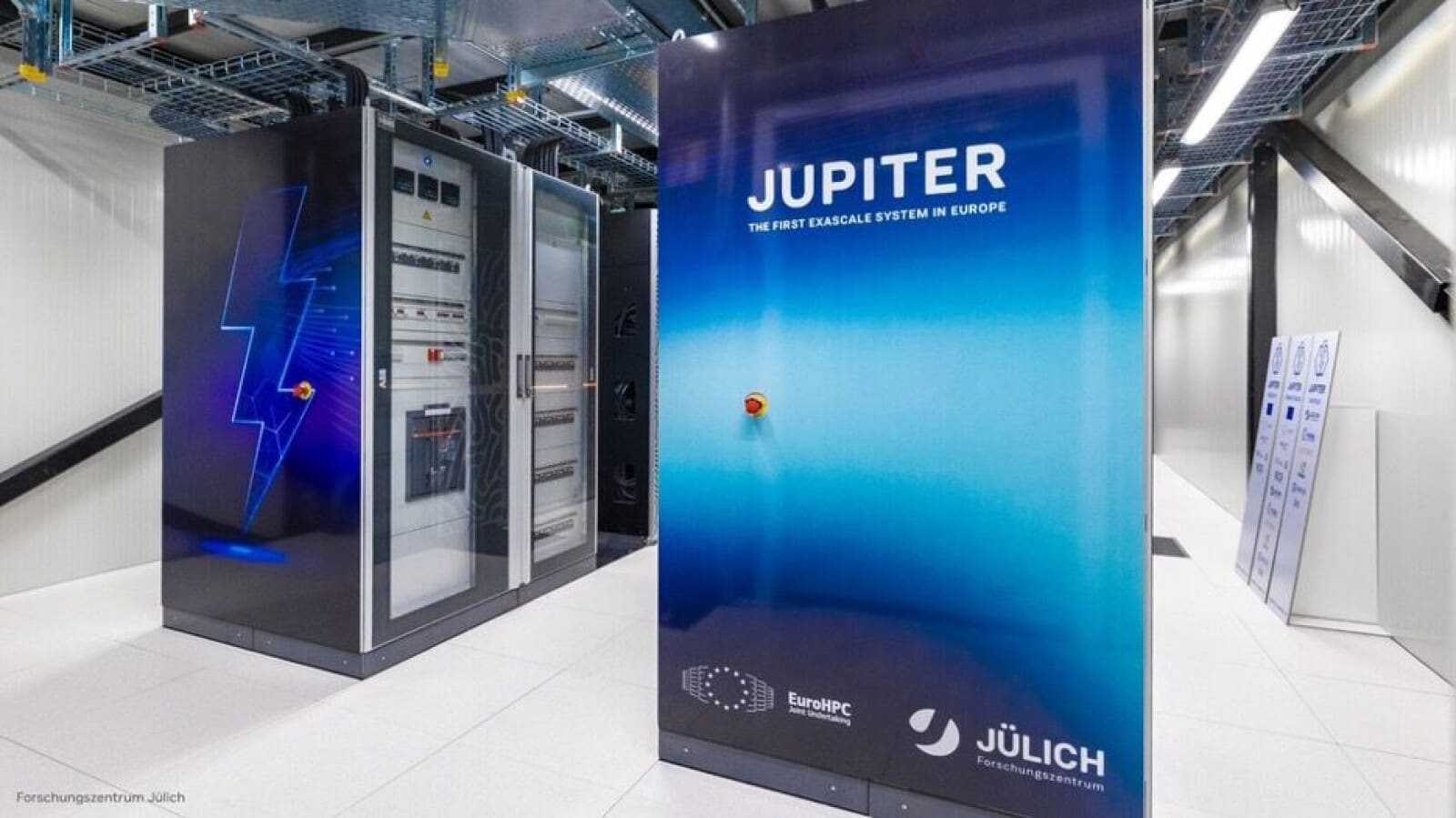
Nvidia reported that 35 new supercomputers came online in Europe over the past year, all incorporating the company's hardware. The list includes Jupiter, Europe's first exascale system; MareNostrum 5 at the Barcelona Supercomputing Center; Bavaria AI's Blue Swan; HammerHAI at the University of Stuttgart; and CINECA in Italy.
The geographic concentration reflects two dynamics. First, European research institutions and governments have committed substantial capital to sovereign compute infrastructure, motivated by both scientific ambition and concerns about dependence on US-based cloud providers. Second, Nvidia has structured its supply chain and partnership model to prioritize large institutional buyers who can absorb entire rack-scale systems and integrate them into multi-year research programs.
Asia remains the larger market by node count, but Europe's recent deployments signal a willingness to adopt early-stage platforms like Vera Rubin and to co-develop software tools in partnership with the vendor. That co-development model carries risks: institutions invest engineering resources in frameworks that may not generalize beyond Nvidia's architecture, and they accept longer validation cycles in exchange for access to cutting-edge silicon.
Simulation and Inference Converge
The architectural shift underway in scientific computing is the convergence of simulation and inference on shared infrastructure. A decade ago, researchers ran simulations on HPC clusters and trained models on separate GPU farms. Today's agent-driven workflows require both capabilities on the same nodes, with low-latency interconnects and shared memory pools.
That convergence creates new optimization challenges. Simulation workloads favor high-precision arithmetic and sustained memory bandwidth. Inference workloads tolerate lower precision and benefit from high-speed interconnects that allow model weights to be distributed across nodes. Designing a system that serves both well, without forcing one workload to wait while the other monopolizes resources, demands careful scheduling and resource allocation.
Nvidia's software stack attempts to solve this through microservices and orchestration layers that allocate GPU resources dynamically. Whether that approach scales to clusters with thousands of nodes, running dozens of concurrent projects, is a question that will be answered by the Los Alamos deployments and the systems coming online in Europe.
Open Questions
Several uncertainties surround the agent-driven supercomputing model. Foundation models remain prone to hallucination, and even small errors in generated simulation code can invalidate results. Verification and validation processes designed for human-written code may not transfer cleanly to agent-generated workflows.
Data provenance is another concern. When an agent synthesizes information from thousands of papers, traces an unexpected result back to a specific assumption or citation, and proposes a new experiment, how do researchers audit that chain of reasoning? Traditional scientific workflows embed human judgment at every step; autonomous loops compress those steps, and the compression may obscure errors or biases.
Finally, there is the question of access. The systems Nvidia is deploying cost tens of millions of dollars and require dedicated data centers, power infrastructure, and technical staff. A handful of national labs and elite research institutions can afford them. Most universities, and nearly all researchers in lower-income regions, cannot. If agent-driven science delivers the productivity gains Nvidia projects, the gap between well-funded and under-resourced institutions will widen.
At DailyTechWire, we see this as part of a broader pattern in AI infrastructure: capability concentrates in a small number of sites, and the benefits accrue disproportionately to actors who already command significant resources. Whether open-source frameworks and cloud-based access models can democratize agentic supercomputing remains an open question, one that will shape the geography of scientific discovery over the next decade.
The hardware is ready. The software is shipping. The experiments will tell us whether autonomous agents can genuinely accelerate science or simply automate the parts of research that were never the bottleneck.