Zero Zero Robotics Bets on Semantic Arbitrage to Evade US Drone Ban
The company behind HoverAir is marketing its newest flying device as a handheld camera with detachable propellers, testing whether product categorization can circumvent regulatory restrictions.
A Regulatory Puzzle Wrapped in Product Design
Zero Zero Robotics has built its HoverAir brand on form-factor innovation: devices compact enough to slip into a jacket pocket, waterproof variants that touch down on lakes, models that recharge while stored. The engineering has always been iterative, but the company's newest product represents a different kind of bet. The Versa, priced at $750, launches into a regulatory environment that technically forbids its existence, and its designers are wagering that a semantic distinction will hold up under scrutiny.
In December 2025, the Federal Communications Commission implemented restrictions preventing foreign-manufactured drones from entering the US market. The regulation arrived without transition periods or grandfather clauses, and Zero Zero's Aqua drone was among the first products caught in the enforcement sweep. Six months later, the company is back with hardware that occupies an ambiguous classification zone.
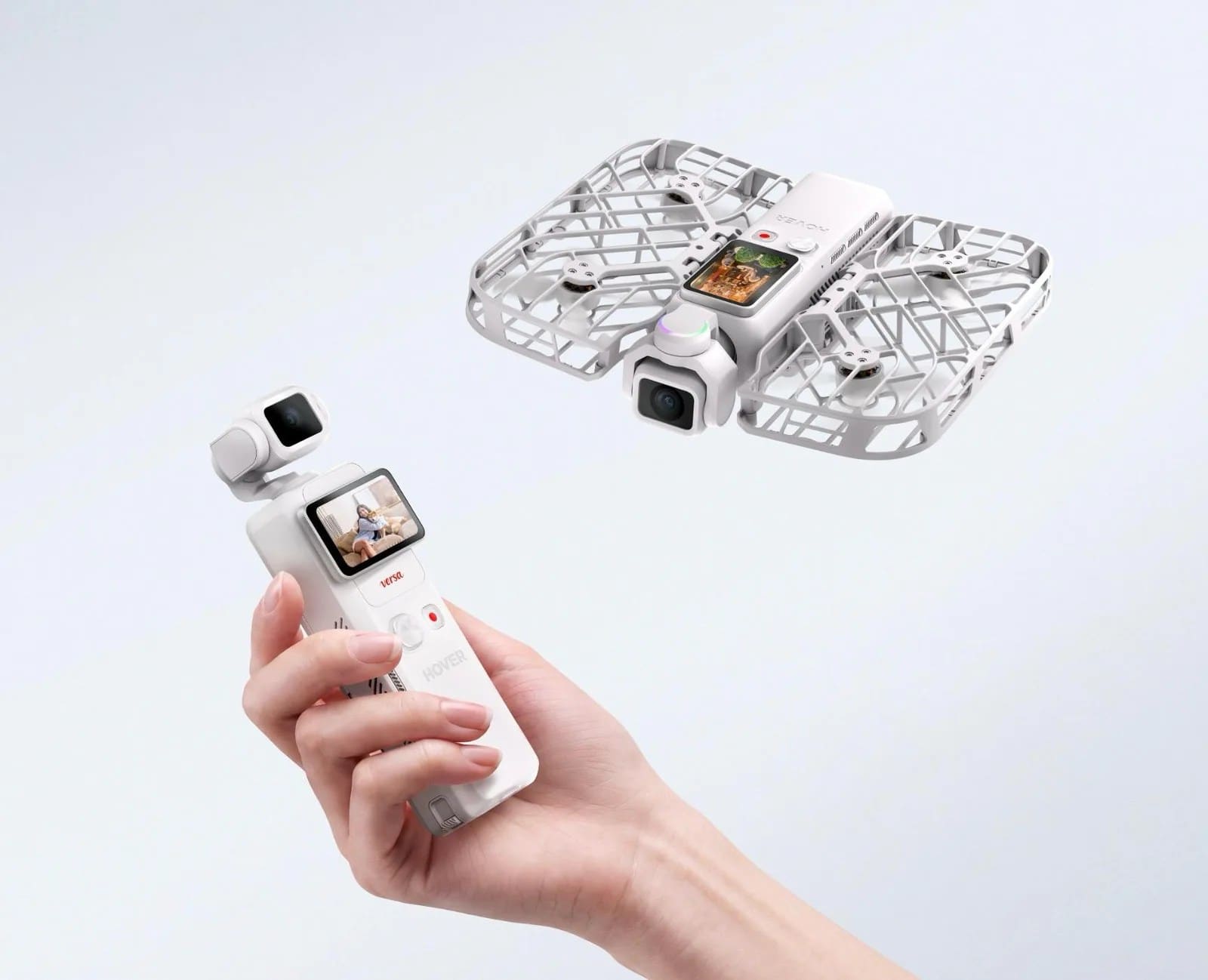
The Versa's primary configuration is a handheld stabilized camera, similar in concept to DJI's Pocket series. The gimbal mechanism, sensor assembly, and processing hardware function independently of flight capability. What distinguishes the product is a set of detachable propeller modules that transform the camera into an autonomous flying device. The company's regulatory argument hinges on this modularity: if the base unit is a camera that can optionally fly, rather than a drone that can optionally be held, does it fall outside the scope of the import ban?
The Regulatory Gray Zone Zero Zero Is Testing
At DailyTechWire, we've tracked how hardware companies navigate certification processes across markets, and product categorization is rarely a trivial question. The FCC's December restrictions targeted "unmanned aircraft systems" manufactured outside US borders, a definition that typically encompasses any device capable of sustained autonomous flight. The question Zero Zero is implicitly posing is whether capability or primary function determines classification.
The company has not disclosed whether it received advance guidance from the FCC or is proceeding based on internal legal interpretation. What is clear is that the Versa's industrial design was shaped with regulatory positioning in mind. The propeller modules attach via magnetic connectors and store separately from the camera body. Marketing materials emphasize handheld stabilization and ground-level shooting modes before mentioning flight. The user manual reportedly describes the rotors as "accessories" rather than core components.
This approach mirrors strategies used in other regulated hardware categories. Gaming consoles have been imported under lower tariff codes by emphasizing multimedia functions. Certain e-bike models skirt classification as motor vehicles by limiting assist speeds or requiring pedal input. In each case, manufacturers are exploiting definitional boundaries that regulators have not yet clarified.
Whether the FCC will accept Zero Zero's framing remains an open question. The agency has not issued public guidance on modular flying cameras, and its enforcement approach to the December ban has been inconsistent. Some foreign drone shipments have been detained at customs; others have entered the market without apparent challenge. Smaller manufacturers lack the resources to contest determinations, creating a patchwork of outcomes that offers little predictability.
What the Versa Reveals About Trade Policy and Hardware Innovation
The Versa's design raises broader questions about how trade restrictions interact with product evolution. The December drone ban was framed as a national security measure, driven by concerns over data transmission and supply chain integrity. But the regulation's language was written for a previous generation of hardware, when drones were distinct product categories rather than modular systems.
Zero Zero's bet is that regulators will struggle to classify devices that blur functional boundaries. If the Versa's camera components are manufactured in one country and its flight modules in another, which jurisdiction's restrictions apply? If firmware updates can enable or disable flight modes, at what point does a camera become a drone? These are not hypothetical edge cases; they represent the direction hardware development is moving as companies seek manufacturing flexibility and regulatory arbitrage.
The pricing of the Versa also signals how the company is positioning the product. At $750, it sits above entry-level drones but below professional cinematography rigs. The cost includes both handheld and flight configurations, making the modular design an economic rather than purely regulatory choice. For users in markets without import restrictions, the device offers versatility. For those in restricted regions, it provides a potential workaround that shifts legal risk onto the consumer.
The Industry Context: Why More Companies May Follow This Path
Zero Zero is not alone in confronting the December restrictions. DJI, which commands the majority of the global consumer drone market, has seen US sales channels constrict. Smaller manufacturers that relied on cross-border e-commerce have faced shipment rejections. The regulatory environment has created an incentive structure that rewards creative product categorization over direct compliance.
We've observed similar dynamics in other hardware sectors where geographic restrictions collide with global supply chains. When the US imposed tariffs on certain electronics imports, manufacturers responded by relocating final assembly steps, redesigning products to change tariff classifications, or routing shipments through intermediary markets. The December drone ban is producing parallel adaptations, with modular design emerging as one strategy.
The risk for Zero Zero is that the FCC will view the Versa as an evasion attempt rather than a legitimate product innovation. Regulatory agencies have broad discretion to look beyond formal classifications and assess the primary use case of a device. If the FCC determines that the Versa's flight capability is not genuinely optional, or that the modular design exists primarily to circumvent restrictions, the company could face enforcement action that extends beyond the Versa itself.
There is also a question of how this approach scales. If multiple manufacturers adopt similar strategies, regulators are more likely to issue clarifying guidance that closes the loophole. The Versa may succeed as a one-off experiment but fail as a template for the industry.
The Forward View: Regulation Catching Up to Hardware Reality
The Versa's market entry will serve as a test case for how US regulators handle products that challenge categorical definitions. The outcome will influence not only drone manufacturers but any hardware company operating in a trade-restricted environment. If Zero Zero's semantic arbitrage succeeds, expect more modular designs that split regulated and non-regulated functions across detachable components. If it fails, the industry will need to pursue other paths: domestic manufacturing partnerships, non-consumer market pivots, or direct regulatory engagement.
For now, the Versa occupies an uncertain status. It is available for pre-order through crowdfunding platforms, a distribution channel that often operates ahead of formal retail compliance. Whether units will clear customs, how the FCC will respond if they do, and what precedent the case will set remain unresolved. What is certain is that trade policy written for discrete product categories is colliding with hardware design that increasingly resists clean classification, and companies like Zero Zero are probing every boundary they can find.