Waze Bets on Gemini and Motorcycle Riders to Sharpen Its Navigation Edge
Google's navigation app is rolling out AI-driven route suggestions, conversational reporting, and a two-wheeler mode across seven countries as it fights to stay relevant against Apple Maps.
Learning Your Habits, One Highway at a Time
Waze has begun tailoring route recommendations to individual driving patterns. The app now examines your trip history and combines it with real-time traffic intelligence to surface routes that match your preferences. If you consistently choose highways over surface streets, those options will appear first. Drivers who want to opt out can disable personalization in settings or manually select alternative paths. The feature is live on both Android and iOS worldwide.
At DailyTechWire, we've tracked the steady march of personalization across mapping platforms, and this move suggests Waze is leaning harder into behavioral data to differentiate itself from Apple Maps and even Google Maps. The challenge will be whether drivers notice the shift or simply accept whatever route appears at the top of the list.
Asking Gemini Where to Refuel
Waze is integrating Google's Gemini model to handle conversational search queries. Instead of typing a specific business name or address, users can tap the voice icon and ask open-ended questions like "Find me a coffee shop that's open right now" or "Find me parking close to Grand Mall." The assistant returns a list of relevant options, pulling from Waze's map data and business information.
The feature is currently available to beta users globally on Android and iOS. It mirrors similar capabilities in Google Maps but brings them into Waze's community-driven ecosystem, where user-reported data plays a larger role in real-time accuracy. The bet here is that conversational input will lower friction for drivers who know what they need but not where to find it, especially in unfamiliar neighborhoods.
A Mode Built for Two Wheels
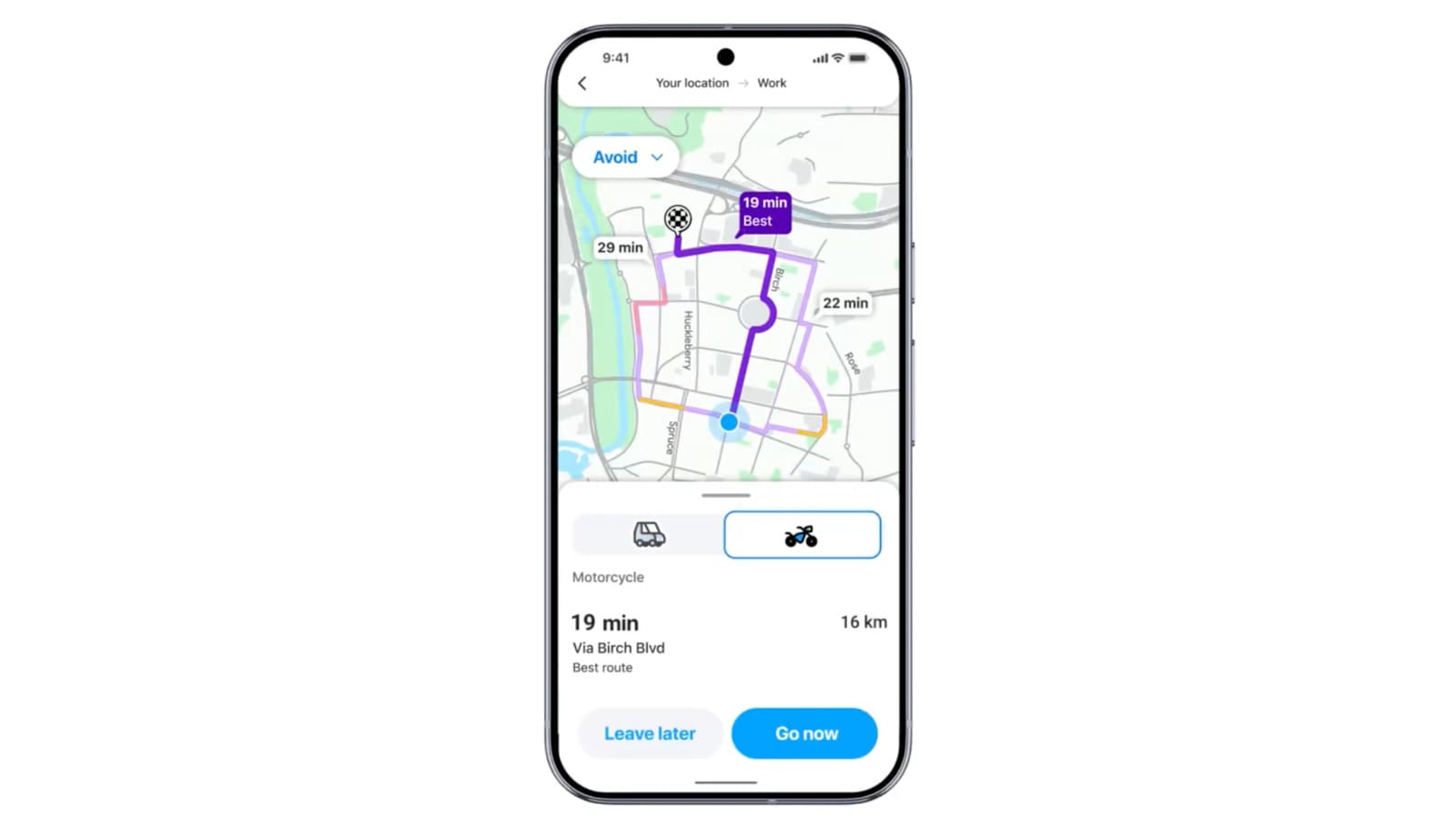
Waze is launching a dedicated motorcycle mode that uses AI to surface routes optimized for two-wheelers. The system accounts for lane-splitting legality, narrower road access, and restrictions that don't apply to cars. It also flags hazards that pose specific risks to riders: potholes, speed bumps, raised crosswalks, shoulder drop-offs, and narrow bridges.
According to Waze, the mode is now live in Argentina, Brazil, Colombia, Malaysia, Mexico, Peru, and the Philippines on both platforms, with additional countries planned. The selection reflects markets where motorcycles and scooters make up a significant share of urban traffic. In Jakarta, Manila, and Kuala Lumpur, two-wheelers often outnumber cars during peak hours, and routing that ignores their needs leaves a sizable user base underserved.
The AI component here is less about generative models and more about classification and risk scoring. The app needs to identify road features from satellite imagery and user reports, then weight them differently for motorcycles than for cars. It's a reminder that practical AI applications in navigation often involve pattern recognition and spatial reasoning rather than natural-language generation.
Talking to the Map
Waze already allows drivers to report incidents like slowdowns or crashes using voice commands. Now it's extending that capability to map edits. You can say "The road is closed here" or mention an outdated address, and the app will forward those details to local map editors for review. The feature is rolling out globally on Android and iOS.
This builds on Waze's long-standing reliance on crowdsourced data. The app's accuracy has always depended on users flagging changes faster than official map providers can update their databases. By making the reporting process more conversational, Waze lowers the cognitive load required to contribute. Whether that translates into higher-quality reports or simply more noise in the moderation queue remains to be seen.
Fewer Interruptions, Same Alerts
A new "less chatty" toggle reduces the frequency and length of voice prompts. Hazard warnings and turn-by-turn directions still come through, but the app trims back on unnecessary commentary. The setting is aimed at drivers who want navigation cues without constant interruptions to music or podcasts. It's live globally on both platforms.
The feature addresses a common complaint about voice navigation: the trade-off between being informed and being annoyed. Waze is trying to thread that needle by keeping critical alerts while cutting filler. In practice, the success of this mode will depend on how well the app's algorithms distinguish between essential and optional prompts, a judgment that can vary widely depending on road complexity and driver experience.
Competing in a Crowded Lane
These updates arrive as Waze faces sustained competition from Apple Maps, which has steadily improved its real-time traffic data and user interface, and from Google Maps, its sibling product under Alphabet. Waze's historical advantage has been its community-driven model and its willingness to surface granular, user-reported details that other platforms filter out. But as machine learning tools become more accessible, that edge narrows.
The integration of Gemini is part of Google's broader strategy to embed its AI assistant across its product portfolio. For Waze, it's a way to tap into Google's infrastructure without losing the app's distinct identity. The question is whether these features will resonate with Waze's core user base, which has historically valued speed and simplicity over feature depth.
The motorcycle mode is perhaps the most geographically specific bet. By targeting markets in Latin America and Southeast Asia, Waze is acknowledging that one-size-fits-all navigation doesn't work in cities where traffic composition varies sharply from Western norms. If the mode proves popular, it could open the door to other vehicle-specific modes, such as routes optimized for delivery vans or electric vehicles with charging constraints.
What Drivers Will Actually Use
Waze's challenge is the same as any feature-rich app: getting users to discover and adopt new capabilities. Many drivers open a navigation app, enter a destination, and follow the top route without exploring settings or voice commands. Personalized routing may quietly improve their experience without them noticing. Conversational search and motorcycle mode require more deliberate engagement.
The conversational reporting feature has the best chance of organic adoption because it builds on an existing behavior. Drivers already report incidents by voice; extending that to map edits is a small cognitive leap. The less chatty mode will appeal to a specific segment, power users who have already explored Waze's settings and know what they want to turn off.
In the end, these updates reflect Waze's attempt to remain relevant in a navigation landscape that's increasingly dominated by AI-powered assistants and platform ecosystems. The app still has a loyal user base, particularly among commuters who prize real-time incident reports and community-generated shortcuts. Whether that's enough to sustain growth in markets where Apple and Google are pouring resources into their own mapping platforms is the question Waze needs to answer in the next few years.