Boston Dynamics Explores Last-Mile Delivery With Spot Conveyor Add-On
The robotics firm is trialing a belt-fed payload system that could offload drivers from the most physically demanding leg of package delivery.
A New Payload System for Urban Logistics
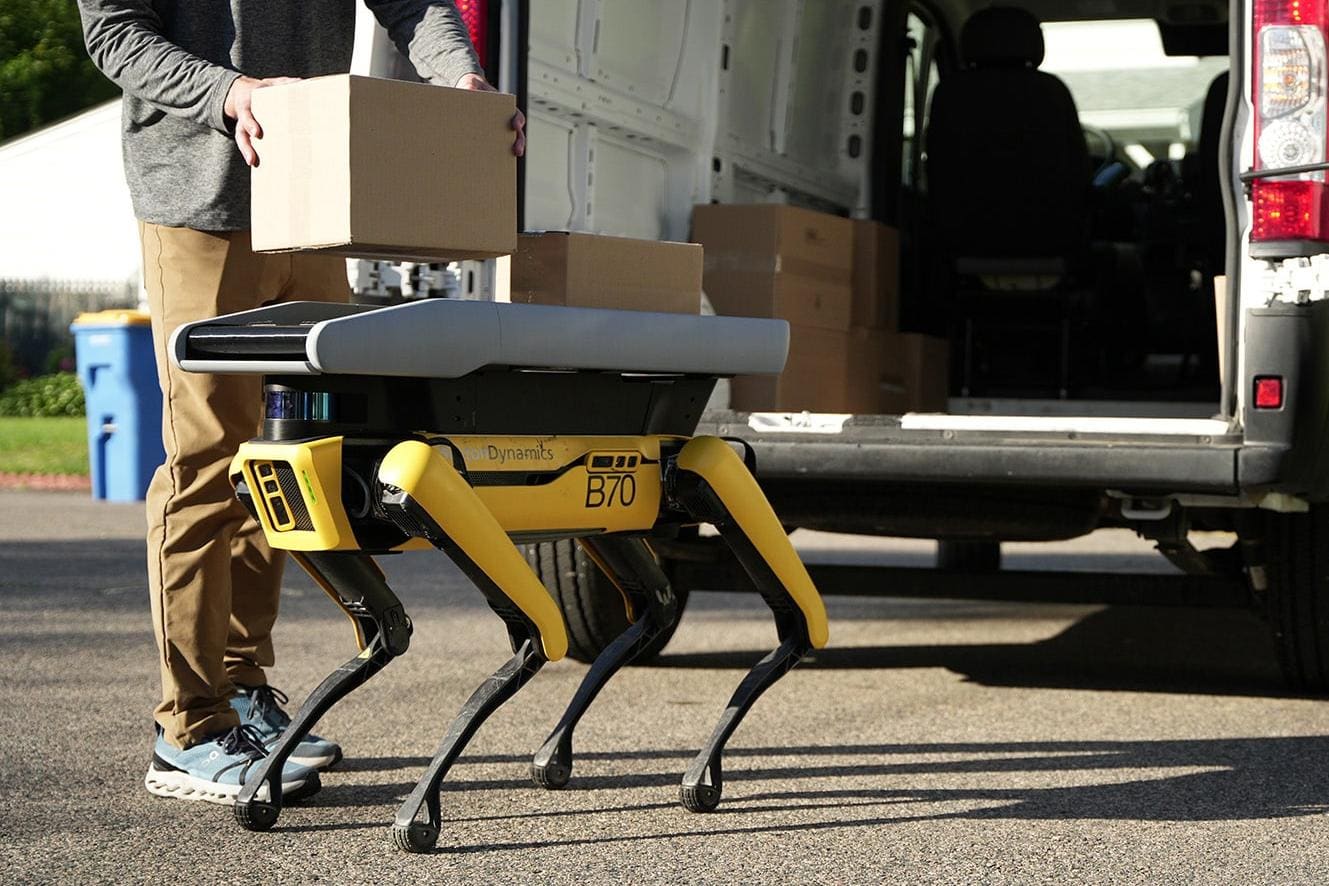
Boston Dynamics has unveiled a conveyor belt attachment for Spot, its four-legged mobile platform, designed to ferry parcels from delivery vans directly to residential doorsteps. The experiment represents a shift in application strategy: instead of deploying Spot for hazardous industrial inspection or heritage-site monitoring work it has performed in recent years, the company is now probing whether legged autonomy can solve bottlenecks in last-mile logistics.
The hardware addition enables Spot to receive packages from a vehicle, traverse driveways, stairs, and other residential terrain, then deposit items at the customer's door without human accompaniment. At DailyTechWire, we've tracked scores of wheeled sidewalk bots and quadcopter schemes aimed at automating the final fifty meters of delivery; Boston Dynamics is betting that articulated legs will outperform wheels and rotors on the uneven, unpredictable surfaces that define suburban and urban doorsteps.
Why Legs Beat Wheels in Residential Terrain
Wheeled delivery robots have proliferated across university campuses and planned communities in North America and Europe over the past five years, yet adoption has stalled in neighborhoods with aging infrastructure, steep grades, or inconsistent sidewalk maintenance. Spot's legged locomotion offers mechanical advantages: each limb adjusts independently to steps, curbs, gravel, and thresholds that would immobilize a wheeled chassis. The conveyor accessory mounts atop Spot's back and appears purpose-built to accept standard parcel dimensions, suggesting Boston Dynamics studied the dimensional distribution of e-commerce shipments before finalizing the design.
Aerial drones face their own constraints. Regulatory ceilings on autonomous flight remain low in most jurisdictions, weather limits operational windows, and the final handoff - lowering a package safely to a porch - requires either precision winching or a flat, obstacle-free landing zone. Legged platforms sidestep those variables by staying grounded and navigating the same paths a human courier would walk.
Driver Augmentation, Not Replacement
Boston Dynamics frames the trial as a way to reduce physical strain on delivery personnel rather than eliminate the role entirely. Under the proposed workflow, a driver remains in or near the vehicle, loading parcels onto Spot's conveyor as the robot shuttles back and forth. This division of labor keeps the human operator focused on route sequencing, customer communication, and exception handling - tasks that remain difficult to automate - while offloading the repetitive lifting, climbing, and walking that contribute to musculoskeletal injury in the logistics workforce.
The model mirrors patterns we've observed in warehouse automation, where collaborative robots handle the heaviest or most monotonous sub-tasks while human workers manage variability and judgment calls. Whether this hybrid approach proves economically viable at the doorstep scale depends on hardware cost, route density, and the speed at which Spot can complete a round trip. Boston Dynamics has not disclosed per-unit pricing for the conveyor-equipped configuration or shared cycle-time benchmarks from the trial.
Operational Questions and Edge Cases
Several practical challenges will shape the viability of legged delivery assistants. Battery endurance limits the number of trips Spot can complete between charges; if the robot must return to the vehicle every five to ten stops for a swap or recharge, throughput gains may be modest. Navigation reliability in adverse conditions - rain-slicked steps, icy walkways, or poorly lit porches at dusk - will determine whether the system can operate year-round across varied climates.
Customer acceptance is another variable. Wheeled sidewalk bots have occasionally triggered complaints about sidewalk obstruction and accessibility; a sixty-pound quadruped ascending a residential stoop may prompt different reactions, particularly in neighborhoods unaccustomed to robotic visitors. Boston Dynamics will need to demonstrate that Spot can detect and yield to pedestrians, pets, and other unpredictable actors in the delivery environment.
The conveyor accessory also raises questions about package security. Wheeled bots typically feature locked compartments; an open-top belt system may require line-of-sight supervision or geofenced operation to prevent opportunistic theft during the transit from curb to door.
Strategic Context: Spot's Expanding Role Portfolio
Spot entered commercial availability in 2020 priced above sixty thousand dollars, targeting industrial inspection, public safety, and research applications. Early deployments included monitoring construction sites, scanning for gas leaks in energy infrastructure, and documenting archaeological sites where human foot traffic risks damage. The addition of a delivery-focused accessory signals Boston Dynamics' intent to diversify revenue streams beyond heavy industry and explore consumer-adjacent markets.
The move also reflects broader momentum in logistics automation. Parcel volumes have grown faster than the available labor pool in many regions, and delivery companies face persistent pressure to lower per-package costs while maintaining service speed. If Boston Dynamics can demonstrate meaningful productivity uplift in real-world trials, it may attract pilot partnerships with national carriers or regional last-mile specialists.
What Comes Next
Boston Dynamics has released demonstration footage but has not announced commercial partners or a timeline for broader deployment. The trial phase will likely focus on instrumentation - collecting data on terrain traversal success rates, cycle times, energy consumption, and incident frequency - to refine both the hardware and the autonomy stack before any scaled rollout.
For the wider robotics industry, Spot's foray into delivery serves as a test case for legged mobility in unstructured, human-centric environments. Success could accelerate investment in quadruped and bipedal platforms for tasks beyond inspection and entertainment. Failure, or even marginal performance, may reinforce the prevailing view that wheeled and aerial solutions remain the more pragmatic path for last-mile automation, leaving legged robots confined to niches where their mechanical flexibility commands a clear premium.