Waze Adds Motorcycle Navigation and Voice Controls That Talk Less
Google's crowdsourced navigation platform deploys Gemini-powered voice search and mode tailored for two-wheeled hazards across seven markets.
Routing for Two Wheels
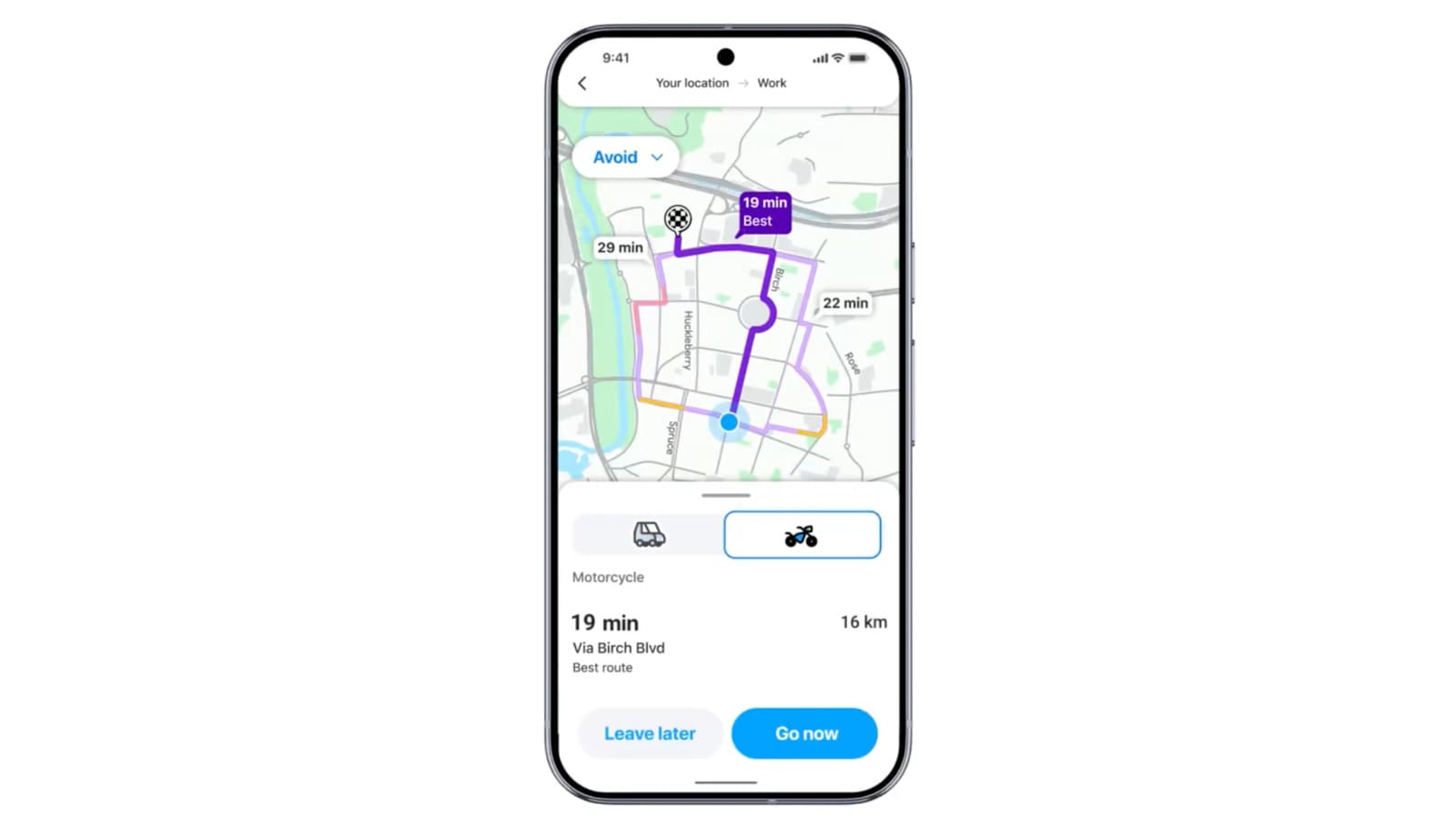
Waze has introduced a Motorcycle mode that applies AI to surface-specific routing considerations for riders. The feature accounts for shortcuts accessible only to motorcycles and flags hazards particularly dangerous for two-wheeled travel: potholes, speed bumps, raised crosswalks, shoulder endings, and narrow bridges.
The mode combines algorithmic suggestions with human oversight. A dedicated team of motorcycle-focused editors maintains the hazard database in real time, working alongside Waze's existing crowdsourced traffic layer. That hybrid approach addresses a common concern with AI-generated navigation: accuracy in edge cases where machine learning alone might miss critical context.
Motorcycle mode launches in Argentina, Brazil, Colombia, Malaysia, Mexico, Peru, and the Philippines. The geographic focus reflects markets where two-wheeled vehicles account for a significant share of urban mobility, and where infrastructure often presents unique challenges absent from car-centric road networks.
Personalization Without Noise
Waze now suggests routes based on driving history, layering preference data atop its traditional traffic-optimization logic. The feature is opt-out by default; users who prefer purely traffic-driven recommendations can disable historical routing in settings.
A Less Chatty mode reduces voice prompt frequency. Instead of announcing every upcoming turn or minor hazard, the app limits audible guidance to critical maneuvers and high-priority alerts. The change targets drivers who find constant narration distracting, a complaint that has surfaced in user feedback since voice navigation became standard.
Both features reflect a shift in how navigation apps balance information density with user attention. Where earlier generations of turn-by-turn systems erred toward over-communication, the current design philosophy privileges selective intervention.
Conversational Reporting Expands
Waze began testing Conversational Reporting in October 2024, allowing drivers to describe traffic incidents in natural language rather than tapping predefined categories. The feature now extends to map updates: users can verbally suggest corrections to road data, business listings, or route errors.
Gemini integration powers the conversational layer. Voice search queries such as "Find me a gas station nearby with the lowest prices" return custom result pages, moving beyond simple location lookups to parameter-based filtering. The capability is rolling out to Waze's beta community globally before wider release.
At DailyTechWire, we've tracked the gradual embedding of large language models into productivity and utility apps over the past eighteen months. Waze's implementation is notable for constraining conversational AI to specific, high-value tasks rather than attempting a general-purpose assistant. The focus on map corrections and filtered search suggests Google is using Waze as a testing ground for practical LLM applications that don't require perfect accuracy across unbounded domains.
Platform Fragmentation and Feature Rollout
Personalization features, Less Chatty mode, and Conversational Reporting are available globally on Android and iOS. Gemini-powered voice search remains in beta. Motorcycle mode's limited geographic rollout highlights a persistent challenge in navigation software: local data quality determines feature viability more than algorithmic sophistication.
The staggered deployment also underscores Google's approach to its dual navigation properties. While Google Maps serves as the default, general-purpose tool, Waze continues to function as a laboratory for community-driven features and experimental interfaces. Motorcycle mode, for instance, relies on a contributor model that Maps hasn't replicated at scale.
The Attention Economy of Turn-by-Turn
Less Chatty mode addresses a problem that has intensified as in-car interfaces proliferate. Drivers now juggle audio from navigation apps, streaming services, phone calls, and vehicle alerts. Reducing prompt frequency acknowledges that constant narration competes for cognitive bandwidth rather than supporting it.
The feature also hints at a broader rethinking of how AI-powered assistants should communicate. Early voice interfaces assumed more information was better; recent design trends favor brevity and contextual silence. Waze's implementation lets users define their own threshold for intervention, a pattern likely to spread across other ambient computing products.
Motorcycle mode, meanwhile, represents a rare case of navigation software adapting to vehicle-specific needs beyond car versus pedestrian. The feature set required to serve riders well differs materially from four-wheeled routing: lane positioning matters more, weather exposure changes risk calculations, and infrastructure gaps that cars navigate easily become impassable obstacles.
What Gemini Brings to Crowdsourced Maps
Waze's value proposition has always rested on real-time, user-generated data. Integrating Gemini into that workflow introduces a new variable: whether natural language processing can lower the friction of contributing map intelligence.
Conversational Reporting reduces the cognitive load of incident logging. Instead of pulling over to select the correct hazard category, drivers can describe what they see and let the model parse intent. If adoption increases reporting volume without degrading data quality, the feature could meaningfully improve Waze's core asset.
Voice search with parameter filtering, by contrast, competes directly with Google Maps. The test will be whether Waze's community-sourced pricing data and real-time updates deliver enough differentiation to justify maintaining a separate search interface. For now, the beta rollout suggests Google is evaluating whether Gemini's capabilities are compelling enough to keep power users anchored to Waze rather than migrating to the more feature-rich Maps ecosystem.
The update package signals that Waze remains a distinct product rather than a feature destined for absorption into Google Maps. Motorcycle mode and Less Chatty both address use cases Maps doesn't prioritize, while Gemini integration explores interaction patterns that may eventually migrate across Google's navigation suite. Whether that strategy sustains Waze's user base in an increasingly crowded mobility app market will depend on execution: the precision of motorcycle hazard detection, the relevance of personalized routes, and the accuracy of conversational parsing when a driver is moving at speed.