Tesla-SpaceX Merger Speculation Meets Geopolitical Reality
As talk of combining Elon Musk's two largest ventures intensifies, cross-border production networks and export controls present structural obstacles that dealmakers may underestimate.
A Merger Hypothesis Under New Scrutiny
Speculation about combining Tesla and SpaceX has circulated in Silicon Valley and Wall Street circles for years, typically dismissed as the idle conjecture of investors imagining synergies between Elon Musk's two most valuable enterprises. That conversation has gained fresh momentum in recent months, driven by overlapping shareholder bases, technology adjacencies in battery systems and materials science, and the operational efficiencies that a unified entity might theoretically unlock.
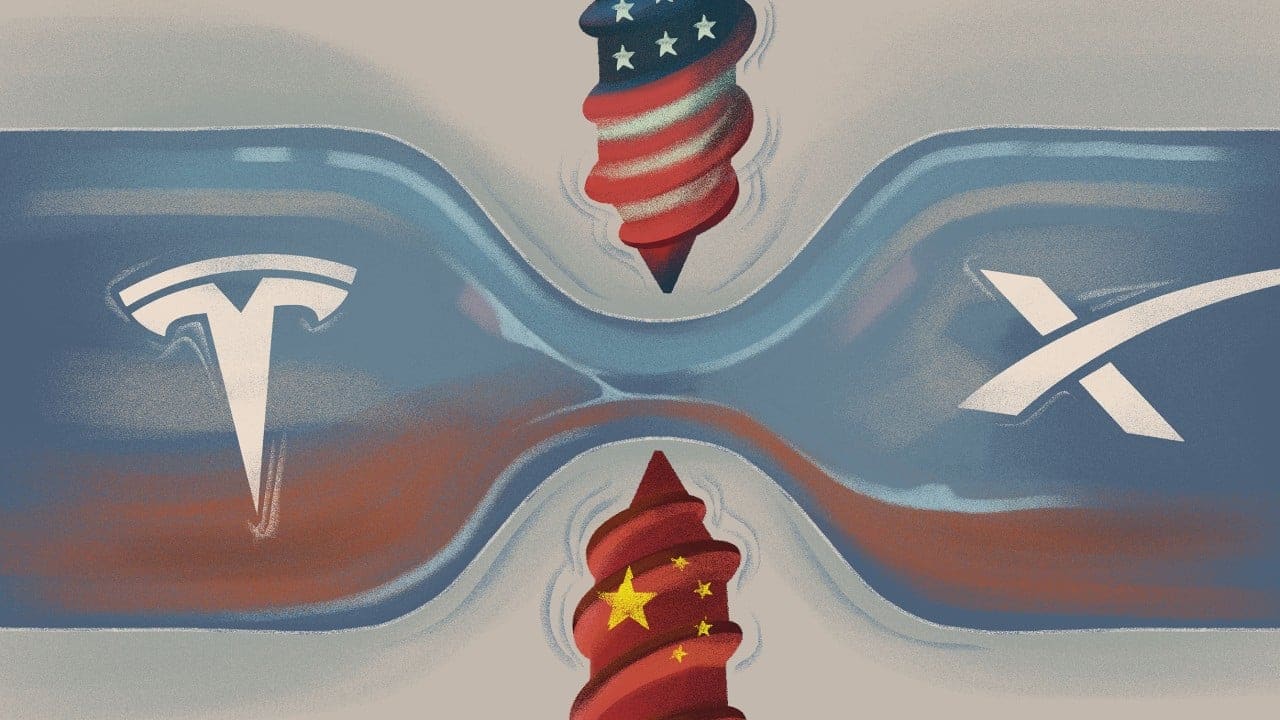
Yet the mechanics of such a transaction face a set of constraints that have received less attention than the financial engineering: the deep geopolitical entanglements each company has accumulated through its production footprint and customer relationships. Tesla's Shanghai Gigafactory represents the clearest illustration. The facility assembles Model Y vehicles in under 40 seconds per unit and ships to markets across Asia-Pacific and Europe, making it the most productive node in Tesla's global manufacturing network. SpaceX, meanwhile, operates under layers of U.S. export controls and national security oversight tied to its satellite and launch vehicle technologies.
At DailyTechWire, we've tracked how regulatory frameworks governing dual-use technology and critical supply chains have tightened across major economies since 2022. A corporate structure that yokes together a defense-adjacent aerospace contractor and an automaker reliant on Chinese manufacturing scale would navigate a regulatory environment that has grown considerably more fractured.
Manufacturing Geography as Strategic Liability
Tesla's Shanghai operation is not a marginal assembly plant. The Lingang site produces vehicles for domestic Chinese consumption and for export to Southeast Asia, Australia, New Zealand, and portions of Europe. The facility benefits from local supply chains for battery cells, electric drive units, and structural components, many of which involve Chinese suppliers that have become world leaders in lithium-ion cell production and power electronics.
SpaceX's work, by contrast, sits firmly within the International Traffic in Arms Regulations (ITAR) regime. Rocket propulsion systems, satellite buses, and the Starlink ground infrastructure are all considered defense articles under U.S. law. Personnel access, technology sharing, and even routine operational data are subject to controls designed to prevent foreign adversaries from acquiring sensitive aerospace capabilities.
Merging these entities would create a combined organization whose automotive division depends on deep integration with Chinese manufacturing ecosystems, while its space division operates under restrictions that prohibit technology transfer to China and limit hiring of foreign nationals. The friction is not merely administrative. It is structural, embedded in the physical location of factories, the nationality of key engineering talent, and the legal architecture governing what can be shared across internal divisions.
Capital Markets and Disclosure Tensions
A combined Tesla-SpaceX would inherit another layer of complexity: the disclosure obligations of a publicly traded entity. Tesla, listed on Nasdaq, files quarterly earnings, discloses material risks, and operates under SEC oversight. SpaceX has remained private, allowing it to avoid the detailed financial and operational transparency that public markets demand.
Aerospace and defense contractors that do go public, such as Lockheed Martin or Northrop Grumman, navigate these tensions by maintaining separate classified and unclassified reporting streams. They disclose revenue at a segment level but provide limited operational detail on defense programs. A merged Tesla-SpaceX would need to adopt a similar structure, likely requiring SpaceX operations to be reported as a discrete, minimally detailed segment to satisfy both SEC rules and ITAR confidentiality requirements.
Investors accustomed to Tesla's granular production and delivery updates would encounter a black box around the space business. The risk is that the opacity required to protect national security information undermines the equity valuation multiple that Tesla has historically commanded, which rests in part on its perceived transparency and growth visibility.
Technology Transfer Policies in Flux
The regulatory environment has not been static. U.S. export controls on semiconductor manufacturing equipment, advanced computing chips, and certain battery chemistries have expanded since 2022. The European Union has introduced its own screening mechanisms for foreign investment in critical technologies. China has countered with export restrictions on gallium, germanium, and certain rare-earth processing technologies.
A Tesla-SpaceX entity would sit at the intersection of these overlapping regimes. Battery research conducted in the United States might be subject to Department of Energy oversight if it involves materials on a restricted list. Manufacturing process innovations developed in Shanghai could face export restrictions if they involve controlled software or dual-use manufacturing equipment. The compliance burden would be nontrivial, requiring dedicated legal and export-control teams to adjudicate every cross-border transfer of technical data.
We have observed similar challenges at other multinational technology firms. Semiconductor companies, for example, now maintain separate product roadmaps for China and non-China markets to comply with U.S. export rules. A merged automotive and aerospace giant would likely need to adopt comparable segmentation, raising questions about whether the operational synergies that justify a merger can actually be realized if technology and personnel cannot move freely within the combined organization.
Shareholder Alignment and Strategic Rationale
Proponents of a merger point to potential efficiencies: shared research in battery technology, joint procurement of raw materials like lithium and cobalt, and unified lobbying efforts on regulatory issues ranging from autonomous vehicle standards to orbital debris policy. Both companies have invested heavily in vertical integration, from battery cell production at Tesla to rocket engine manufacturing at SpaceX.
Yet the strategic logic depends on the ability to integrate operations, not merely to consolidate balance sheets. If export controls and national security restrictions force the two businesses to operate as walled-off entities within a single corporate structure, the value creation case weakens. Investors would effectively own a holding company with limited ability to transfer capital, technology, or talent between its divisions.
There is also the matter of culture and operational tempo. Tesla has cultivated a manufacturing-focused identity, iterating rapidly on production lines and vehicle design. SpaceX operates on longer development cycles, driven by the physics of rocket engineering and the regulatory approval processes for launch vehicles. Merging these organizations would require reconciling not just different regulatory environments but different organizational rhythms.
Precedent and Path Forward
Corporate combinations that span defense and commercial sectors are not unprecedented. United Technologies, before its breakup, housed both Pratt & Whitney jet engines (subject to ITAR) and Otis elevators (largely commercial). The structure worked, but it required rigorous internal controls and limited synergy realization between divisions.
A Tesla-SpaceX merger could follow a similar playbook: a holding company structure with separate operating subsidiaries, minimal technology sharing, and distinct regulatory compliance teams. The question is whether such a structure delivers enough value to justify the transaction costs, shareholder dilution, and regulatory scrutiny that a deal of this scale would invite.
For now, the speculation remains just that. Neither Tesla nor SpaceX has publicly entertained the idea, and Musk has historically resisted pressures to take SpaceX public or to merge it with other ventures. But the conversation itself reveals a broader tension in global technology markets: as geopolitical fragmentation deepens, the corporate structures that once made sense in an era of relatively open trade and investment flows are increasingly difficult to sustain. The question is not whether a Tesla-SpaceX merger is likely, but whether the global system can still accommodate the kind of cross-border, multi-sector integration that such a deal would represent.
What Boards and Policymakers Are Watching
Corporate boards at other multinationals are paying attention. The challenges facing a hypothetical Tesla-SpaceX merger are not unique. Any company with significant operations in both the United States and China, and with business lines that touch national security, faces similar pressures. Semiconductor firms, telecommunications equipment makers, and advanced materials companies are all navigating versions of the same trade-offs.
Policymakers, too, are watching. The Biden administration's focus on supply chain resilience and the Trump administration's earlier emphasis on decoupling from China have created a bipartisan consensus that certain technologies should not be entangled with geopolitical rivals. A Tesla-SpaceX merger would test the boundaries of that consensus, forcing regulators to decide how much integration between defense-adjacent aerospace and Chinese manufacturing they are willing to tolerate.
The outcome of that test, whether it occurs through an actual merger attempt or remains hypothetical, will shape the strategic options available to other technology leaders. In an environment where capital, technology, and talent are increasingly subject to national security screening, the era of frictionless global expansion may be over. What comes next is a more fragmented landscape, where corporate structure is as much a function of geopolitics as of business strategy.