Software Eats the Robot: Why Humanoid Intelligence Now Matters More Than Mechanics
As commercial deployments multiply across Asia, the ability to learn and adapt on the fly is separating practical robotics from engineering showpieces
When Zero-Shot Learning Becomes the Bar
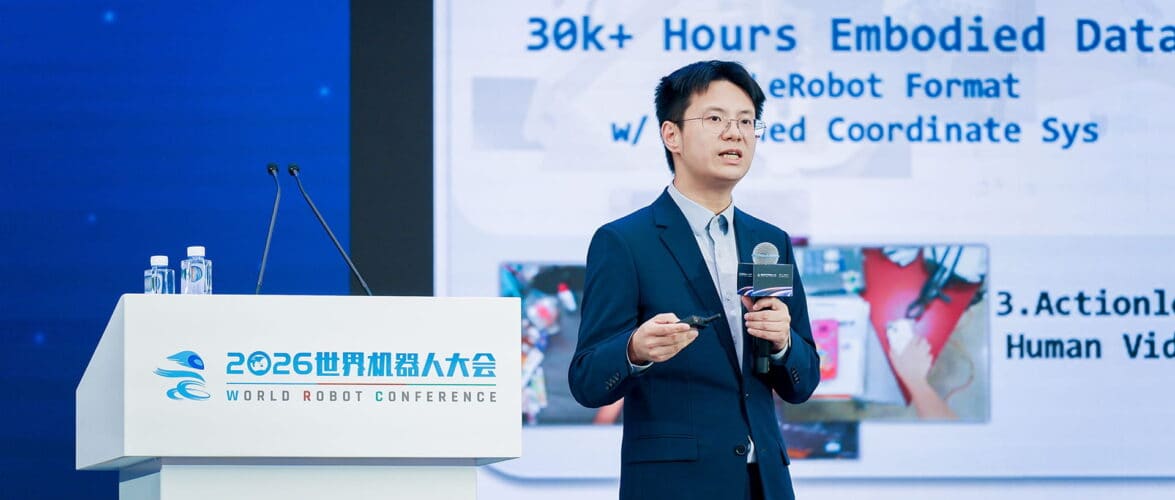
A robot that can mimic a hip-hop dancer in real time or rally at tennis sounds impressive. But Wang He, Galbot's founder and CTO, laid out a tougher standard during the World Robot Conference forum his company hosted in mid-August: true embodied intelligence should let machines generalize to tasks they have never rehearsed, and let non-technical users teach them new behaviors through simple interaction. No algorithm expertise required. No pre-recorded demo videos.
That benchmark reflects a deeper shift in how robotics companies are thinking about commercial viability. Over the last two years, attention in the humanoid space has clustered around mechanical feats: run faster, jump higher, absorb more shock. Unitree Robotics' August debut on the Shanghai exchange drove that point home. Shares surged more than 600 percent intraday before settling 460 percent above the IPO price, underscoring investor appetite for visible, legible hardware progress.
Yet once robots leave the demo stage and enter pharmacies, retail fulfillment centers, and factory floors, pure athleticism hits a ceiling. A machine must parse spoken instructions, handle objects it has never seen, and replan when a human walks into its workspace or shifts a target mid-task. At DailyTechWire, we have tracked dozens of pilot deployments across the region, and the pattern is consistent: the systems that scale are the ones that learn from disruption rather than break when conditions deviate from script.
Galbot is betting that foundation models trained on diverse physical interactions, not just kinematics, will separate durable platforms from expensive prototypes. The company's newly introduced ET1 humanoid runs on AstraBrain-Agent, a system designed to observe, reason, and act in continuous feedback loops. Instead of relying on engineers to code every motion sequence, users demonstrate a task once and the robot internalizes the pattern. That claim, if it holds under volume, reframes what a "general-purpose" robot actually means.
Agents Leave the Browser and Enter the Warehouse
In software, agents have become table stakes. They route API calls, scrape data, and automate workflows across SaaS tools. Physical environments impose harsher constraints. Lighting shifts. Objects rotate. A person reaches across a table. Each change requires the model to update its spatial understanding and translate that update into motor commands, then observe the outcome and loop again.
AstraBrain-Agent is architected around that cycle. Perception and planning operate directly on three-dimensional space, and reasoning outputs must resolve into limb trajectories and joint torques. Once the robot moves, the world changes, feeding new sensor data back into the planning layer.
Galbot structures its system into three modules: a "brain" that interprets context and sets goals, a "cerebellum" that orchestrates full-body and bimanual control, and a bridge that translates high-level intent into executable motion primitives. The brain uses what Galbot calls a world action model architecture, which fuses vision-language-action generation with forward simulation. Instead of treating perception and prediction as separate stages, the model anticipates how an action will alter the environment and selects moves accordingly.
The cerebellum, AstraBrain-WBC, has been trained on more than 100,000 hours of human motion data, according to Galbot. Some of that comes from marker-based motion capture; another portion is extracted from video footage scraped online. The model learns balance strategies, joint coordination patterns, and transition dynamics from human examples, then maps those patterns onto robot morphologies without requiring engineers to hand-tune every trajectory.
That transfer matters because it decouples skill acquisition from hardware specificity. Traditionally, adding a capability meant collecting task-specific data, retraining a model, and validating the result on a single robot configuration. AstraBrain is designed to preserve learned behaviors while adapting to new embodiments and scenarios through limited additional interaction. Galbot demonstrated the same foundation model controlling a G1 unit picking products from supermarket shelves and a different platform folding garments, a task that involves continuous replanning as fabric deforms with each grasp.
Breakfast Routines and the Problem of Interruption
At Galbot's booth during the conference, one demonstration involved a mundane breakfast sequence: pick bread, pour water, arrange items on a plate. The revealing moments came when spectators interfered. Someone removed a cup. Another person blocked the robot's line of sight to a target object. In each case, the system replanned and continued.
Conventional industrial automation assumes tightly controlled environments. The physical world does not cooperate. A coworker reaching for a tool or a package arriving in unexpected orientation can invalidate a pre-scripted motion plan in milliseconds. Folding clothes multiplies the problem: garments have no fixed geometry, so the model must reassess shape, identify viable grasp points, and update its strategy after every manipulation.
For commercial deployment, succeeding once in a demo is noise. What matters is whether a robot can repeat a task thousands of times with acceptable accuracy and handle edge cases without human intervention. Galbot has been testing those metrics in live settings. The company reports that its platforms are operating in smart pharmacies and on-demand retail nodes, where robots identify SKUs, retrieve items from dense shelving, and hand packages to delivery riders. Those interactions happen many times daily, turning reliability and exception handling from engineering curiosities into operating requirements.
Industrial environments add payload and safety constraints. Galbot's S1 unit features dual arms and can handle loads up to 50 kilograms. Moving heavy materials requires dynamic posture adjustment and force modulation, while proximity to human workers demands continuous collision prediction. The scenarios vary: soft, shape-shifting textiles in one setting; tightly packed retail inventory in another; bulk industrial materials in a third. Galbot's strategy is to use AstraBrain as the shared technical substrate across all of them.
That approach also turns deployment into a training data engine. Smart pharmacies, fulfillment centers, and production lines generate failure modes difficult to replicate in simulation: packaging variations, sensor drift over months of operation, unpredictable human interference. Feeding that information back into training lets the model refine edge-case handling, and updated capabilities can be pushed to the robot fleet in subsequent releases.
At the forum, Galbot announced plans to open its simulation platform, data collection hardware, foundation models, and reinforcement learning pipeline to technology partners and developers. The company also intends to let third parties build custom movements and applications for ET1. The logic is straightforward: more users and deployment contexts generate more varied data, which improves the next model iteration, which attracts more users.
The Data Flywheel and the New Competitive Moat
Humanoid robotics has spent the last few years obsessing over the body. Speed, jump height, and impact tolerance are legible proxies for engineering progress, and they generate compelling video. But once robots enter commercial operation, movement alone is insufficient. A platform must interpret ambiguous instructions, manipulate unfamiliar objects, and respond when people or obstacles move unpredictably.
Hardware determines where a robot can go. The model increasingly determines what it can do once it gets there. That makes embodied foundation models another axis of competitive differentiation, and one that is harder to benchmark than motor performance.
General-purpose intelligence requires exposure to a wide range of physical interactions, then repeated validation in uncontrolled environments. The broader that experience base, the more prior knowledge a model can draw on when encountering a novel task. Galbot identified data infrastructure as central to that challenge early. Its AstraData system organizes training inputs into five layers: internet data for semantic grounding, human motion data for action priors, simulation-generated samples for scale, teleoperation data for fine-grained calibration, and real-world feedback from deployed robots.
Wang He noted that Galbot has accumulated one million hours of human data and 80,000 hours of real-world feedback. The team began building an egocentric human-object interaction dataset in 2021. Today, data collection hardware, simulation, and model evaluation run on unified infrastructure, creating a self-reinforcing loop. More deployments expose the model to edge cases. Better models reduce the effort required to adapt robots to new tasks and embodiments. Deployment and model development amplify each other.
That brings the discussion back to Wang's original question: when will embodied intelligence have its defining moment? He proposed two benchmarks. Robots should generalize to common skills they have never explicitly learned. Non-technical users should be able to teach them new movements through interaction, with no algorithmic background. Meeting both standards requires understanding the physical world, controlling full-body and bimanual motion, and learning continuously.
What Separates a Platform from a Prototype
The robotics industry has no shortage of demos. Tennis rallies, dance routines, and backflips generate headlines. What separates a platform from a prototype is whether the system can operate reliably under volume in environments it was not explicitly trained for.
Galbot's approach ties commercial deployment directly to model improvement. Every pharmacy pick, every garment fold, every unexpected human interruption becomes a training signal. That data, fed back into AstraBrain, refines the model's ability to handle variation. Updated capabilities then propagate to the robot fleet, improving performance across all deployment sites.
The strategy mirrors the playbook that scaled large language models: accumulate diverse data, train a general-purpose foundation model, then fine-tune or adapt through post-training and user interaction. In software, that cycle produced systems that can draft emails, write code, and summarize documents without task-specific retraining. In robotics, the same logic applies, but the feedback loop runs through the physical world.
Opening the platform to external developers is intended to accelerate that cycle. More contributors mean more tasks, more edge cases, and more training diversity. If the flywheel spins, Galbot's foundation model becomes more capable with each turn, and the gap between it and competitors who lack comparable data infrastructure widens.
The humanoid robotics sector is still young, and most commercial deployments remain pilots. But the companies that build durable data engines, not just impressive hardware, are the ones likely to define the category as it matures. At DailyTechWire, we see the same pattern across AI infrastructure: the players who control the data flywheel control the platform. Embodied intelligence is no different. The body gets you in the door. The model determines whether you stay.