SK Hynix Pulls $26.5 Billion in Record U.S. Listing as Washington Eyes Korean Fab Capacity
The memory chipmaker's debut eclipsed Alibaba's 2014 record, while Commerce officials press Seoul's semiconductor giants to manufacture stateside amid surging AI demand
A Memory Giant Goes to Wall Street
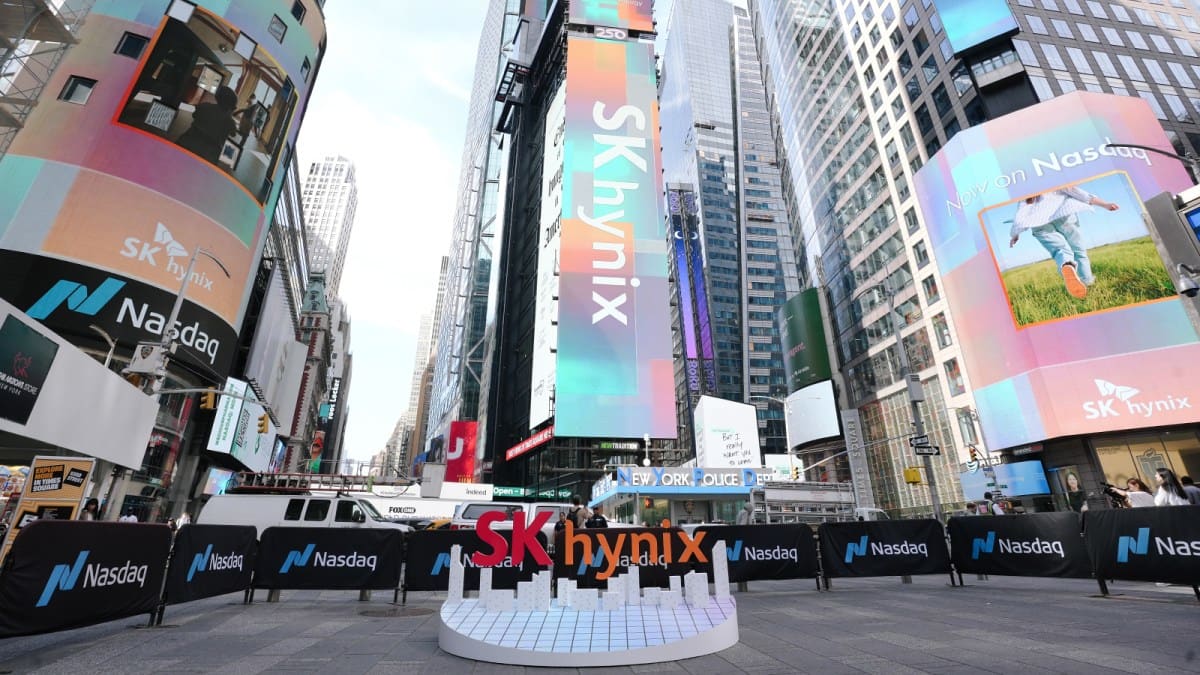
SK Hynix closed a $26.5 billion capital raise on Friday, pricing 177.9 million American depositary shares at $149 apiece in what stands as the largest U.S. market debut by a foreign company. The South Korean memory manufacturer's offering surpassed the previous benchmark set by Alibaba in 2014 by roughly $1.5 billion, and investor appetite proved robust: demand reportedly ran seven times oversubscribed even as the company priced its ADRs at a 2.7% premium to its three-day Seoul average.
The stock opened 14% above issue price when trading began on Nasdaq under the temporary ticker SKHYV. Regular trading shifts to the permanent symbol SKHY on Monday, July 13. For context, Korean equities have historically traded at a discount to global peers, a valuation gap shaped by governance complexity, modest shareholder returns, regulatory ambiguity, and geopolitical risk tied to the North. SK Hynix has effectively sidestepped that penalty, and the reason is straightforward: it manufactures high-bandwidth memory, the specialized DRAM that powers AI accelerators.
HBM Dependency Rewrites Valuation Rules
High-bandwidth memory stacks multiple DRAM dies vertically and connects them with through-silicon vias, delivering the bandwidth and power efficiency that GPU-based training and inference workloads require. Nvidia, which commands the majority of the AI accelerator market, sources HBM from a narrow supplier base. SK Hynix sits at the center of that base, shipping HBM3 and HBM3E modules into data-center builds from Redmond to Shenzhen.
That dependency has rewritten investor calculus. Where Korean industrials once faced skepticism, SK Hynix now commands a scarcity premium. The oversubscription rate and first-day pop underscore a broader shift: capital is chasing exposure to the physical infrastructure beneath large language models, and memory has become a choke point as acute as advanced logic or packaging capacity.
Three Deployment Targets for Fresh Capital
SK Hynix disclosed three uses for the proceeds in its Korea Stock Exchange filing. The largest tranche will fund a new fabrication facility in South Korea, already under construction and designed to lift HBM and conventional DRAM output in response to the global memory shortfall driven by generative AI workloads. A second allocation supports a domestic packaging plant, critical as chiplet architectures and 3D stacking push more value into back-end assembly. The third portion goes toward extreme ultraviolet lithography scanners, the ASML tools required to pattern sub-7-nanometer features and push DRAM density forward.
None of the capital, at least as outlined in public filings, is earmarked for facilities outside South Korea. That geographic concentration has drawn attention in Washington, where policymakers remain uneasy about the degree to which critical semiconductor capacity sits in a peninsula shadowed by North Korean artillery range and, more broadly, regional tension.
Commerce Secretary Floats U.S. Fab Push
Commerce Secretary Howard Lutnick used a Micron event on Thursday to signal that the administration is in active discussions with Samsung and SK Hynix about establishing memory manufacturing in the United States. Micron, the sole large-scale U.S. memory producer and a direct competitor to both Korean firms, announced it will commit $250 billion to domestic manufacturing expansion, a plan the company projects will generate more than 90,000 jobs and anchor leading-edge production onshore.
The timing carries weight. Samsung and SK Hynix recently committed a combined $550 billion to new manufacturing investment in South Korea, underscoring the scale at which both companies are moving to capture AI-driven memory demand. Lutnick's overture suggests Washington wants a share of that buildout to land in U.S. jurisdictions, leveraging CHIPS Act incentives, federal grants, and diplomatic pressure to shift some incremental capacity stateside.
Balancing Subsidy, Speed, and Supply-Chain Geography
The pitch to Korean chipmakers hinges on subsidy packages and strategic alignment, but execution risk remains high. Memory fabs require multi-year construction timelines, reliable access to ultrapure water and stable power grids, and deep pools of process-engineering talent. South Korea offers all three in mature semiconductor clusters around Pyeongtaek and Icheon. Replicating that ecosystem in Arizona or upstate New York demands not only capital but also workforce development, utility planning, and permitting speed that U.S. jurisdictions have historically struggled to deliver.
At the same time, geopolitical calculus is shifting. Export controls on advanced chipmaking equipment to China have fragmented the semiconductor map, and memory is no exception. SK Hynix and Samsung both operate legacy fabs in China that serve the domestic market, but leading-edge HBM production remains concentrated at home. If Washington succeeds in pulling even a fraction of future capacity to U.S. soil, it would mark a structural change in how memory supply chains are organized and a hedge against scenarios in which access to Korean output is disrupted.
What the IPO Signals About AI Infrastructure Investment
SK Hynix's record raise reflects a broader pattern we've tracked across Asia and North America: investors are willing to deploy large sums into the physical layer of AI, particularly where supply is constrained and demand visibility extends years into the future. Memory, alongside advanced packaging and power delivery, has emerged as a bottleneck that financial markets now price accordingly.
The oversubscription and opening-day performance also suggest that U.S. institutional buyers view exposure to Korean semiconductor leaders as a necessary portfolio position, even if that means accepting ADR structures and cross-listing complexity. For years, the Korea Discount kept foreign capital on the sidelines. The AI boom has inverted that reluctance, at least for companies with direct lines into Nvidia's supply chain.
Whether Washington's diplomatic campaign yields new fabs in the U.S. remains uncertain. What is clear is that memory has moved from a cyclical commodity business to a strategic asset, and the companies that control HBM production now operate in a policy environment where capital access and site selection carry geopolitical weight. SK Hynix has secured the funding to expand at home; the question is whether the next tranche will fund construction in a different time zone.