Pony.ai and Uber Target 2,000 Autonomous Vehicles Across Four European Markets
The expanded partnership clarifies the joint-deployment model as Chinese AV maker and American platform giant push into a fragmented regulatory landscape.
A Continental Bet on Autonomy
Guangzhou-based Pony.ai and ride-hailing platform Uber have committed to deploying 2,000 autonomous vehicles across four European cities, though neither company has disclosed a timeline or named the launch markets. The announcement refines a partnership that began in the Middle East in May 2025 and extends the companies' attempt to establish presence in a region where autonomous vehicle regulation remains fragmented and early-stage commercial deployments are sparse.
At DailyTechWire, we've tracked the robotaxi sector's uneven global rollout. While China's cities have granted test licenses and limited commercial permits to dozens of operators, Europe has moved cautiously, with individual member states setting their own frameworks. This patchwork creates both opportunity and friction for companies attempting multi-city rollouts. Pony.ai's strategy hinges on a joint-deployment model that assigns technology, platform, and operations to separate entities, a structure the company has refined through partnerships with local transportation authorities in China and Qatar.
How the Model Works
Under the clarified arrangement, Pony.ai supplies the autonomous driving stack, Uber contributes its ride-hailing platform and demand aggregation, and local providers can handle fleet management tasks such as maintenance, charging, and cleaning. Vehicle ownership may vary by market, allowing capital to flow from local partners, leasing companies, or fleet operators depending on regulatory and tax incentives.
This modular approach mirrors strategies employed by Waymo in Phoenix and San Francisco, where the company owns vehicles but relies on third-party service providers for depot operations. It also reflects the capital intensity of scaling robotaxi fleets. A 2,000-vehicle deployment, even at conservative $150,000 per unit hardware cost, implies $300 million in vehicle capex alone, not counting software development, insurance, and operational overhead. Distributing ownership and operational risk across partners reduces balance-sheet exposure for both Pony.ai and Uber.
Europe's Regulatory Mosaic
European markets present distinct challenges. Germany permits Level 4 autonomy under certain conditions following amendments to its road traffic act in 2021, but requires a technical supervisor to be reachable remotely. France has authorized trials in designated zones, while the United Kingdom is drafting an Automated Vehicles Act expected to take effect in 2026. The European Union's proposed regulation on automated driving systems, still under negotiation, aims to harmonize type-approval but leaves member states discretion over operational permits.
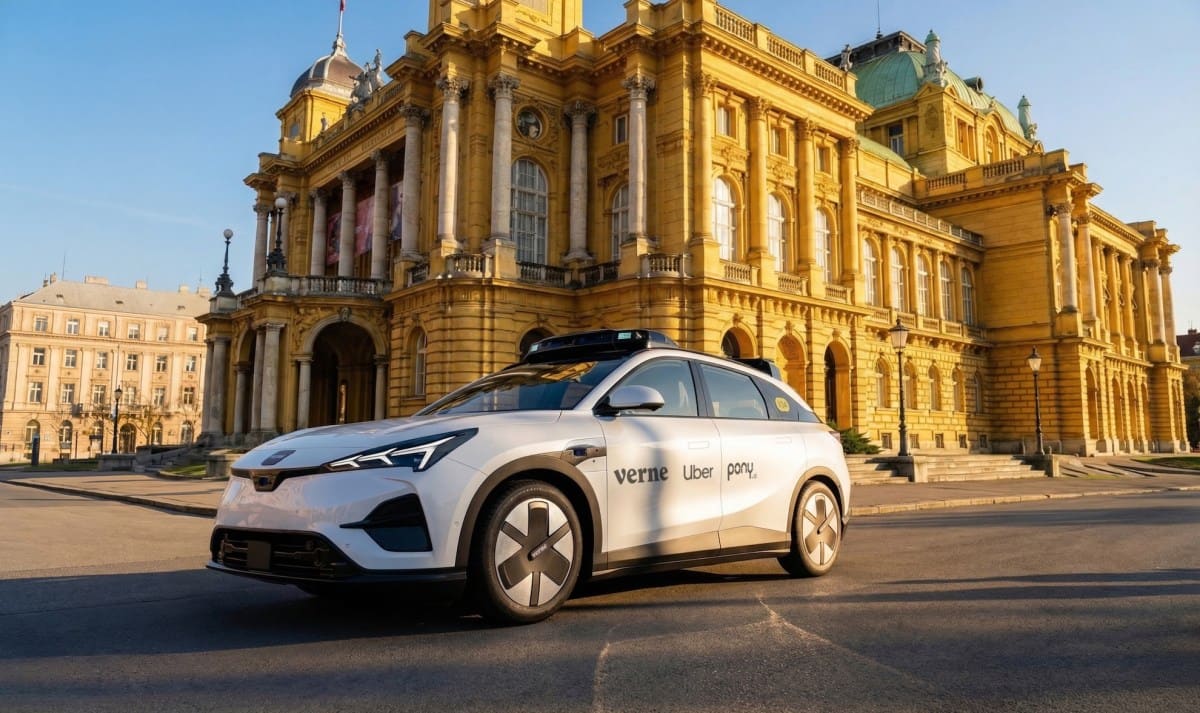
Pony.ai has already announced plans to launch in Zagreb, Croatia, in partnership with local company Verne, a signal that smaller markets with simpler regulatory paths may serve as initial beachheads. Croatia's transport ministry has shown willingness to fast-track pilot programs as part of broader smart-city initiatives. The other three cities in the expanded partnership remain unconfirmed, though industry observers point to potential launches in Germany, France, or the Nordic region, where public transit authorities have expressed interest in autonomous shuttles and taxis.
Uber's Aggregator Play
Uber has signed partnerships with more than 30 autonomous vehicle developers over the past several years, positioning itself as a platform layer rather than a technology owner. This strategy contrasts with vertical integration pursued by Waymo, which develops both software and operates its own fleet, and Cruise, which until recently maintained tight control over hardware, software, and operations.
For Uber, the robotaxi partnerships offer a hedge against the risk that autonomous vehicles erode its driver network. If self-driving technology matures and unit economics favor robotaxis over human-driven vehicles, Uber's platform can remain relevant by serving as the consumer-facing interface and demand router. The company earns a take rate on each ride and avoids the capital burden of owning and maintaining fleets.
Yet the aggregator model carries its own risks. Uber depends on AV partners to deliver reliable technology and scale production, neither of which is guaranteed. Pony.ai, for instance, operates commercially in four Chinese cities but has not disclosed utilization rates, safety metrics, or profitability. The company went public on the Nasdaq in late 2024 through a traditional IPO, raising approximately $260 million, but has faced questions about its ability to compete with better-capitalized rivals such as Baidu's Apollo Go, which operates thousands of vehicles in Wuhan and other cities.
Competitive Landscape in Europe
Pony.ai and Uber are not alone in targeting European markets. Waymo has explored partnerships with automotive OEMs including Stellantis and Renault, though no commercial launches have been announced. Mobileye, the Intel-backed perception and mapping company, has conducted pilots in Munich and Paris and is working with vehicle manufacturers to integrate its autonomous driving system into production cars. Local players such as Oxbotica in the UK and Navya in France have focused on low-speed shuttles and defined routes, positioning themselves as complementary rather than direct competitors to full-scale robotaxi services.
The competitive dynamic will likely depend on which companies can navigate the regulatory process most efficiently and demonstrate safety performance that satisfies both regulators and insurers. Europe's emphasis on data privacy, particularly under GDPR, adds another layer of complexity. Autonomous vehicles generate terabytes of sensor data, including images of pedestrians and license plates, and operators must ensure compliance with privacy rules while retaining enough data to improve algorithms and investigate incidents.
Timing and Execution Uncertainty
Neither Pony.ai nor Uber has committed to a deployment schedule or phasing plan, beyond stating that details will be revealed over time. This ambiguity reflects the difficulty of coordinating across multiple jurisdictions, each with its own permitting process, insurance requirements, and infrastructure readiness. Charging infrastructure for electric robotaxi fleets, for example, varies widely. Cities with robust public charging networks and depot space can support large fleets more easily than those where operators must build dedicated facilities.
The 2,000-vehicle target is ambitious relative to the current European market. As of mid-2026, no operator has deployed more than a few dozen autonomous vehicles commercially in any single European city. Scaling to hundreds, let alone thousands, will require not only regulatory approval but also public acceptance, reliable technology in diverse weather and traffic conditions, and sustainable unit economics.
Pony.ai's experience in China, where it has operated in rain, fog, and dense urban traffic, may accelerate the learning curve. However, European road layouts, driver behavior, and pedestrian patterns differ from those in Chinese cities, and localization of the autonomous driving stack will be necessary. The company has established an engineering presence in Europe to support this work, but the timeline for achieving commercial readiness in each market remains uncertain.
What Comes Next
The partnership's success will hinge on execution across technology, regulation, and operations. If Pony.ai and Uber can demonstrate safe, reliable service in initial markets and secure the necessary permits for expansion, the 2,000-vehicle target becomes plausible over a multi-year horizon. If early deployments encounter safety incidents, regulatory delays, or poor customer reception, the rollout will stall.
For now, the announcement signals intent and clarifies roles, but the hard work of proving the model in Europe's complex environment lies ahead. The robotaxi industry's trajectory in the region will depend as much on political will and public trust as on technical capability, and both companies are betting that a distributed, partnership-driven approach can navigate that terrain more effectively than a go-it-alone strategy.