OpenAI's Custom Silicon Targets Inference Bottlenecks With Aggressive Timeline
First benchmarks show Jalapeño outpacing Nvidia Blackwell on throughput and latency, but commercial deployment won't arrive until late 2026 - raising questions about how long the lead will last.
A Bet on Vertical Integration
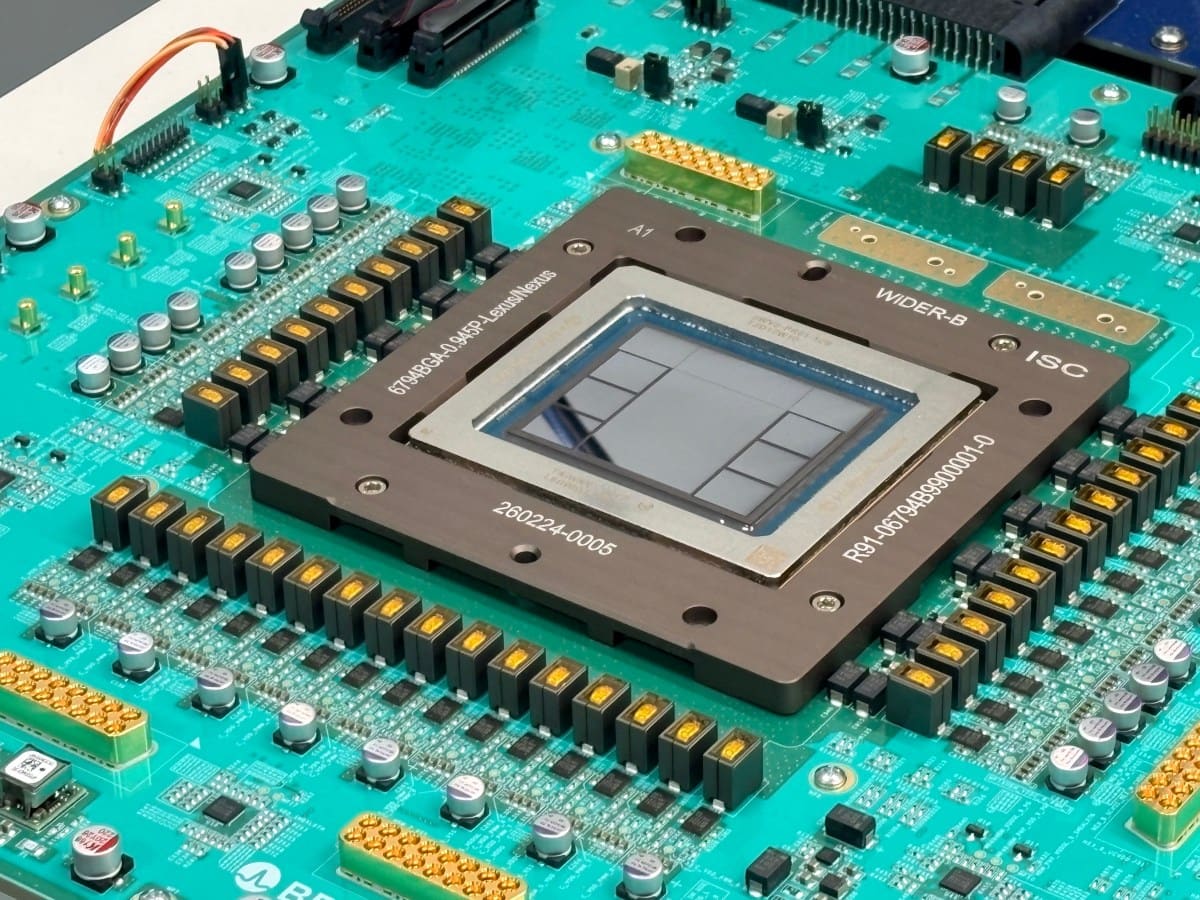
OpenAI unveiled performance data for its first custom inference accelerator this week, revealing a design philosophy that prioritizes end-to-end control over raw compute power. Speaking at the Hot Chips symposium, Richard Ho, the company's head of hardware, presented benchmark results positioning Jalapeño ahead of current inference systems on two critical dimensions: tokens served per user and throughput per kilowatt.
The chip, developed in partnership with Broadcom and announced last October, represents OpenAI's move toward vertical integration. The company used its own models during the design process, a feedback loop that allowed engineers to optimize for the specific bottlenecks they encounter when serving production workloads at scale. According to OpenAI, Jalapeño delivers higher efficiency per unit of power while reducing response latency, a combination designed to support both high-volume concurrent users and low-latency applications.
But the timeline carries risk. Ho acknowledged that initial deployment will arrive in "very small volumes" by the end of 2026, with broader rollout planned for 2027. By then, competitors including Nvidia will have shipped next-generation architectures, potentially eroding Jalapeño's current lead.
Addressing Prefill and Communication Overhead
At DailyTechWire, we've tracked inference optimization as a defining challenge for large language model deployment. While training remains capital-intensive, inference represents the operational cost that scales with user adoption. The economics hinge on two factors: how many tokens a system can generate per watt, and how quickly it can return the first token to a waiting user.
Jalapeño's architecture targets the phases where delays typically accumulate. During prefill, the system processes the user's input prompt and populates the key-value cache that stores context for the response. During generation, the model produces output tokens sequentially. Between these stages, data must move across memory hierarchies and network links, and coordination overhead can stall computation.
OpenAI's approach minimizes this friction by keeping model state, including the KV cache, local to the compute resources handling each phase. The system dynamically activates the appropriate combination of processing units, memory, and interconnect bandwidth depending on whether it's in prefill or generation mode. This explicit placement strategy reduces unnecessary data movement, a common source of latency in distributed inference clusters.
The design reflects a broader shift in AI hardware: moving from general-purpose accelerators toward application-specific architectures that co-design silicon, memory hierarchy, and system software. OpenAI has signaled that Jalapeño will evolve into a multi-generation platform, with future iterations developed alongside new models and memory technologies.
Benchmarks Against Blackwell
The performance claims rest on results from SemiAnalysis' InferenceX benchmark suite, which measures real-world serving scenarios rather than peak theoretical throughput. Jalapeño outperformed an Nvidia Blackwell configuration on both token throughput and energy efficiency. Ho described the margin as "very, very significant," though OpenAI has not published detailed numbers or methodology.
The comparison is instructive but incomplete. Blackwell represents Nvidia's current high-end inference platform, but the company typically ships new architectures on an annual cadence. By late 2027, when Jalapeño reaches volume production, Nvidia will likely have introduced at least one successor. The same applies to other inference-focused silicon efforts from Google, Amazon, and a growing cohort of startups targeting the inference workload.
This creates a narrow window for OpenAI to capture value from its custom chip investment. If Jalapeño's advantage persists into 2027, the company will reduce its dependence on external suppliers and improve margin on inference-heavy workloads. If competitors close the gap, OpenAI will have spent significant capital on a chip that offers only incremental gains over merchant silicon.
The Broadcom Partnership and Full-Stack Control
OpenAI's collaboration with Broadcom follows a pattern established by other hyperscalers that have pursued custom silicon. Broadcom provides design services, IP blocks, and manufacturing coordination, allowing customers to focus on architecture and workload optimization without building a full chip design team. Google used a similar model for its TPU line; Amazon followed suit with Trainium and Inferentia.
The partnership also reflects OpenAI's position in the AI stack. Unlike cloud providers that serve diverse workloads, OpenAI optimizes primarily for its own models and API traffic patterns. This narrow focus enables more aggressive architectural choices. Engineers can hardcode assumptions about model structure, batch sizes, and request distributions that would be risky for a general-purpose chip.
The trade-off is flexibility. If OpenAI's model architecture shifts significantly, or if the company needs to serve third-party models with different characteristics, Jalapeño's specialized design may become a liability. The multi-generation platform strategy suggests OpenAI expects its core architecture to remain stable, at least through the next several product cycles.
Deployment Economics and Competitive Pressure
The business case for Jalapeño hinges on whether the efficiency gains justify the development cost and opportunity cost of delayed deployment. Custom silicon programs typically require hundreds of millions of dollars in non-recurring engineering expenses, mask costs, and validation. OpenAI must amortize that investment across enough deployed chips to achieve a lower total cost of ownership than buying Nvidia or AMD accelerators off the shelf.
Volume deployment in 2027 aligns with OpenAI's expected capacity expansion, but it also exposes the company to execution risk. Chip bring-up is notoriously difficult; even experienced teams encounter yield issues, firmware bugs, and integration challenges that delay production. A six-month slip would push Jalapeño into 2028, by which point the competitive benchmark will have moved significantly.
Meanwhile, inference optimization is becoming a crowded field. Cerebras, Groq, and SambaNova have all shipped inference-focused architectures with different trade-offs. Nvidia continues to refine its software stack, extracting more performance from existing hardware through better scheduling and memory management. And model-level techniques such as speculative decoding and continuous batching are reducing the importance of raw chip speed.
For OpenAI, Jalapeño represents a hedge. If the chip delivers as promised, the company gains cost and performance leverage at a time when inference workloads are growing faster than training. If it underperforms or arrives late, OpenAI can fall back on merchant silicon while iterating on the next generation. Either way, the move signals that the company views hardware control as strategic, not just operational - a recognition that in AI infrastructure, the full stack increasingly determines competitive advantage.