Open-Source Camera Control Arrives for DJI Osmo Pocket Users
A reverse-engineered app offers photographers an alternative to DJI's official software, prioritizing local control over cloud connectivity.
The Friction Point in Pocket Cameras
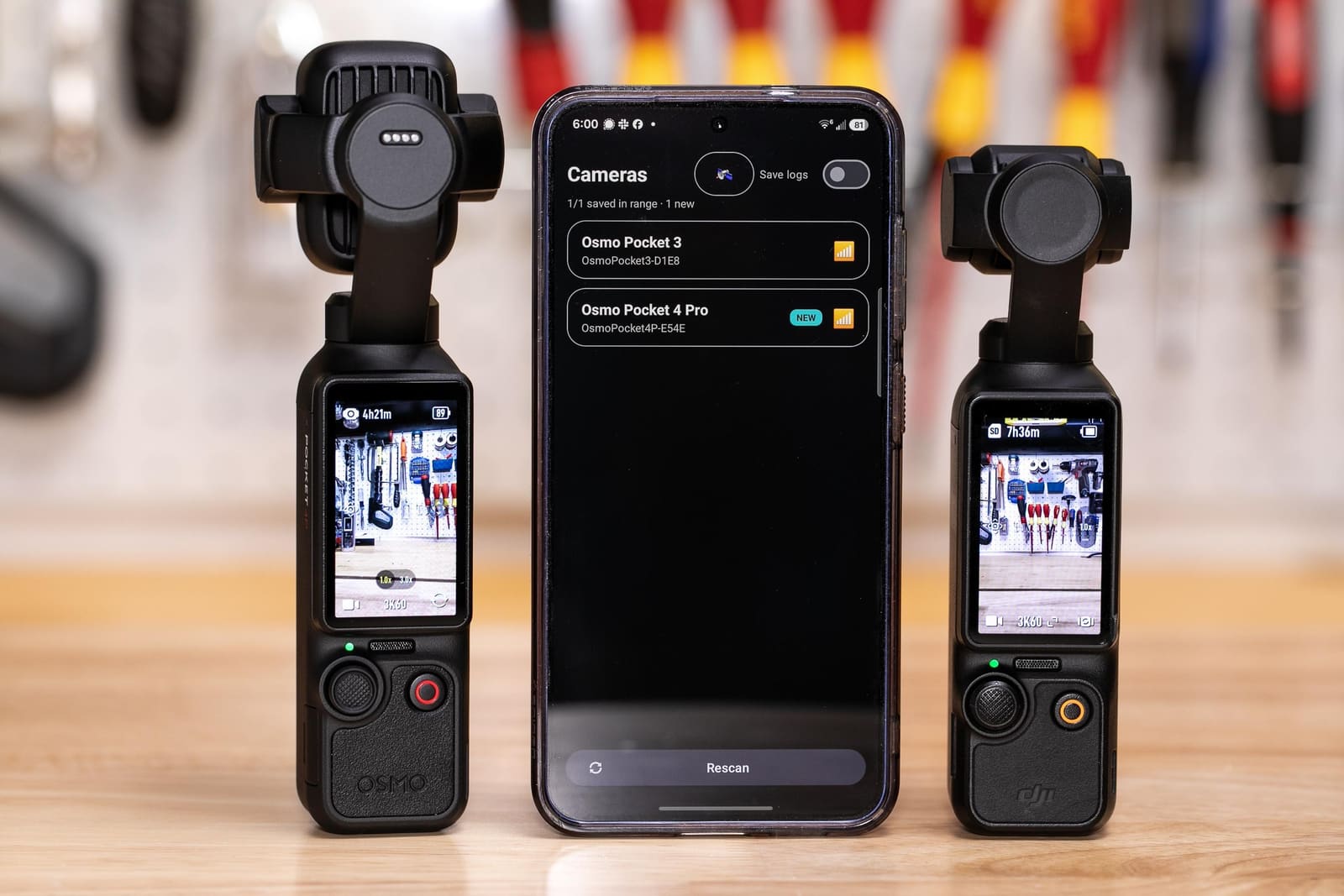
DJI's Osmo Pocket line represents one of the better hardware executions in gimbal-stabilized cameras: compact form factor, solid image quality, reliable mechanical stabilization. Yet the software story has consistently lagged behind. Users who want to preview footage, manage files, or wirelessly transfer video from their Pocket 3 or Pocket 4 Pro have been locked into DJI's official companion app, a piece of software that bundles cloud connectivity, telemetry transmission, and feature bloat into what should be a straightforward file-management task.
For photographers working in bandwidth-constrained environments, or those simply skeptical of sending camera metadata to manufacturer servers, this has been an ongoing pain point. The app's closed-source nature meant no visibility into what data traveled where, and no ability to strip out unwanted features.
Reverse Engineering as a Path Forward
Konrad Iturbe, a developer who has tracked DJI's ecosystem for years, took a different approach. Rather than wait for DJI to offer a lightweight alternative, he reverse-engineered the communication protocol the Osmo cameras use to talk to their official app. The result is Osmosis, a free and open-source application that replicates core camera-control functions without the cloud dependencies or closed codebase.
The technical work involved capturing and analyzing the data packets exchanged between camera and app, then rebuilding that handshake logic in a clean implementation. Iturbe acknowledged assistance from Claude, an AI coding assistant, in accelerating parts of the development process. The resulting app handles wireless file downloads, thumbnail generation, low-resolution preview streaming, clip trimming, and basic file filtering, all without requiring internet connectivity or manufacturer account sign-in.
What Local Control Actually Enables
Osmosis strips the camera interaction down to its essential functions. Users can browse footage via thumbnails, stream previews at reduced resolution to conserve bandwidth, mark favorites, and filter by media type. The trimming feature allows rough cuts directly on the device before transferring files, a workflow optimization that matters when working with multi-gigabyte 4K or 6K clips over Wi-Fi.
More importantly, the open-source license means the code is auditable. Any developer can inspect what data the app requests, where it sends information, and how it handles local storage. For professional users operating under data-residency requirements or journalists working in sensitive contexts, this transparency carries weight.
The app currently supports the Osmo Pocket 3 and Pocket 4 Pro, the two most recent models in DJI's handheld gimbal camera lineup. Older devices in the Osmo family use different communication protocols and are not yet compatible, though the open codebase theoretically allows community contributors to extend support.
The Broader Pattern in Camera Software
DJI is hardly alone in tying capable hardware to frustrating software. Canon's Camera Connect, Sony's Imaging Edge Mobile, and Nikon's SnapBridge have all drawn criticism for sluggish performance, unreliable wireless transfers, and feature sets that prioritize social-media integration over professional workflows. The camera industry has treated companion apps as afterthoughts, often outsourcing development or treating them as low-priority SKUs within larger product organizations.
What makes the DJI case notable is the company's dual role as both drone manufacturer and camera maker. Its flight-control apps carry regulatory and safety obligations that justify more complex software architectures. Those patterns then migrate to simpler products like the Osmo Pocket, where the same cloud infrastructure and telemetry frameworks appear despite less obvious need.
At DailyTechWire, we've watched this tension play out across hardware categories. Fitness wearables, smart home devices, and even some professional audio gear now ship with apps that assume constant connectivity and centralized data storage, even when the core functionality could operate entirely offline. The emergence of reverse-engineered alternatives signals user demand for local-first architectures, particularly in tools used for creative work.
Risks and Realities of Third-Party Protocols
Using an unofficial app introduces its own trade-offs. DJI could, in theory, alter the communication protocol in a firmware update, breaking compatibility with Osmosis until Iturbe or other contributors catch up. The company has no obligation to maintain backward compatibility with reverse-engineered clients, and protocol changes tied to security patches or new features could be frequent.
There is also the question of warranty and support. While simply using a third-party app is unlikely to void hardware warranties in most jurisdictions, it does place users outside the official support channel. If file corruption or transfer errors occur, DJI's support teams will reasonably point users back to the official app before troubleshooting further.
Still, the open-source model offers its own form of resilience. If Iturbe steps away from the project, the codebase remains available for others to fork and maintain. This distributed maintenance model has kept older camera utilities alive long after their original developers moved on, and it aligns well with the needs of professional users who require stable, predictable tooling over years-long production cycles.
What DJI Could Learn
The existence of Osmosis is both a critique and a roadmap. It demonstrates that the core functions users need, wireless file transfer, thumbnail previews, basic editing, can be delivered in a lean package without cloud dependencies. If a single developer working with AI assistance can build this in spare time, a company with DJI's resources could certainly ship an official lightweight alternative alongside its full-featured app.
Some hardware companies have already moved in this direction. Blackmagic Design offers both its full DaVinci Resolve ecosystem and simpler utilities for camera control. GoPro provides Quik for casual users and separate tools for professional workflows. A tiered app strategy acknowledges that different users have different needs, and that forcing everyone through the same cloud-connected funnel creates unnecessary friction.
For now, Osmosis exists in the space that DJI has left open. It will appeal most to users who already understand the trade-offs of third-party software and who value local control over feature breadth. Whether it remains a niche tool or grows into a broader movement depends partly on how DJI responds, and partly on whether other developers pick up the reverse-engineering model for additional camera platforms.
The technical barriers to building these alternatives are falling. AI-assisted coding, better protocol analysis tools, and active open-source communities all lower the effort required to challenge closed ecosystems. Camera manufacturers who continue treating software as a lock-in mechanism may find their users building exit routes faster than expected.