New Jersey's Lidar Mandate Draws a Line Between Tesla and the AV Industry
A proposed state law requiring overlapping sensors for robotaxis would effectively block camera-only systems from commercial deployment, crystallizing a technical debate that has divided the autonomous vehicle sector for years.
A Technical Debate Moves to the Statehouse
For over a decade, autonomous vehicle developers have split into two camps over sensor architecture. One side argues that machine vision trained on camera feeds can replicate human perception. The other insists that safe navigation demands multiple, redundant sensing modalities: lidar for precise depth mapping, radar for velocity tracking through adverse weather, and cameras for semantic understanding. Tesla has staked its entire self-driving roadmap on the first approach. Waymo, Cruise, Zoox, and nearly every other serious AV operator have chosen the second.
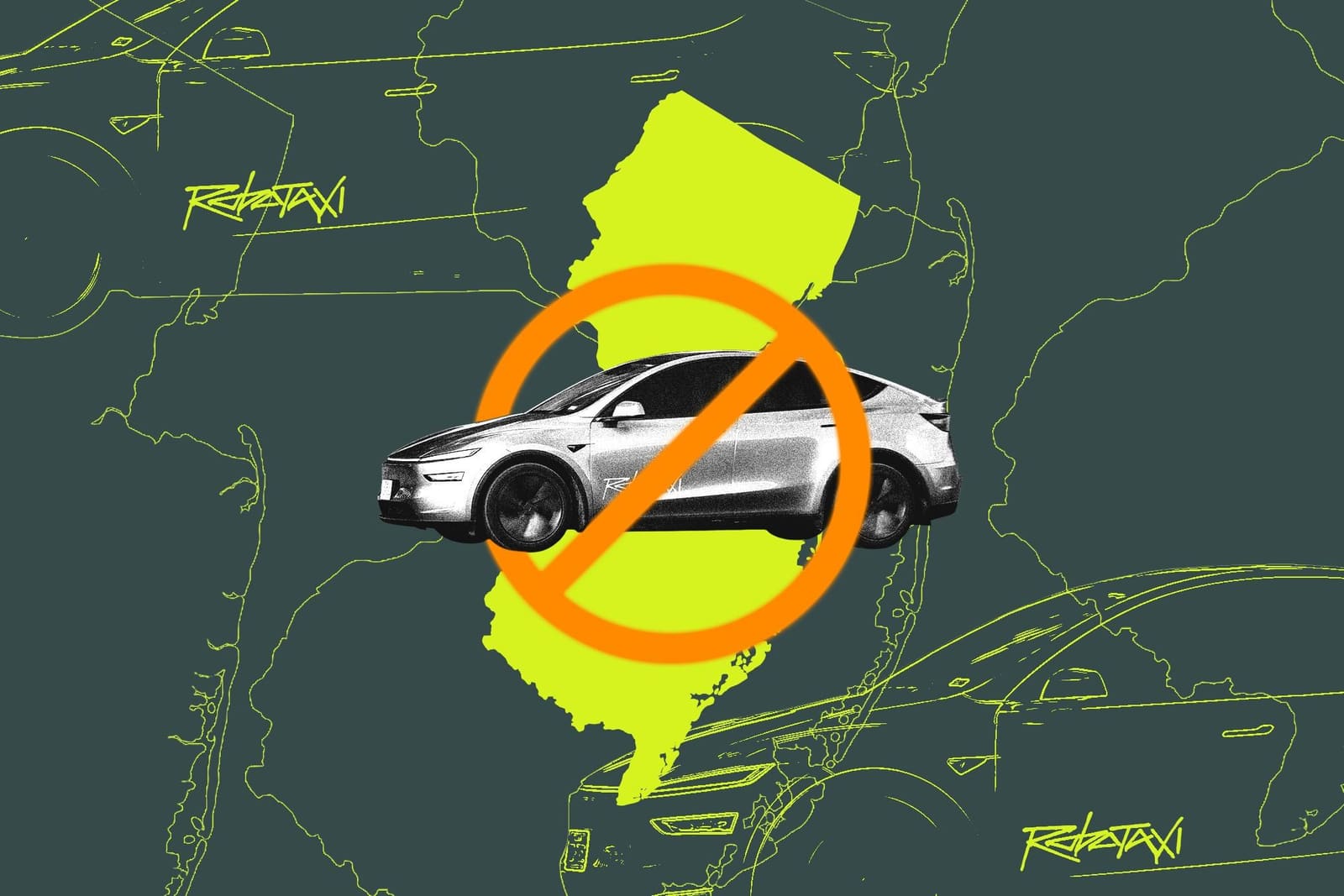
Now New Jersey legislators are preparing to encode that technical disagreement into state law. A bill expected to reach a vote before year-end would require any commercial robotaxi operating on state roads to deploy overlapping sensor suites that include both lidar and radar. The language effectively bars camera-only systems from obtaining permits, regardless of how sophisticated their neural networks become.
The proposal represents a sharp departure from the regulatory posture most U.S. states have adopted toward autonomous vehicles. To date, policymakers have largely deferred to federal safety frameworks and voluntary industry guidelines, allowing companies to self-certify their technology and report disengagements. California, Arizona, and Nevada, the three states that host the bulk of American AV testing, impose data disclosure requirements but stop short of dictating sensor configurations. New Jersey's bill would make it the first state to legislate the hardware stack itself.
The Case for Sensor Redundancy
Proponents of multi-modal sensing argue that no single technology is infallible. Cameras struggle in low light, glare, and heavy precipitation. Lidar, which uses laser pulses to generate three-dimensional point clouds, delivers centimeter-level accuracy in measuring distance to objects but can be confused by fog or airborne dust. Radar penetrates weather but offers lower spatial resolution. By fusing data streams from all three, an AV can cross-check its interpretation of the environment and maintain situational awareness even when one sensor degrades.
This redundancy philosophy has become standard practice among the companies closest to commercializing driverless ride-hail services. Waymo's fifth-generation hardware suite, deployed across its Phoenix and San Francisco fleets, integrates 29 cameras, five lidar units, and six radar modules. Cruise's Origin vehicle, designed without a steering wheel or pedals, similarly layers multiple sensor types across every angle of approach. Both firms cite overlapping perception as a cornerstone of their safety cases submitted to regulators.
Academic research supports the redundancy argument. A 2024 study from MIT's Computer Science and Artificial Intelligence Laboratory found that lidar-equipped systems detected pedestrians in low-visibility scenarios 34 percent more reliably than vision-only architectures, even when the camera models were trained on datasets three times larger. Another paper from Carnegie Mellon's Robotics Institute documented how radar provided critical velocity estimates during a highway merge event where camera-based object tracking momentarily failed due to lens flare.
Tesla's Vision-Only Bet
Tesla has moved in the opposite direction. In 2021, the automaker began removing radar from its Model 3 and Model Y vehicles, a decision it later extended to the Model S and Model X. The company's Full Self-Driving software now relies exclusively on eight cameras feeding data into neural networks trained on billions of miles of real-world driving. CEO Elon Musk has repeatedly dismissed lidar as unnecessary and expensive, arguing that if humans can drive with two eyes, a machine equipped with multiple cameras and superior reaction times should perform even better.
The technical rationale hinges on the belief that vision, processed through sufficiently advanced AI, captures all the semantic information needed for navigation: lane markings, traffic signals, the posture of pedestrians, the intent signaled by another vehicle's trajectory. Tesla's approach also carries a significant cost advantage. A single automotive-grade lidar unit can run several thousand dollars, while the cameras and compute hardware in a Tesla add a few hundred dollars to the bill of materials. For a company aiming to produce millions of vehicles, that gap matters.
Yet Tesla's safety record under Full Self-Driving has drawn scrutiny. The National Highway Traffic Safety Administration has opened multiple investigations into crashes involving the software, including incidents where Teslas struck stationary emergency vehicles or failed to recognize cross-traffic. The company does not publish disaggregation data that would allow independent verification of how often human drivers must intervene. Critics argue that Tesla is effectively conducting a public beta test at scale, outsourcing the validation work that other AV developers perform in controlled environments before deployment.
Regional Implications and the Patchwork Risk
If New Jersey's bill passes, it would create an immediate problem for any automaker planning to offer a commercial robotaxi service using camera-only systems. Tesla has stated its intention to launch a ride-hail network once its Full Self-Driving software reaches a reliability threshold the company deems acceptable. A state-level sensor mandate would lock Tesla out of New Jersey's market unless the company redesigns its hardware stack, a costly and time-consuming pivot that contradicts years of public messaging.
The legislation also raises the prospect of a fragmented regulatory landscape. If other states follow New Jersey's lead, AV developers could face a patchwork of incompatible hardware requirements. A vehicle certified for deployment in Pennsylvania might be barred from crossing the Delaware River. That scenario would undermine the economic logic of autonomous fleets, which depend on utilization across wide geographies to justify capital expenditure.
Industry groups have signaled concern. The Autonomous Vehicle Industry Association, a trade body whose members include Waymo, Aurora, and Motional, has not taken a formal position on the New Jersey bill but has emphasized in past statements that prescriptive hardware mandates risk stifling innovation. The argument is that regulatory focus should remain on outcomes, such as crash rates and disengagement frequency, rather than the specific technologies used to achieve those outcomes.
The Broader Debate on Technology-Neutral Regulation
At DailyTechWire, we've tracked similar tensions in other domains where rapid technical change outpaces the policy cycle. Export controls on semiconductor manufacturing equipment, for instance, have struggled to define "advanced" in a way that remains relevant as lithography nodes shrink and chiplet architectures proliferate. Data-localization rules in Southeast Asia often specify storage infrastructure in terms that inadvertently favor legacy systems over cloud-native designs.
New Jersey's proposed sensor mandate reflects a parallel challenge: how to write durable safety standards when the underlying technology is still evolving. Lidar costs have fallen dramatically over the past five years, from more than ten thousand dollars per unit to under a thousand in some solid-state designs. Camera resolution and low-light performance have improved in tandem. Neural network architectures for vision processing have grown more sample-efficient, narrowing the performance gap that once seemed insurmountable.
Legislating a specific sensor configuration today risks locking in assumptions that may not hold in three years. If camera-only systems eventually demonstrate crash rates lower than human drivers, or if a new sensing modality emerges that renders both lidar and cameras obsolete, a hardware mandate becomes an obstacle rather than a safeguard. Conversely, if overlapping sensors prove essential to safe operation at scale, allowing vision-only systems onto public roads as commercial services could expose passengers and other road users to avoidable risk.
What Comes Next
The New Jersey bill has cleared committee and awaits a floor vote in the state legislature. Passage would trigger a ninety-day implementation period, after which the Department of Transportation would begin enforcing the sensor requirements for any new robotaxi permit applications. Existing pilot programs would be grandfathered under current rules, but expansion beyond their initial service areas would require compliance with the new standard.
Tesla has not issued a public statement on the legislation. The company dissolved its public relations department in 2020 and typically communicates policy positions, when it does so at all, through executive remarks or regulatory filings. Whether Tesla would challenge the law in court, seek a legislative carve-out, or simply write off New Jersey as a market remains unclear.
For the broader AV industry, the bill is a test case. If a single state can impose hardware mandates that effectively exclude a major automaker, other jurisdictions may feel emboldened to do the same. That could accelerate a shift toward federal preemption, with Congress or the Department of Transportation stepping in to establish uniform standards that override state-level variation. It could also deepen the rift between Tesla and the rest of the sector, formalizing in regulation what has already become a philosophical divide over how machines should perceive the world.