Milan's Bending Spoons Opens at $18 Billion, Proves Aging Brands Can Scale With AI
The Italian acquirer of Evernote, Vimeo, and Meetup went public today on Nasdaq, with revenue per employee jumping from $1.12M to $2.57M in two years as AI unlocked rapid feature velocity.
A Private Equity Playbook, Built for Permanence
Bending Spoons opened trading on the Nasdaq this morning at an $18 billion valuation and closed the session up 40 percent, making it one of the largest European tech listings of the decade. The Milan-headquartered firm has spent thirteen years assembling a portfolio that reads like a time capsule of early web culture: Meetup, Eventbrite, Vimeo, WeTransfer, and most visibly, Evernote. The strategy borrows from private equity, acquiring companies below intrinsic value, restructuring operations, and extracting margin. But Bending Spoons does not flip. It holds, applies technology, and runs each property as a permanent asset.
Co-founder and chief product officer Matteo Danieli frames the model as operator-first. The company identifies brands with strong recognition but weak execution, then overlays data infrastructure, pricing optimization, and now, AI-driven product velocity. In the eighteen months leading up to the IPO, revenue per full-time employee surged from $1.12 million in 2023 to $2.57 million in 2025, a jump the company attributes in large part to accelerated feature delivery powered by machine learning tooling.
That trajectory matters. Public markets have soured on aging SaaS businesses, but Bending Spoons positioned itself as an AI story before the current wave. Its F-1 filing includes a section titled "AI before it was cool," pointing back to Evertale, a failed diary app the founding team built more than a decade ago. Evertale used what the team then called machine learning to auto-generate life logs. The product didn't survive, but the lesson did: zero-to-one success is volatile, shaped by timing and circumstance. Operational excellence, by contrast, can be engineered.
Engineering Out Luck
Danieli and his co-founders, Luca Ferrari, Francesco Patarnello, and Luca Querella, drew a sharp conclusion from their early failure. Talent and effort do not guarantee outcomes when product-market fit is the goal. Luck dominates that phase. So the team designed a company optimized for the second phase, where execution and compounding improvements matter more than the initial spark. The F-1 filing states this plainly: "Luck plays a big role in finding product-market fit," but "luck is irrelevant when pursuing operational excellence."
That philosophy shows up in how Bending Spoons prices its products. The company runs continuous experimentation on feature gating, subscription tiers, and paywalls, using what Danieli describes as a sophisticated analytics and testing stack. Sometimes that means releasing more functionality for free to drive word-of-mouth acquisition. Other times it means raising prices on legacy subscribers, a move that has generated public backlash. Danieli insists retention has remained stable, though the company does not break out churn by product in its public disclosures.
Evernote became the highest-profile test of this approach. The note-taking app had a devoted user base and a reputation for drift. Bending Spoons acquired it, laid off a significant portion of the team, and shipped version eleven with a heavy AI feature set. The release drew criticism initially, but Danieli points to positive feedback from long-time users, including Evernote co-founder Phil Libin, as validation. The company views Evernote as the acquisition it is most proud of, precisely because the brand had such vocal and exacting users.
Talent Density as Competitive Moat
Ferrari, one of the co-founders, spent the company's first two to three years building hiring and culture processes. The belief: spotting talent early, before conventional credentials accumulate, creates asymmetric advantage. Bending Spoons hires young, invests in onboarding, and measures output per person rather than headcount growth. The $2.57 million revenue-per-employee figure in 2025 reflects that focus, though it also reflects the layoffs that followed most acquisitions.
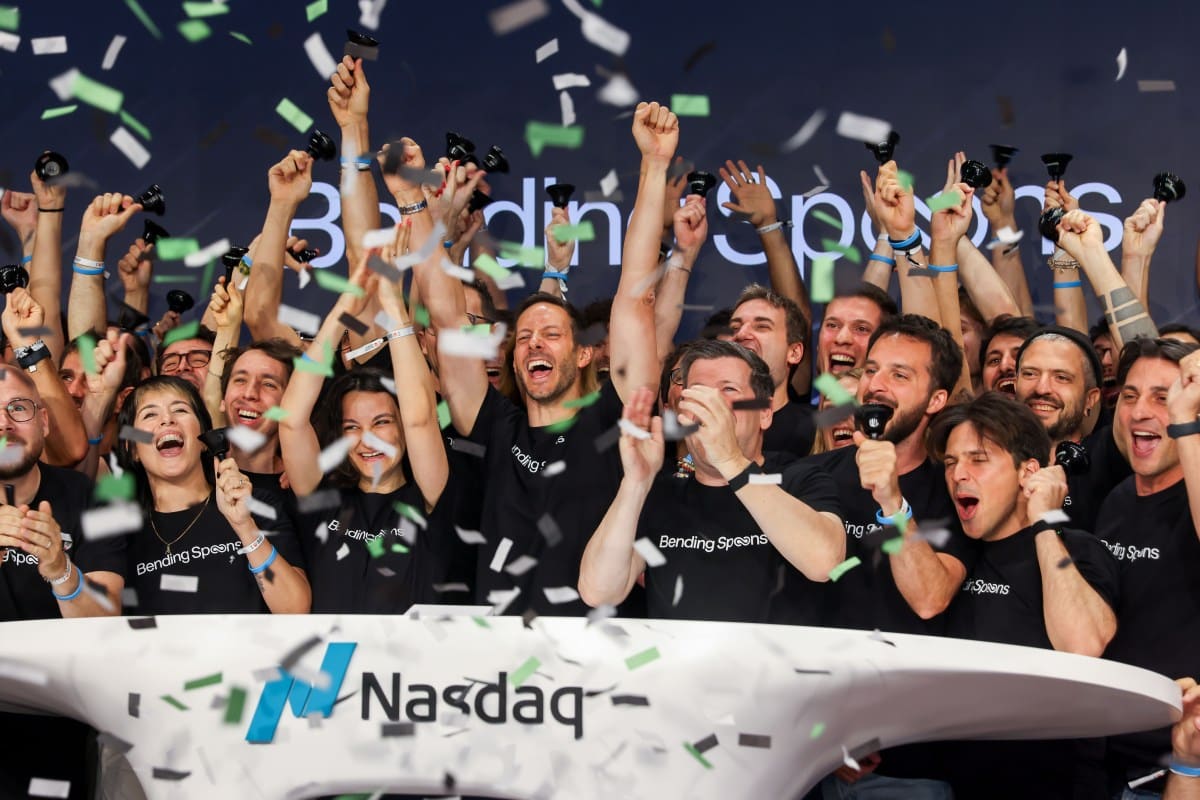
The company's approach to talent extends to how it celebrated the IPO. Bending Spoons flew its entire team to New York for the listing, an unusual decision for a firm that typically operates with financial discipline. Danieli frames the event as both a capital access milestone and a moment to acknowledge the people who built the platform. The listing itself is a tool, he says, to fund more acquisitions at a time when SaaS valuations have compressed sharply. Bending Spoons raised capital at an $11 billion private valuation before going public, with backing from venture firms and individual investors spanning tech and entertainment.
Early venture conversations were less smooth. Danieli recalls hearing "you're crazy" repeatedly in the company's first years. Investors struggled to map the strategy onto familiar categories. It was not pure software, not traditional private equity, and not a roll-up in the conventional sense. The company adopted "Impossible. Maybe." as a tagline, a nod to the skepticism it faced.
AI Velocity and the Next Wave of Acquisitions
In its filing, Bending Spoons credits AI with driving a step-change in feature development speed. The company does not disclose which models or tooling it uses internally, but Danieli describes the past eighteen months as a period of "incredible acceleration" in shipping new capabilities and creating user value. That narrative aligns with investor appetite. Public markets have shown limited interest in legacy SaaS businesses, but AI-augmented productivity stories have drawn capital.
At DailyTechWire, we've tracked how acquirers with strong engineering cultures have used AI to unlock margin in mature products, particularly in consumer subscription businesses where feature velocity had stalled. Bending Spoons fits that pattern. Its portfolio consists largely of products that reached scale years ago but struggled to maintain growth. Layering modern tooling and experimentation infrastructure on top of those assets creates a second lifecycle, especially when the brand still carries recognition.
The company now turns its attention back to acquisitions. Danieli sees current SaaS valuations as an opportunity, particularly for businesses with strong brand equity but weak unit economics. Bending Spoons has capital, a repeatable playbook, and a public currency. The IPO provides liquidity to continue buying, and the market has validated the model, at least on day one.
What the Model Reveals About Software Longevity
Bending Spoons offers a lens into a question that has hung over the software industry for years: what happens to products that win early but lose momentum? The traditional answer has been acquihire, shutdown, or slow decline. Bending Spoons proposes a third path: operational transformation under permanent ownership. The company bets that brand value persists longer than product execution, and that a disciplined operator can extract decades of cash flow from assets that their original teams could not sustain.
That thesis depends on a few assumptions. First, that users care more about brand and habit than about the specific team behind a product. Second, that pricing power remains intact even as the product changes hands. Third, that AI and data infrastructure can substitute for the institutional knowledge lost in post-acquisition layoffs. Bending Spoons has so far validated those assumptions at scale, but the public market test is just beginning.
The company's growth will now be measured quarterly, and its acquisition strategy will face scrutiny each time it cuts headcount or raises prices. The model works if revenue per employee continues climbing and if users stay despite the changes. If retention cracks or if the portfolio stops growing, the narrative shifts quickly. For now, the market has given Bending Spoons the capital and the mandate to keep building. The next phase will show whether operational excellence can truly engineer out luck, or whether holding aging internet brands carries risks that only reveal themselves over time.