Memory Squeeze Hits Student Laptops as Schools Reopen
A global RAM and storage shortage is pushing prices higher, but savvy buyers can still find machines that will last through graduation and beyond.
The Supply Picture
The back-to-school laptop market is colliding with an uncomfortable reality: memory and storage supplies remain constrained, and manufacturing allocations are locked through 2027. Prices have climbed unevenly, with some models seeing modest bumps and others jumping sharply. For families shopping on tight budgets, this creates a difficult trade-off between immediate affordability and multi-year usability.
At DailyTechWire, we've tracked component shortages across Asia's manufacturing hubs for two years, and the current RAM crunch stands out for its duration. Unlike previous supply squeezes that resolved within quarters, DRAM and NAND production capacity is now spoken for years in advance. That makes today's purchase decisions more consequential than usual.
The practical result: a laptop that feels sluggish on day one will only degrade from there, and upgrading memory or storage after purchase is often impossible on modern machines. The calculus has shifted toward buying more headroom upfront, even if that means stretching the initial budget.
Threshold Configurations
Functional Windows laptops now start around $500, with genuinely capable machines clustering near $700. But spending closer to $1,000 or more delivers a meaningful jump in longevity, particularly for students entering four-year programs. Several Verge staff members continue using MacBook Airs from 2020, a testament to how well-specced machines from that generation have aged.
The baseline recommendation for Windows systems is 16GB of memory and 512GB of storage, paired with Intel 13th-generation Raptor Lake processors or AMD Ryzen 7000-series chips from 2022 onward. Anything older risks compatibility gaps as software demands grow. Apple's silicon chips, by contrast, manage 8GB more gracefully on macOS, though 16GB remains the better long-term bet.
Qualcomm's Snapdragon X processors offer strong performance and excellent battery life, but Windows on Arm still carries software compatibility caveats. Students in engineering, architecture, or creative programs that rely on specialized tools should verify compatibility before committing.
Apple's Budget Play
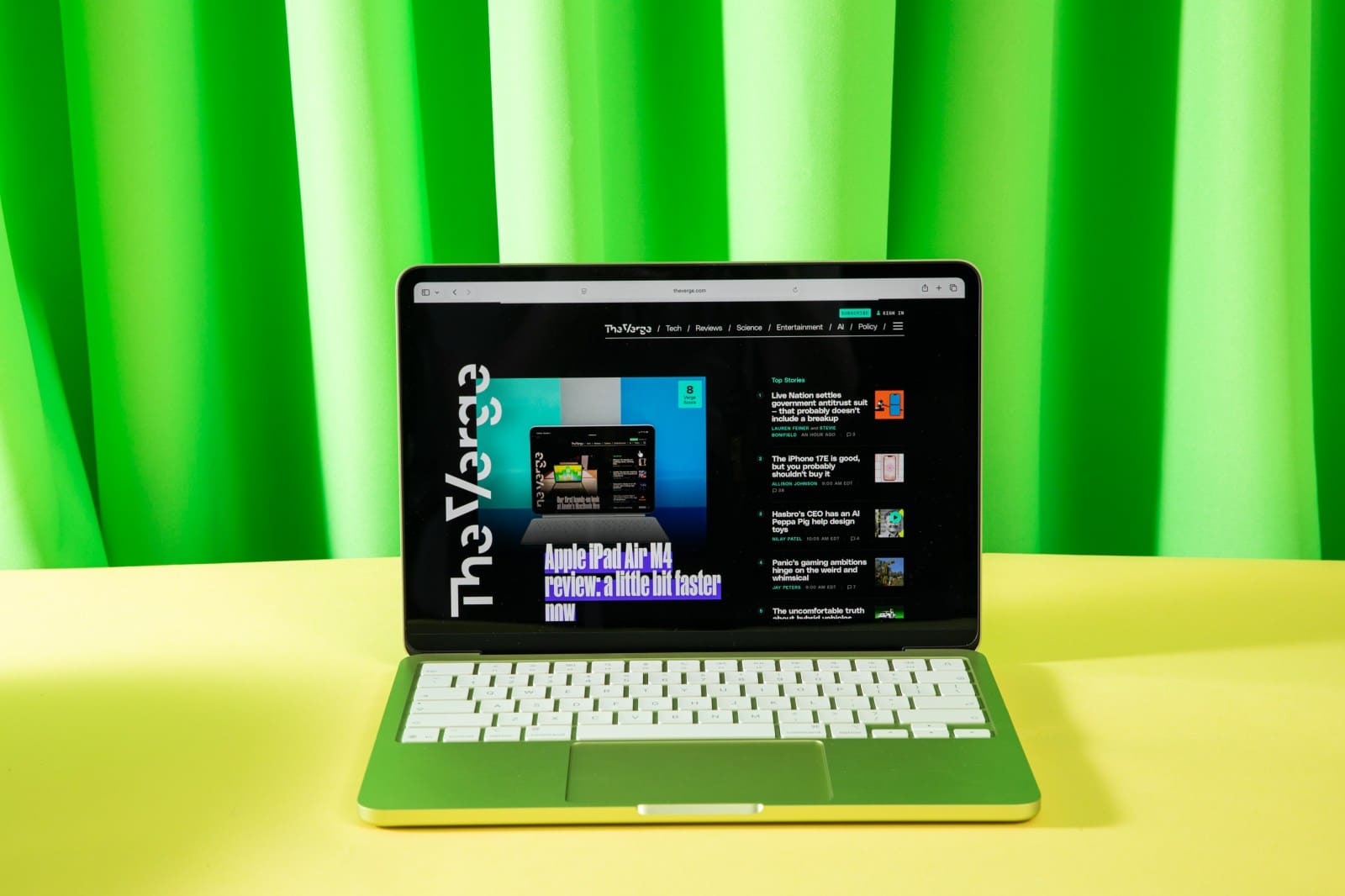
Apple introduced the MacBook Neo at $699, targeting middle and high school students with an A18 Pro chip, 8GB of memory, and 256GB of storage. The education discount drops that to $599. For another $100, buyers can step up to 512GB and add a Touch ID sensor, which streamlines password entry and authentication.
The Neo's appeal rests on its build quality and ecosystem integration. Its trackpad, speakers, and display all exceed what Windows laptops deliver at similar price points. The A18 Pro handles typical student workloads without strain, though the 8GB memory ceiling means power users will eventually bump against limits.
The main compromise is port selection. Two USB-C connections may require a hub for students juggling external drives, displays, and peripherals. And the base model ships with a 20W charger, slower than what higher-end MacBooks include.
The Premium Standard
The MacBook Air with M5 chips starts at $1,299 for the 13-inch model and $1,499 for the 15-inch. Both now include 16GB of memory and 512GB of storage as standard, a configuration bump from prior generations that also raised the entry price. Students qualify for a $100 discount.
The M5 Air is a step up in every dimension: faster processor, double the RAM, and significantly quicker storage than the Neo. Battery life stretches through full days of classes and study sessions. The aluminum chassis is rigid, the keyboard is comfortable over long typing sessions, and the display is sharp without feeling oversaturated.
Apple's refurbished store and third-party retailers occasionally discount older M3 and M4 Airs substantially. Given how little performance has changed across recent generations, a refurbished M3 Air at $900 can be a smarter buy than a new Neo, particularly for college students who will lean on the machine daily for years.
Windows Alternatives
Asus positions the Zenbook A14 as a direct Air competitor. It weighs 2.4 pounds, features a 14-inch OLED display, and runs on a Snapdragon X Plus chip with 16GB of memory and 512GB of storage. The list price is $1,000, but sales have brought it as low as $700.
The Zenbook's Ceraluminum finish gives it a textured, beige aesthetic that stands out in a sea of silver and black laptops. Port selection is generous: two USB4, one USB-A, and HDMI 2.1. The OLED panel delivers deep blacks and vibrant colors, though battery life on Snapdragon X Plus falls slightly short of Apple's efficiency.
For buyers who need Windows but want Air-like portability and premium materials, the Zenbook A14 hits the mark, assuming you can find it on sale.
Budget Intel Option
Acer's Aspire 14 AI pairs an Intel Lunar Lake processor with 16GB of memory, 512GB of storage, and a robust port array for around $600 on sale. The list price is $880, which dulls its appeal, but frequent discounts make it a viable choice for students who need Windows and can tolerate mediocre build quality.
The Aspire 14 AI's display suffers from washed-out colors and noticeable light bleed. Speakers are poor, and the chassis creaks under pressure. But the Lunar Lake chip delivers strong battery life and enough performance for light gaming on low settings. Two Thunderbolt 4 ports, two USB-A, and HDMI 2.1 give it flexibility for docking setups and external monitors.
At $500 to $600, the Aspire 14 AI is a spec sheet win. At $700 or above, better options exist.
Large and Affordable
HP's OmniBook 3 16 offers a 16-inch display, Snapdragon X processor, and solid battery life for around $500. The 1920 x 1200 resolution looks soft at this scale, and the speakers lack depth, but the overall package is competitive for students who prioritize screen size and battery endurance over display fidelity.
At 3.65 pounds and 0.63 inches thick, the OmniBook 3 16 is lighter and slimmer than most 16-inch laptops. It includes a full numpad, useful for students in finance, accounting, or data-heavy coursework.
Refurbished Enterprise Machines
Lenovo's ThinkPad line dominates corporate fleets, and used units flow steadily into the refurbished market as companies cycle hardware. ThinkPads are known for excellent keyboards, durable builds, and comprehensive port selections, including Thunderbolt 4 on many models.
A refurbished ThinkPad T14 Gen 4 from 2023, equipped with a 13th-generation Intel chip, 16GB of memory, and 512GB of storage, sells for around $700 through Lenovo's official refurb channel. The T14's 14-inch 1920 x 1200 IPS display is functional, and the TrackPoint remains a divisive but beloved navigation tool.
For students comfortable with slightly older hardware, refurbished ThinkPads offer enterprise-grade reliability at consumer prices. More adventurous buyers can source even older models and install Linux for a low-cost, long-lasting setup.
Chromebook Baseline
For students whose workloads center on web apps, Google Docs, and browser-based tools, Chromebooks remain a practical choice. The Asus Chromebook Plus CX34 delivers a sharp 1080p display, a 1080p webcam with a physical shutter, and solid build quality for $350.
The CX34 runs a 12th-generation Intel chip with 8GB of memory, adequate for ChromeOS. The touchpad is stiff, and battery life trails newer models, but the overall experience is smooth for typical student tasks. No touchscreen option is available, which may disappoint users who prefer touch input.
Google's upcoming Googlebooks may reset Chromebook expectations this fall, though early leaks suggest higher prices that could undermine their traditional value proposition.
Convertible Chromebook
Acer's Chromebook Plus Spin 514 from 2025 adds a convertible hinge and stylus support for $749, frequently discounted to $600. The MediaTek Kompanio Ultra chip paired with 12GB of memory delivers strong performance and excellent battery life. The convertible form factor suits students who take handwritten notes or sketch.
Speakers are muffled, and the absence of biometric login is an inconvenience. At $600, the Spin 514 is a reasonable step up from the Asus CX34. At full price, a Lenovo Chromebook with OLED and more memory for $50 more becomes the better pick.
Buying Strategy
The memory shortage reshapes the usual advice to wait for deals. Prices are more likely to climb than fall over the next 12 months, making current inventory the last chance to lock in pre-2027 pricing. For college-bound students, investing in 16GB of memory and 512GB of storage now avoids the risk of needing a replacement mid-degree.
Refurbished machines from Apple, Lenovo, and other manufacturers offer a way to access higher-spec configurations without paying new prices. Apple's refurb store, Best Buy's open-box section, and Lenovo's outlet all stock recent models with full warranties.
For younger students in middle or high school, the MacBook Neo or a solid Chromebook should suffice. The key is avoiding machines that feel constrained on day one. A laptop that struggles with basic multitasking today will be unusable in two years, no matter how cheap it was upfront.