LinkedIn's Crowdsourced AI-Slop Filter Shows 40% Drop in Low-Quality Content Views
After one million user reports, the professional network's experimental reporting button is reshaping what appears in feeds - and notifying creators when their posts get flagged.
A Million Reports in Three Weeks
The professional network's experiment with a "seems like AI slop" reporting button has generated more than one million user submissions since its quiet rollout, according to Hari Srinivasan, Chief Product Officer at LinkedIn. That volume of crowd feedback, concentrated in a matter of weeks, marks one of the fastest uptakes of a content-moderation feature the platform has introduced - and signals just how visible synthetic text has become to the network's 950 million members.
Srinivasan shared that users now encounter 40 percent fewer views on content the platform classifies as AI slop compared to the baseline measured at launch. The metric refers to reach rather than total posts, meaning algorithmically demoted content still exists but surfaces far less frequently in feeds. For a platform that has struggled with engagement bait and formulaic inspiration-porn posts for years, the drop represents a measurable shift in distribution dynamics.
At DailyTechWire, we've tracked the rise of synthetic content across professional networks since late 2023, when generative writing assistants began embedding themselves into everyday workflows. What distinguishes this rollout is the speed at which user reports appear to be training - or at least informing - LinkedIn's ranking models.
Opacity Around Signal Weighting
LinkedIn has not disclosed the exact role user reports play in content demotion. Srinivasan noted that the platform relies on "many signals" to determine post reach and has "built safeguards to help prevent individual feedback from being used to unfairly target other members." That language suggests the company is wary of brigading - coordinated reporting campaigns designed to suppress specific voices or viewpoints.
The platform had already adjusted its algorithms earlier this year to down-rank posts containing telltale AI phrasings, such as the "it's not X, it's Y" construction that proliferated across feeds in early 2025. The addition of explicit user reports appears to accelerate that filtering, though it remains unclear whether a single report triggers demotion or whether the system waits for a threshold of flags before adjusting reach.
The 40 percent figure implies that user feedback is either being aggregated rapidly or is weighted heavily enough to influence distribution within days. Both scenarios raise questions about how the platform distinguishes between legitimately AI-assisted writing - common among non-native English speakers and accessibility users - and the low-effort, engagement-farming posts that dominate complaints.
Notifications for Flagged Authors
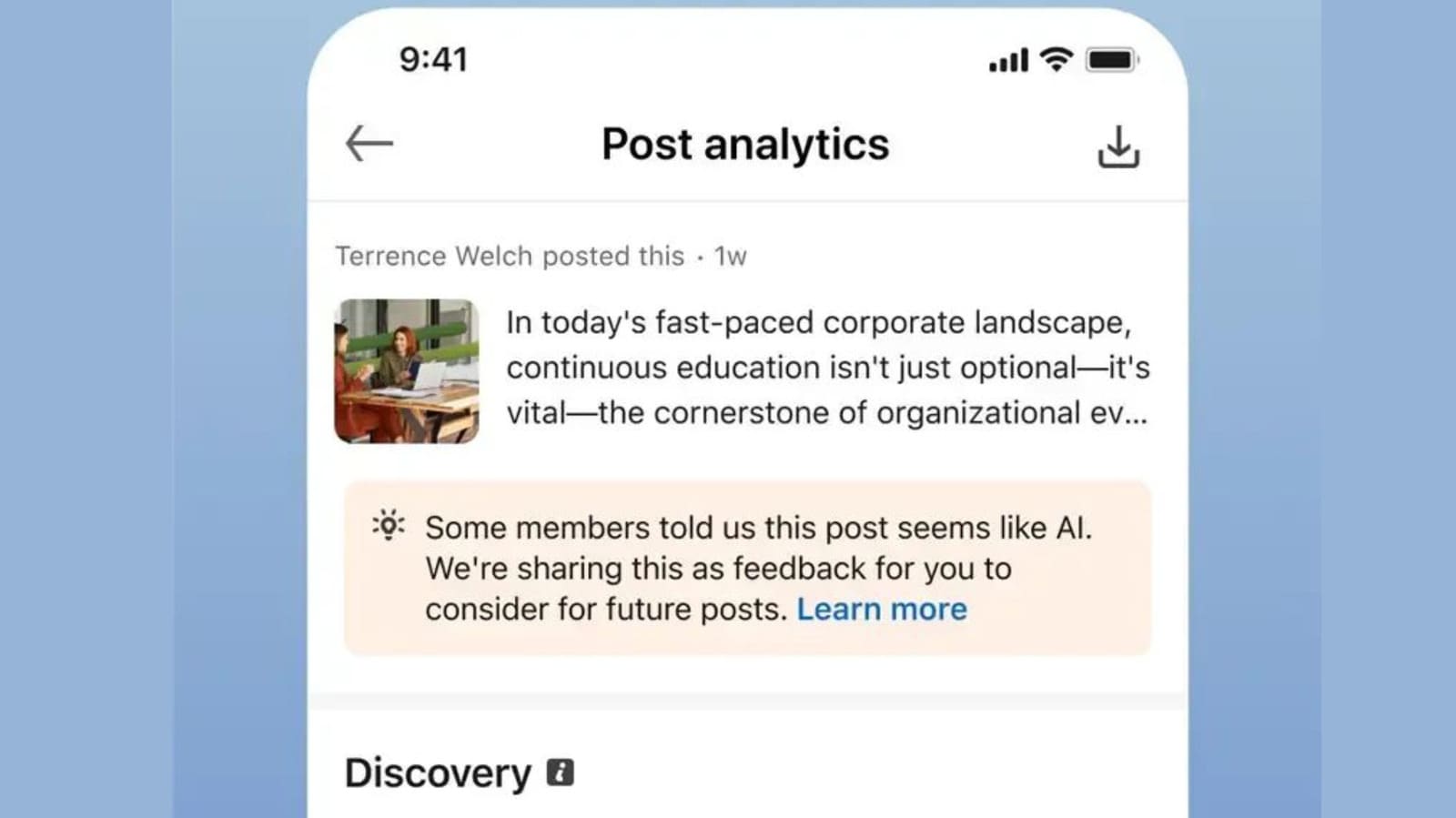
LinkedIn is now rolling out a feature that alerts users when one of their posts has been reported as appearing AI-generated. The notification will appear in the app's post-analytics section, giving creators visibility into how their content is being received - and potentially flagged - by the community.
This transparency move is unusual. Most social platforms do not surface individual moderation signals to users, preferring to aggregate feedback silently to avoid gaming. By notifying authors, LinkedIn is effectively inviting them to adjust their writing style or reconsider their use of generative tools. It also opens the door to disputes: users who believe their posts were wrongly flagged may push back, complicating enforcement.
The decision to notify reflects the platform's ongoing tension between encouraging AI adoption - Microsoft, LinkedIn's parent company, has invested billions in OpenAI and embeds Copilot across its product stack - and mitigating the reputational damage from feeds clogged with synthetic noise.
The Scale of the Problem
A study earlier this year by Pangram, an AI-detection firm, estimated that more than 40 percent of long-form posts on LinkedIn were likely generated by language models. That figure, while contested by some researchers who question the reliability of detection heuristics, aligns with anecdotal observations from recruiters, hiring managers, and active users who report diminishing signal-to-noise ratios in their feeds.
LinkedIn has oscillated in its messaging around AI-assisted writing. The platform introduced an "enhance" button in 2023 that allowed users to rewrite posts and messages using a large language model, positioning the feature as a productivity aid. It quietly removed that button when it launched the slop-reporting tool, a reversal that underscores the difficulty of balancing feature velocity with content quality.
The platform's challenge is structural. Unlike consumer social networks where entertainment value can compensate for authenticity questions, LinkedIn's utility hinges on trust - in credentials, in expertise, in the veracity of professional narratives. Synthetic content that mimics thought leadership without substance erodes that trust, particularly when it crowds out posts from practitioners sharing hard-won lessons.
Regional Variations and Moderation Load
The reporting tool is currently available globally, but early data suggests usage patterns vary by region. Markets with high concentrations of job seekers and freelancers - India, the Philippines, parts of Southeast Asia - have seen disproportionately high report volumes, reflecting both the prevalence of AI-generated self-promotion and the competitive pressures that drive users to game visibility.
Moderating at scale remains a challenge. LinkedIn employs a hybrid model that combines automated classifiers with human review for edge cases, but the addition of a million user reports in three weeks adds significant load. The company has not disclosed whether it has expanded its trust-and-safety headcount in response, nor whether it is using the reports primarily as training data for future models rather than as direct inputs into real-time demotion.
What the Data Does Not Show
The 40 percent reduction in views is a platform-level aggregate. It does not reveal how many unique posts were demoted, whether certain types of content - career advice, motivational anecdotes, product pitches - are flagged more frequently, or whether the tool is disproportionately affecting users in specific industries or geographies.
It also does not address false positives. Users who write clearly and concisely, or who happen to use phrases that overlap with common LLM outputs, may find their reach curtailed even if they never touched a generative tool. LinkedIn's safeguards are designed to mitigate this risk, but the company has not published accuracy metrics or appeal data.
The notification feature may help surface these cases, giving affected users a chance to understand why their content underperformed. Whether that leads to better calibration of the detection system or simply more confusion depends on how LinkedIn iterates on feedback loops in the coming months.
The Broader Implications for Platform Governance
LinkedIn's approach - crowdsourcing quality signals and feeding them into algorithmic ranking - represents a hybrid model that other platforms are watching closely. Meta experimented with similar "not interested" and "why am I seeing this" controls on Facebook and Instagram, but those tools have not been weaponized at the same scale, likely because entertainment feeds are more tolerant of low-quality content than professional networks.
The risk is that user reports become a new vector for manipulation. Competitors, disgruntled colleagues, or ideologically motivated groups could coordinate to suppress content they dislike, regardless of whether it is AI-generated. LinkedIn's safeguards are meant to prevent this, but the company has not detailed what those safeguards entail - whether they involve velocity checks, account-reputation scoring, or cross-referencing with automated classifiers.
If the tool succeeds in improving feed quality without enabling abuse, it could become a template for other platforms grappling with synthetic content at scale. If it fails, LinkedIn risks creating a new moderation crisis just as it tries to clean up the last one.