LG Display Ditches Metal Masks in Bid to Unlock Larger, More Durable OLED Screens
The FLiPP manufacturing process promises brighter panels with extended lifespans, but scaling from lab to production line remains the real test.
A Manufacturing Constraint That Has Shaped Every OLED Screen
For over a decade, the fine metal mask has been both enabler and bottleneck in OLED production. These precision-etched plates, perforated with microscopic holes, act as stencils during the deposition of red, green, and blue organic materials onto glass substrates. The process works, but it carries hard limits: masks sag under their own weight at larger sizes, restricting practical panel dimensions. Alignment tolerances tighten as pixel density climbs. And the masks themselves wear out, adding cost and complexity to every production run.
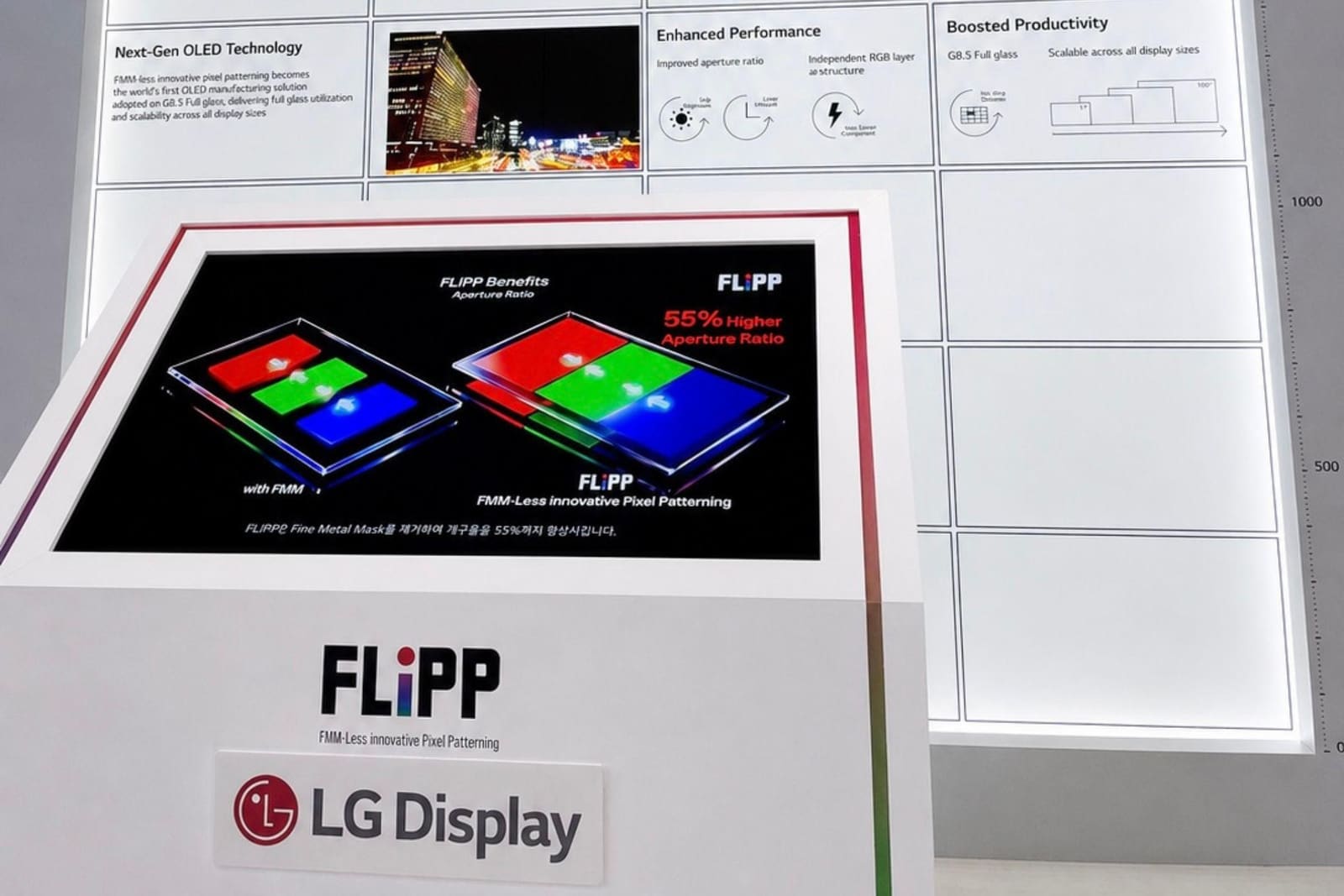
LG Display introduced its FLiPP process at the International Meeting on Information Display in Seoul on August 19, positioning the technology as a way to sidestep those constraints entirely. By eliminating the metal mask from pixel patterning, the company claims it can produce OLED panels that are not only brighter and more power-efficient but also significantly longer-lived.
At DailyTechWire, we've tracked incremental OLED improvements for years. This proposal, if it scales, represents a more fundamental shift in how the industry thinks about panel economics and form factors.
How FLiPP Changes the Deposition Process
Traditional RGB OLED manufacturing relies on a fine metal mask to define where each color subpixel sits. The organic materials evaporate in a vacuum chamber and pass through the mask's apertures, landing in precise patterns on the substrate below. It is an additive process, but one that demands exacting mechanical stability.
FLiPP, short for FMM-Less innovative Pixel Patterning, replaces that mask-based approach with a direct patterning method. LG Display has not disclosed the full technical pathway, but the core idea is to deposit or define pixel structures without relying on a large-area shadow mask. This could involve photolithography, inkjet printing of organic layers, or a hybrid technique that patterns emissive materials after deposition.
Removing the mask has immediate implications. Panel size is no longer constrained by the maximum dimension of a taut, thermally stable metal sheet. Pixel layouts can be adjusted with software rather than by fabricating new masks. And because there is no mask to degrade or replace, material utilization improves and production throughput can rise.
Brightness, Efficiency, and Longevity Gains
According to LG Display, FLiPP panels deliver higher luminance and better power efficiency than current RGB OLED designs. The company also highlights extended lifespan, a perennial concern for OLED technology as organic materials degrade with use.
These improvements likely stem from more precise control over layer thickness and subpixel geometry. In mask-based deposition, the shadow effect and mask-to-substrate gap introduce small variations in material distribution. A maskless process can reduce those inconsistencies, yielding more uniform emission and less wasted light.
Lifespan gains may also come from optimized pixel structures that reduce current density or improve heat dissipation. OLED degradation accelerates with higher drive currents and elevated temperatures, so any design that spreads the load more evenly across the panel can push out the onset of visible burn-in or brightness loss.
Still, LG Display has not published side-by-side lifetime data or specified the magnitude of efficiency improvements. The claims are directional rather than quantified, which is typical for early-stage technology announcements but leaves questions about commercial viability.
Size Flexibility and the TV Market
One of the more intriguing aspects of FLiPP is its potential to unlock larger OLED panels without the mechanical constraints that have kept the largest consumer displays in the 80- to 90-inch range. Fine metal masks for those sizes are difficult to manufacture and prone to warping, which limits yield and drives up cost.
A maskless process, in theory, removes that ceiling. If LG Display can maintain uniformity and pixel density across substrates larger than current RGB OLED panels, it opens the door to 100-inch-plus televisions at price points that might finally compete with premium LCD and microLED alternatives.
The television market has been slow to adopt OLED at the high end, in part because of size limitations and in part because of cost. Samsung Display's QD-OLED and LG Display's own WOLED architectures have each addressed different parts of the problem, but neither has fully closed the gap with LCD on large-screen affordability. FLiPP, if it proves scalable, could shift that calculus by reducing both material waste and tooling complexity.
The Path from Prototype to Production Line
LG Display has a history of demonstrating promising OLED technologies that take years to reach mass production, if they reach it at all. The company has shown rollable, transparent, and ultra-thin panels at trade shows, many of which remain confined to concept devices or niche applications.
FLiPP faces similar questions. The technology was unveiled at an academic conference, not a product launch. There is no announced timeline for integration into commercial panel lines, and no confirmed customers or device categories.
Scaling a new deposition or patterning process requires more than laboratory validation. It demands high-throughput equipment, supply chain alignment for any new materials or precursors, and rigorous yield management to ensure that defect rates stay within acceptable bounds. OLED manufacturing already operates on thin margins; any process that increases scrap or requires expensive retooling will struggle to find adoption, regardless of its performance benefits.
LG Display's existing fabs are optimized for WOLED production, which uses a white emissive layer and color filters rather than RGB subpixels. If FLiPP is intended for RGB OLED, the company will need to either retrofit existing lines or build new capacity, both of which carry significant capital expense.
Competitive Pressure and Industry Context
LG Display is not the only panel maker exploring alternatives to fine metal masks. Samsung Display has invested heavily in QD-OLED, which uses blue OLED emitters and quantum-dot color conversion, bypassing some of the patterning challenges inherent in RGB designs. BOE and other Chinese manufacturers have ramped OLED capacity using conventional methods, driving down costs through scale rather than process innovation.
Inkjet printing of OLED materials, long considered a potential disruptor, has seen renewed interest from companies including JOLED and AUO, though commercial traction has been limited. FLiPP may represent another attempt to achieve the cost and flexibility benefits of inkjet without fully committing to a solution-processed architecture.
The competitive landscape will shape FLiPP's trajectory. If rival panel makers can deliver comparable performance improvements through incremental refinements to existing processes, LG Display's incentive to invest in a new manufacturing platform diminishes. Conversely, if FLiPP enables differentiated products that command price premiums or open new markets, the technology could accelerate toward volume production.
What This Means for Consumer Devices
For device makers and end users, the promise of FLiPP is straightforward: better OLED screens in more sizes, at potentially lower cost. Laptops, monitors, and tablets could see larger OLED options without the price penalty that currently limits adoption. Televisions could push past 100 inches. Automotive displays, where size and durability are both critical, could benefit from the extended lifespan claims.
But those outcomes depend on execution. OLED has been the "next big thing" in displays for over a decade, and while the technology has made significant inroads in smartphones and premium TVs, it still lags LCD in most other categories. Cost remains the primary barrier, followed by concerns about burn-in and brightness in high-ambient-light environments.
If FLiPP can materially reduce manufacturing cost while improving panel performance, it has a chance to shift the adoption curve. If it remains a marginal improvement or proves too expensive to scale, it will join the long list of OLED innovations that looked impressive in the lab but never reached the market in volume.
LG Display's next step will be to demonstrate FLiPP at scale, with real yield data and a clear path to commercial integration. Until then, the technology remains a promising experiment rather than a guaranteed leap forward.