Building the Hidden Half of Fusion: Japan's Kyoto Fusioneering Moves to Tennessee
While reactor startups chase plasma breakthroughs, one supplier is building the fuel-breeding and heat-harvesting systems that will actually keep fusion plants running
The Unsexy Side of Fusion Is Where the Money Goes
Fusion energy startups love to talk about plasma temperatures, confinement times, and net energy gain. But a reactor that achieves fusion is only one piece of a commercial power plant. The harder engineering challenge, and the one that determines whether fusion ever connects to the grid, is everything else: the systems that breed fresh fuel, extract heat, recycle exhaust, and survive neutron bombardment for decades.
Kyoto Fusioneering has spent the past several years building a business around that unglamorous reality. The Japan-based company, which has secured $121 million in committed capital according to FusionX data, announced it will relocate its U.S. headquarters to Oak Ridge, Tennessee. The move coincides with grants from the U.S. Department of Energy and the state of Tennessee to build a prototype fuel-breeding device at Oak Ridge National Laboratory.
The decision reflects a broader shift in fusion commercialization. While venture capital has poured into reactor designs, the supply chain needed to turn those reactors into functioning power plants has received less attention and far less funding. Kyoto Fusioneering is betting that the gap between demonstration and deployment will be filled by specialized suppliers, not vertically integrated startups trying to build everything in-house.
Why More Than Half of Fusion Startups Outsource Fuel Cycles
A recent Fusion Industry Association survey found that over half of fusion startups plan to work with external suppliers on fuel cycle technologies. That's a striking number in an industry where many founders initially assumed they would need to control every component.
The reason is straightforward: breeding blankets, tritium extraction, and plasma heating systems require materials science, fluid dynamics, and radiation engineering that have little overlap with plasma physics. A team that excels at magnetic confinement or inertial fusion is not necessarily equipped to design liquid lithium pumps that operate at 500 degrees Celsius while being bombarded by high-energy neutrons.
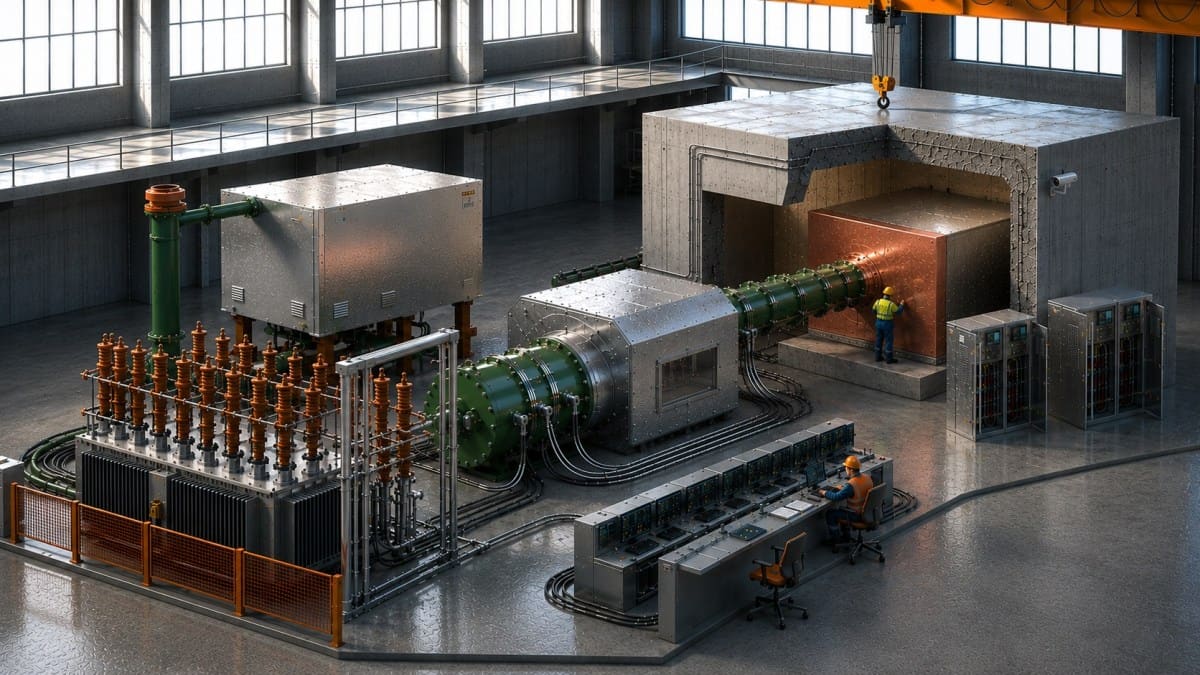
Kyoto Fusioneering's prototype device, called Unity-3, will test exactly those kinds of systems. Developed in partnership with Oak Ridge National Laboratory, Unity-3 is designed to validate breeding blanket concepts that have so far existed mostly in simulation. Breeding blankets serve a dual purpose: they capture heat from fusion reactions to generate electricity, and they produce tritium, the hydrogen isotope that fuels many reactor designs.
The concept is elegant but mechanically complex. In one design, liquid lithium circulates through the blanket, absorbing neutrons from the fusion reaction. When a lithium atom captures a neutron, it splits into helium and tritium. The tritium is then separated and fed back into the reactor as fuel, while the heat carried by the lithium is extracted to drive turbines. The entire cycle must happen continuously, at high temperature, in a radiation-intense environment, using materials that can withstand years of neutron damage.
Oak Ridge as the Center of U.S. Fusion Infrastructure
Oak Ridge National Laboratory has emerged as the de facto testing ground for fusion supply chain technologies in the United States. The lab has decades of experience with neutron science, materials testing, and tritium handling, infrastructure that fusion startups cannot afford to replicate on their own.
By locating Unity-3 at Oak Ridge, Kyoto Fusioneering gains access to specialized facilities and regulatory pathways for handling tritium, which is both radioactive and tightly controlled. The lab also offers a neutral proving ground where multiple startups can validate their designs without building competing test facilities.
Four fusion companies have already committed to using data from Unity-3: Realta Fusion, Thea Energy, Type One Energy, and Xcimer Energy. That list spans a wide range of reactor architectures, from stellarators to Z-pinch to laser-driven inertial confinement. The diversity of customers is strategic. Kyoto Fusioneering is not betting on a single reactor design winning the fusion race. Instead, it is positioning itself as the supplier that can serve whichever approach reaches commercial scale first.
Testing Materials That Do Not Yet Exist at Scale
Unity-3 will evaluate not only liquid lithium but a range of breeding blanket materials, some of which have never been tested under fusion-relevant conditions. Solid ceramic breeder concepts, liquid metal alternatives, and hybrid designs all need experimental validation before they can be deployed in a commercial reactor.
The challenge is that many of these materials behave differently under neutron irradiation than they do in benign laboratory conditions. Metals become brittle. Ceramics crack. Liquid metals corrode containment structures. Computer models can predict some of these failure modes, but not all of them, and certainly not with the precision required to design a power plant that must operate reliably for 30 years.
Unity-3 is intended to close that gap. By subjecting candidate materials to high neutron flux and elevated temperatures, the device will generate the empirical data that fusion startups need to finalize their engineering designs. It will also reveal which materials fail in ways that models did not anticipate, forcing a return to the drawing board before a company commits hundreds of millions of dollars to a full-scale demonstration plant.
The Economics of Vertical Integration Versus Supply Chains
The decision to outsource fuel cycle technologies reflects a broader question in the fusion industry: should startups try to build everything themselves, or should they focus on core reactor technology and rely on suppliers for the rest?
Tesla famously chose vertical integration, building its own battery cells, electric motors, and software stack. But Tesla also had the luxury of iterating on a product that could be sold in small volumes before scaling to mass production. Fusion startups do not have that option. Their first commercial plant must work at grid scale, and it must work reliably enough to justify the billions of dollars in capital required to build it.
That economic reality pushes many fusion companies toward a supply chain model. By buying breeding blankets, plasma heating systems, and tritium recycling equipment from specialists like Kyoto Fusioneering, startups can reduce their technical risk and focus their limited engineering resources on the reactor itself.
For Kyoto Fusioneering, the opportunity is to become the Bosch or Denso of fusion energy: a tier-one supplier whose components are integrated into multiple reactor designs. The company is already developing plasma heating systems, fuel recycling equipment, and heat extraction modules in addition to breeding blankets. If even a few fusion startups reach commercial deployment in the 2030s, Kyoto Fusioneering could find itself supplying components to an industry worth tens of billions of dollars annually.
What Unity-3 Means for Fusion Timelines
Fusion energy has been famously stuck in the "30 years away" trap for decades. But the supply chain is now moving faster than the reactors. Kyoto Fusioneering's decision to build Unity-3 in 2026, years before any fusion plant is expected to reach net electricity production, reflects a calculation that the balance-of-plant systems need to be ready before the reactors are.
That is a shift from the historical pattern, in which fusion research focused almost entirely on plasma physics while assuming that engineering challenges could be solved later. The result was decades of progress on confinement and heating, but almost no progress on tritium breeding, neutron shielding, or remote maintenance, all of which are just as essential to a functioning power plant.
If Unity-3 succeeds in validating breeding blanket designs by the late 2020s, it will remove one of the largest remaining uncertainties in fusion commercialization. Startups will still need to prove their reactors can sustain fusion reactions for hours or days at a time, not just seconds. They will still need to demonstrate that their plants can operate economically, producing electricity at a cost competitive with renewables and gas. But they will at least know that the fuel cycle works, and that the components needed to extract energy and breed tritium are available from a proven supplier.
That is not a guarantee of success. But in an industry where technical risk is measured in billions of dollars and decades of development time, it is a meaningful step forward.