Google's Wearable Gambit: Natural-Language Widgets and Always-On Context
Wear OS 7 lands on three Pixel Watch generations with Gemini-powered automation and a 10-percent battery gain - but Samsung and third-party hardware still wait.
The Interface Bet
Google has shipped Wear OS 7 to its Pixel Watch 2, 3, and 4 hardware, tying wearable software to the same Gemini language model that already threads through Android phones, tablets, and productivity apps. The headline feature is Create My Widget, a natural-language builder that lets users describe a dashboard - "show my next meeting and the weather" - and watch the interface assemble itself. It is a small step toward conversational UI, but one that arrives at a moment when every platform holder is racing to prove that large-language-model inference can live comfortably on the wrist.
At DailyTechWire, we've tracked the steady migration of transformer-based models from data-center racks to edge silicon. Wear OS 7 does not run a full on-device LLM for widget generation; the natural-language parsing still happens server-side, then returns layout instructions to the watch. That round-trip introduces latency, but it also keeps power draw and thermal output within the narrow envelope a 300-to-400-milliamp-hour battery permits. The tradeoff is familiar: richer functionality in exchange for a persistent network dependency and the privacy surface that comes with cloud inference.
Live Updates and the Fight for Glanceability
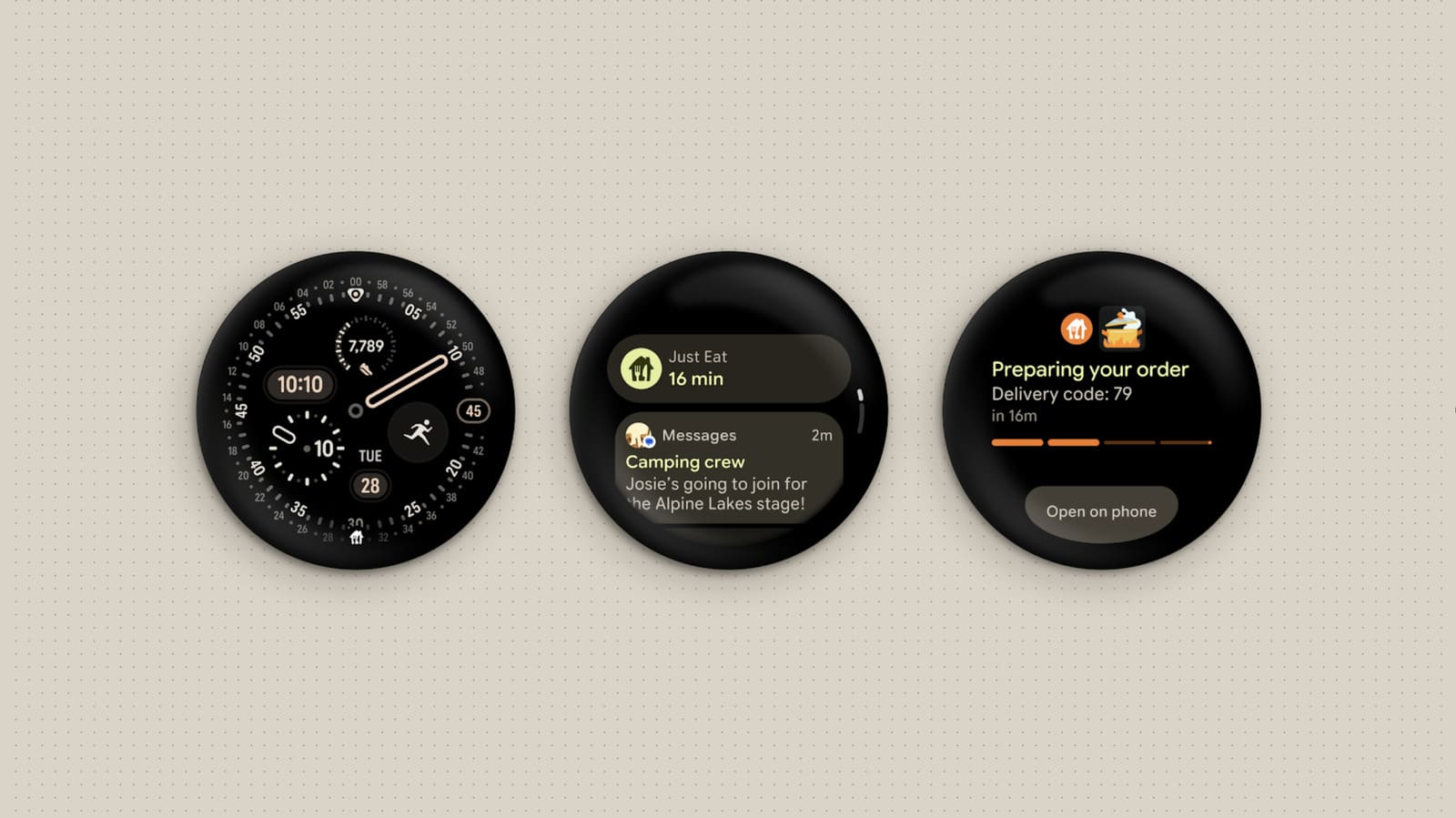
Alongside custom widgets, Google introduced Live Updates - persistent, auto-refreshing cards that surface game scores, workout metrics, and delivery countdowns without requiring the user to open an app. The design borrows from iOS Live Activities and Samsung's Good Lock notification modules, both of which demonstrated that users will tolerate a denser lock screen if the data updates in real time and stays relevant.
The challenge on a circular 1.2-to-1.4-inch display is information hierarchy. A phone lock screen can stack four or five live cards; a watch face has room for two, perhaps three if type size drops below comfortable legibility. Google's solution leans on the same context engine that powers Gemini's proactive suggestions: the system samples calendar entries, location history, and app-usage patterns to decide which live card deserves the top slot at any given moment. When that ranking works, the watch feels prescient. When it misfires - surfacing yesterday's baseball game instead of the inbound food order - the user reaches for the phone, and the value proposition of the wearable dissolves.
Cross-Device Control and the XR Handoff
Wear OS 7 adds a new control surface for paired audio devices and for the Android XR smartglasses Google previewed in May. If a user snaps a photo through XR frames, the image appears on the watch within seconds for quick review and deletion. Playback controls for earbuds, home speakers, and Chromecast endpoints now live in a unified panel, accessible via a long-press on the side button.
The XR handoff is the more consequential addition. Google is betting that its glasses - expected to ship in late 2026 - will generate dozens of photos, voice memos, and short video clips throughout the day, and that users will want to triage that content on the nearest screen rather than wait until they sit down at a laptop. The watch becomes a remote shutter, a gallery, and a delete key, all roles that assume the XR device lacks a touch surface of its own. That assumption aligns with the current generation of camera-equipped frames, which rely on voice commands and capacitive stems. If future XR hardware gains a projector or a fold-out display, the watch's role as intermediary may shrink.
Multi-Step Automation and the Natural-Language API
Gemini now powers multi-step routines triggered by natural language. A user can say "book my usual spin class on Thursday and order a smoothie for pickup," and the assistant will parse two intents, authenticate against the gym's API and the café's online-order endpoint, then confirm both transactions on the watch screen. Google calls this capability multi-step automation; in practice it is a wrapper around existing app actions and the newer App Intents framework that shipped with Android 17.
The reliability of these chains depends on how many third-party developers adopt the App Intents schema and how well Gemini's slot-filling handles ambiguity. Early tests by users in the Pixel community forums show that simple two-step flows - reserve and order, dim lights and lock door - succeed most of the time, while three-step sequences that involve conditional logic or account switching fail more often. Google has not published error rates or disclosed how much training data it used to fine-tune the automation model, so developers and users are learning the boundaries through trial.
Neural Express Design and the Suggestion Engine
The update brings Neural Express, the design language Google introduced with Android 17, to the wearable platform. Neural Express surfaces contextual suggestions - message replies, calendar actions, search shortcuts - based on recent activity in Gmail, Chat, and Search. On a phone, these suggestions appear as chips below the keyboard or as quick-action buttons in notifications. On a watch, they occupy the top of the app drawer and the notification shade.
The risk is over-triggering. A phone notification can be swiped away in a fraction of a second; a watch notification demands a wrist rotation, a tap, and often a scroll. If the suggestion engine misfires repeatedly, users disable it, and Google loses one of the few behavioral signals that distinguish its wearable platform from Apple's. The company has tuned the frequency of Neural Express prompts to roughly one every two hours during active use, according to internal documentation shared with OEM partners. Whether that cadence feels helpful or intrusive will vary by user and by how well the model learns individual routines.
Battery Gains and the Power Envelope
Google claims Wear OS 7 delivers a 10-percent improvement in battery life on average, compared to Wear OS 6 running identical workloads. The gain comes from three changes: more aggressive use of the low-power co-processor for always-on display and step counting, a new scheduler that batches network requests when the watch is stationary, and tighter GPU throttling during animations.
Ten percent translates to roughly two to three additional hours on a Pixel Watch 3, enough to cross the threshold from "needs a midday top-up" to "lasts until bedtime" for users who enable always-on display and receive moderate notification traffic. It does not fundamentally alter the calculus that has kept Wear OS behind Apple Watch in battery reputation - Google's hardware still targets twenty-four-hour life, while Apple aims for thirty-six to forty-eight - but it narrows the gap enough that fast charging becomes a viable mitigation. The Pixel Watch 4 can recover fifty percent charge in twenty-two minutes, according to Google, making a morning shower or breakfast routine sufficient to carry the device through a second day.
The Samsung and OEM Question
Wear OS 7 is live for Pixel Watch 2, 3, and 4, but Google has not announced a rollout timeline for Samsung Galaxy Watch hardware or for devices from Mobvoi, Fossil, and other licensees. Samsung's partnership with Google on Wear OS has always included a long customization tail; the company's One UI Watch skin often ships three to four months after the Pixel release, and some features - particularly those tied to Gemini - require negotiation over data-sharing terms and default-assistant settings.
The delay creates a two-tier ecosystem. Pixel Watch owners gain early access to new AI capabilities and design patterns, reinforcing Google's vertical integration, while the broader installed base waits. If Samsung's update arrives in the fourth quarter of 2026 with a comparable feature set, the gap remains manageable. If key Gemini functions remain Pixel-exclusive, or if third-party OEMs skip Wear OS 7 entirely in favor of waiting for Wear OS 8, fragmentation accelerates. Google has not published adoption metrics for Wear OS 6, so the scale of the trailing user base remains opaque.
The Wearable Inference Frontier
Wear OS 7 is less a technical leap than a steady accretion of language-model hooks into an existing interface. Natural-language widget creation, multi-step automation, and contextual suggestions all depend on server-side inference and on users granting Google access to calendar, location, and communication data. The battery improvement is real but incremental, and the cross-device control features presuppose ownership of other Google hardware.
What the update does signal is Google's belief that wearables will become the primary surface for ambient AI - the place where proactive suggestions, live data feeds, and voice-driven automation converge. Whether that vision resonates with users, or whether it simply adds cognitive load to a device category that promised simplicity, will become clear as Wear OS 7 reaches the installed base and as competitors respond. Apple has so far resisted putting large-language models directly into watchOS, preferring to route complex queries back to the iPhone. If Google's bet pays off, that conservatism may look like a miscalculation. If it does not, Wear OS 7 will be remembered as the release that tried to do too much, too soon, on too small a screen.
What Comes Next
The rollout to Pixel hardware is complete; the test now is adoption, retention, and developer buy-in. Google has seeded the App Intents framework to partners and published natural-language widget templates in the Wear OS documentation. If third-party apps embrace those APIs, the platform gains differentiation. If they do not, Create My Widget and multi-step automation remain showcases for Google's own services, and the broader value proposition of Wear OS 7 narrows to battery life and live updates - worthy improvements, but not the paradigm shift the marketing suggests.
For users outside the Pixel ecosystem, the wait continues. Samsung's Galaxy Watch 6 and 7 remain the volume leaders in Wear OS hardware, and their update cadence will determine whether Wear OS 7 becomes a platform milestone or a Pixel-exclusive footnote. Google has the software; the question is whether it can deliver it to the wrists that matter.