Google Embeds Calibration Into Quantum Error Correction
A new technique allows superconducting quantum processors to continuously tune themselves during computation, solving a drift problem that threatened long-running algorithms.
The Hidden Bottleneck in Quantum Computing
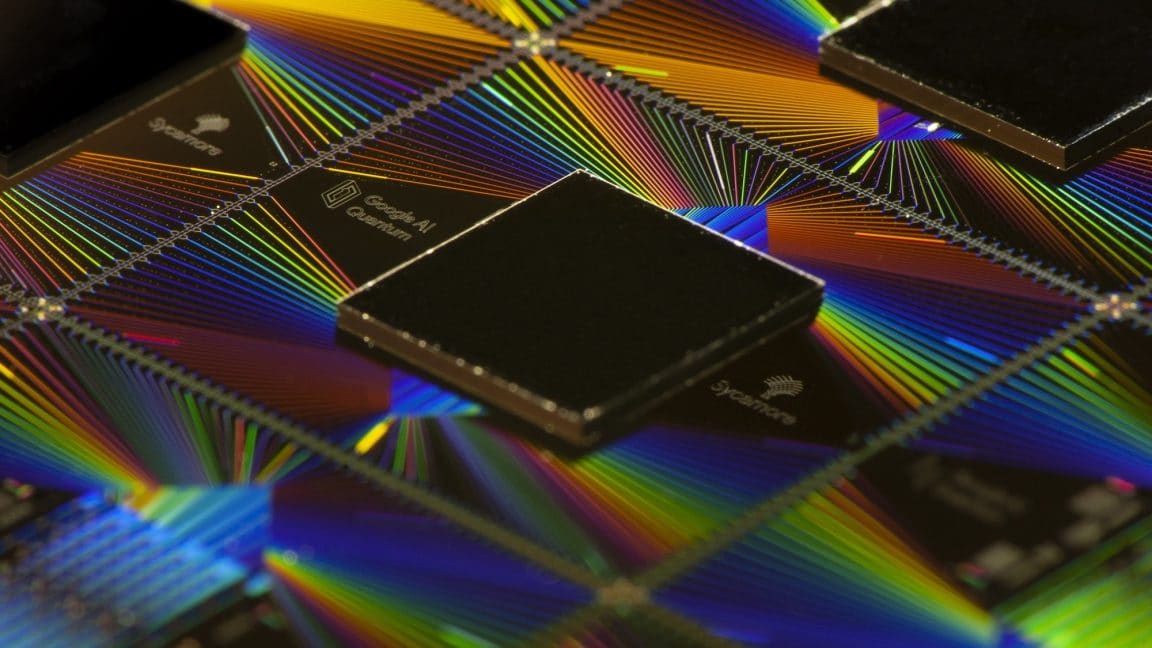
Between the grand challenges of quantum computing, such as building enough stable qubits and achieving fault tolerance, sits a less glamorous but equally critical problem: keeping the hardware in tune while it runs. For superconducting quantum processors, the kind most labs are building today, every qubit behaves slightly differently because manufacturing at the nanoscale introduces variations no foundry can fully eliminate. That means each device must be calibrated before use, a process that tests different microwave pulse shapes and frequencies until engineers find the sweet spot where error rates drop to their minimum.
The catch is that calibration and computation have historically been mutually exclusive activities. You either stop to recalibrate or you let the hardware drift, and for algorithms that run longer than a few minutes, drift becomes a showstopper. Google's quantum team has now demonstrated a way around this trade-off by folding calibration directly into the error-correction cycle itself, using the same measurement data that already flows through the system to detect and fix qubit errors.
Why Manufactured Qubits Need Constant Tuning
Superconducting qubits are lithographically defined circuits, which means they inherit all the variability of semiconductor manufacturing. Two qubits sitting millimeters apart on the same chip will respond to microwave pulses at slightly different frequencies and require slightly different pulse amplitudes to flip their states cleanly. Before any calculation begins, operators run a calibration routine that sweeps through parameter space, records error rates, and locks in the best settings.
The problem intensifies over time. Even within a single computing session, environmental factors such as temperature fluctuations, magnetic field drift, and charge noise cause the optimal parameters to shift. Traditional calibration workflows pause computation entirely, run a fresh sweep, update the control software, and resume. For the sorts of multi-hour quantum simulations or optimization runs that researchers hope to execute in the near future, this stop-and-go rhythm is untenable.
Atomic qubits, such as those built from trapped ions or neutral atoms, sidestep some of this variability because the qubit itself is identical by the laws of physics. But even those systems must contend with laser frequency drift and optical alignment shifts, so the calibration challenge is not unique to superconducting hardware. It is, however, most acute there.
Piggybacking on Error Correction
Google's insight was to recognize that error correction already generates a rich stream of measurement outcomes. In a surface code or similar architecture, ancilla qubits are measured repeatedly to detect whether data qubits have flipped. Those measurements contain not just information about errors but also subtle signatures of miscalibration. If a qubit's control pulse is slightly off-frequency or too weak, the resulting gate fidelity degrades, and that degradation shows up as a shift in the statistical pattern of syndrome measurements.
By analyzing those patterns in real time, the system can infer which qubits are drifting out of tune and in which direction. The correction loop then adjusts the microwave pulse parameters on the fly, without halting the logical computation. In effect, the processor is constantly learning and adapting, using the same feedback channel that keeps errors in check to also keep the hardware aligned.
This approach transforms error correction from a purely reactive process into an active stabilization mechanism. The logical qubit remains protected from errors, and the physical qubits underneath remain optimally tuned, all within a single unified control loop.
Implications for Long Algorithms and Scaling
The immediate payoff is reliability over extended run times. Algorithms that might have seen their error rates creep upward after twenty or thirty minutes can now maintain baseline performance for hours, assuming other sources of decoherence remain under control. That opens the door to quantum simulations of condensed matter systems, optimization routines with deep ansatz circuits, and eventually the kinds of cryptographic or chemistry calculations that justify the enormous investment in quantum hardware.
There is also a scaling argument. As quantum processors grow from dozens to hundreds and eventually thousands of physical qubits, the overhead of traditional calibration grows combinatorially. Each two-qubit gate might need its own parameter set, and recalibrating a thousand-qubit chip could take longer than the coherence time of the qubits themselves. Embedding calibration into the error-correction loop keeps that overhead constant per logical qubit, rather than per physical qubit, which is a more favorable scaling curve.
At DailyTechWire, we have tracked the maturation of error-correction codes over the past three years, and the pattern is clear. Early demonstrations focused on proving that logical error rates could drop below physical ones. More recent work, including this result from Google, is about making error correction practical: reducing its resource cost, its latency, and now its dependence on separate calibration infrastructure. Each of these incremental improvements moves the threshold for useful quantum advantage a little closer.
What Remains Unsolved
Real-time calibration does not eliminate the need for high-quality qubits in the first place. If a qubit's error rate is too high or its coherence time too short, no amount of tuning will rescue it. The technique also assumes that drift is gradual and that the error-correction cycle runs fast enough to catch parameter shifts before they cause uncorrectable errors. In environments with high electromagnetic noise or thermal instability, that assumption may not hold.
There is also the question of how this method scales across different qubit topologies and error-correction codes. Surface codes are relatively forgiving because syndrome extraction is local and repetitive, which gives the calibration loop many opportunities to gather statistics. More exotic codes with non-local or sparse syndrome measurements might not generate enough signal to keep the calibration accurate.
Finally, the technique addresses one axis of calibration, primarily single- and two-qubit gate parameters, but does not yet extend to other control challenges such as crosstalk mitigation, leakage out of the computational subspace, or the tuning of flux-bias lines in frequency-tunable qubit designs. Those remain separate problems, though the same principle of using in-situ measurement data could apply.
The Quiet Work of Making Quantum Practical
Most of the public conversation around quantum computing revolves around qubit counts and benchmark algorithms. But the engineering that will ultimately determine whether these machines become useful happens at a less visible layer, in the control stacks and calibration pipelines and error-correction decoders that turn fragile quantum states into reliable computation. Google's work on integrated calibration is an example of that quiet, unglamorous progress. It does not double the size of the processor or unlock a new algorithm, but it does make the processor more robust, more autonomous, and more capable of running the kinds of workloads that matter outside the lab.
As quantum systems move from research prototypes to production tools, the ability to operate without constant human intervention will be essential. Real-time calibration embedded in error correction is one more step toward that autonomy.