Einride Buys Charging Software Startup to Tighten Grip on Electric Freight
The Swedish trucking operator's $38 million Flipturn acquisition signals a shift from vehicles alone to the full energy stack needed for commercial EV fleets.
Vertical Integration Comes to Electric Trucking
Einride has completed an all-stock deal valued at $38 million to acquire Flipturn, a three-year-old EV charging software startup with 17 employees. The transaction, which closed this month, represents the Swedish company's first acquisition since its Nasdaq debut in June and underscores a strategic bet: operators who control both the trucks and the charging intelligence will win the race to electrify freight.
At DailyTechWire, we've tracked the slow march of heavy-duty electrification across Asia and Europe, where infrastructure anxiety remains the single biggest brake on fleet conversions. Einride's move to own the software layer that manages charging infrastructure addresses that friction head-on. Flipturn's platform communicates with any charger via the Open Charge Point Protocol, monitors equipment health in real time, ingests vehicle telemetry such as battery state and route history, and integrates on-site solar and storage. That stack transforms charging from a logistical headache into a data layer operators can optimize.
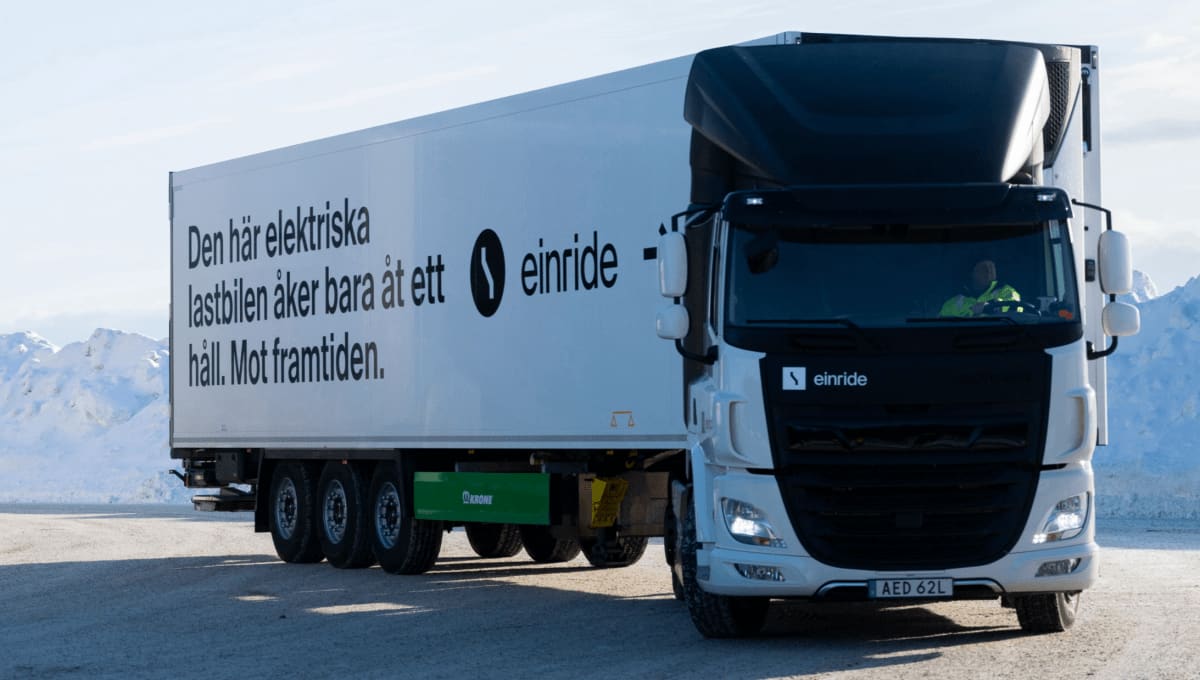
For Einride, which runs 200 heavy-duty electric trucks under contract for Heineken, PepsiCo, Carlsberg Sweden, and now Amazon across Europe, North America, and the United Arab Emirates, bundling software with hardware makes the pitch simpler. Fleet managers wary of stranded assets or unreliable uptime can now point to a single vendor responsible for the entire energy chain.
The Economics of Owning the Charger Brain
Flipturn raised $15.5 million in venture capital since its 2022 founding, building a middleware layer that sits between chargers and fleet operations. The software's value lies not in the electrons it delivers but in the predictability it creates. By pulling route data, battery cycles, and grid pricing into a unified dashboard, it allows fleet operators to schedule charging during off-peak hours, extend battery life through managed charge curves, and reduce downtime caused by faulty infrastructure.
Einride CEO Roozbeh Charli described the deal as central to the company's U.S. scaling strategy. That framing is revealing. The U.S. commercial EV market remains fragmented, with charging networks, truck OEMs, and software providers operating in silos. A vertically integrated model collapses those seams. Einride already operates trucks through its Saga AI software, which handles routing, dispatch, and telematics. Adding Flipturn's charging intelligence closes the loop, letting Einride offer a turnkey service: you book the capacity, we handle the electrons.
The deal structure keeps Flipturn's team intact and the brand operational, at least for now. That suggests Einride sees value in preserving the startup's customer relationships and technical roadmap rather than absorbing it into a corporate engineering org. It also hints that Flipturn may continue serving third-party customers, turning the acquisition into a potential revenue stream beyond Einride's own fleet.
Amazon and the Asset-Light Fleet Model
Einride's most recent customer win offers a window into how the company plans to scale without ballooning its balance sheet. Amazon's Relay freight network, an app-based marketplace for independent truckers launched in 2017, now includes Einride-operated electric trucks. Crucially, Amazon isn't buying the vehicles. Einride retains ownership and manages operations through Saga, while drivers in the Relay network book the hauls.
This asset-light model mirrors patterns we've seen in Asia, where logistics platforms from Lalamove to Rivigo have experimented with managed fleets to bypass the capital intensity of truck ownership. For Einride, it's a way to amortize the cost of electrification across multiple customers while retaining control over utilization and data. For Amazon, it's a path to decarbonize freight without the operational complexity of running its own EV fleet.
The Flipturn acquisition strengthens that model. If Einride can demonstrate that its charging software reduces downtime and lowers total cost of ownership, it becomes easier to pitch the managed-fleet concept to other enterprise buyers. The value proposition shifts from "rent our trucks" to "outsource the entire transition risk."
The Cabless Truck That Launched a Brand
Einride first gained attention for its autonomous, cabless electric pods, a futuristic form factor that generated significant press but remains a small part of the business. The company's revenue engine is its conventional heavy-duty electric trucks, which require human drivers and look like standard Class 8 rigs. The autonomous pods serve as a long-term R&D bet and a branding asset, but the near-term growth story is squarely in crewed electric freight.
That pragmatism reflects the realities of the commercial EV market. Autonomous trucking remains years away from broad deployment, constrained by regulatory uncertainty, sensor costs, and edge-case safety challenges. Electric drivetrains, by contrast, are mature enough to deploy at scale today, provided the charging and energy management pieces are solved. Einride's bet is that owning those pieces matters more than waiting for autonomy to arrive.
What Vertical Integration Signals for the Sector
The Flipturn deal is part of a broader pattern in commercial EVs: hardware companies are moving upstream and downstream to capture more of the value chain. In China, battery manufacturers like CATL now offer energy-as-a-service contracts. In Europe, charging network operators are acquiring fleet management software. In North America, truck OEMs are launching their own financing arms.
Einride's approach is distinctive because it starts from the operator layer rather than manufacturing or infrastructure. The company doesn't build trucks or chargers; it runs them. That positions it closer to the customer's pain points, which are operational rather than technical. Fleet managers care less about kilowatt-hour capacity or charge curve optimization in the abstract and more about whether their trucks will be ready for the next shift.
By acquiring Flipturn, Einride can now guarantee that readiness with software, not just service-level agreements. The platform's integration with solar and storage also opens a path toward energy arbitrage, where fleets generate revenue by selling excess capacity back to the grid or smoothing demand spikes. That's speculative today but plausible as vehicle-to-grid protocols mature.
Risks and Open Questions
Vertical integration brings execution risk. Einride must now maintain excellence across hardware operations, AI dispatch software, and charging infrastructure management, three disciplines that require different talent pools and go-to-market motions. The company went public via SPAC, a structure that has historically led to cash burn and missed targets. Adding a new software division increases complexity at a time when public markets are punishing unprofitable growth.
There's also the question of whether customers will accept lock-in. A fleet operator that buys Einride's managed service becomes dependent on its charging software, truck availability, and pricing decisions. If a competitor offers better economics or a more flexible contract, switching costs could be high. That's good for Einride's retention metrics but may limit initial adoption among cautious buyers.
Finally, the deal assumes that software differentiation matters in charging. If Open Charge Point Protocol becomes commoditized and chargers themselves become reliable enough that management software is table stakes rather than a moat, Flipturn's value could erode. Einride is betting that the intelligence layer remains defensible, which is a reasonable bet today but not guaranteed five years out.
A Template for Regional Operators
The most immediate impact of the Flipturn acquisition may be felt outside Einride's direct footprint. Fleet operators across Southeast Asia, the Middle East, and Latin America are watching how early movers in Europe and North America navigate electrification. If Einride's integrated model proves that charging software reduces risk and improves unit economics, expect regional logistics companies to either build similar stacks in-house or acquire their own Flipturn equivalents.
We've already seen early signs of this in India, where last-mile delivery startups are partnering with charging networks to co-develop fleet-specific infrastructure. The difference is that those deals remain partnerships, not acquisitions. Einride's willingness to own the stack outright suggests it sees strategic value in control, not just coordination.
That control matters most when scaling across borders. Einride operates in Europe, North America, and the UAE, three markets with different grid structures, regulatory regimes, and energy costs. A unified software platform that can adapt to local conditions while feeding data back to a central operations hub is a genuine advantage. It's also the kind of capability that's hard to replicate through partnerships alone.
For now, Einride remains a mid-sized operator with 200 trucks, a fraction of the tens of thousands run by major logistics incumbents. But the Flipturn deal signals ambition beyond niche early adoption. If the company can prove that vertical integration lowers the total cost of electric freight, it may force larger players to either build or buy their own versions of the same stack. That would mark a real shift in how the industry thinks about electrification, not as a vehicle problem but as a systems problem that requires control over energy, software, and operations in equal measure.