Claude Learns to Remember You Across Every Surface
Anthropic's latest memory upgrade bridges chat and agent workflows, while giving users fine-grained control over what the model stores about them.
Persistent Context, Finally Unified
For the past year, Claude users have lived with a frustrating reality: the model could remember some things from some conversations, but those memories existed in disconnected silos. A detail you shared in chat wouldn't carry over to an automated workflow. A preference you set in the browser extension vanished when you switched to mobile. The fragmentation wasn't always intentional; much of it stemmed from architectural choices Anthropic made when it first shipped memory features last summer.
That fragmentation ends today. Anthropic announced that Claude's memory system now operates as a unified layer beneath both the chatbot interface and Cowork, the computer-use agent the company introduced earlier this year. When you ask Cowork to automate a task in the cloud, it can now pull from everything Claude has learned about you in prior chat sessions. Conversely, anything Cowork learns while executing tasks flows back into the shared memory pool, accessible the next time you open a standard chat window.
The practical upside is straightforward: less repetition. If you've already told Claude your preferred coding style, Cowork will apply that style when it writes a script for you without needing to be reminded. If Cowork discovers you always format spreadsheet headers in a particular way, Claude will suggest that format the next time you ask for help with a data table in chat.
Cowork in the Chrome Extension, Now With Context
The timing of this memory unification aligns with a recent expansion of Cowork's availability. A few weeks ago, Anthropic made the agent accessible through the Claude for Chrome browser extension, which means users can now invoke Cowork directly from the side panel while browsing. Those side-panel conversations immediately become part of your usage history, and with today's update, they contribute to and draw from the same memory store as every other Claude surface.
At DailyTechWire, we've tracked the fragmentation problem closely since Anthropic first began rolling out memory features. The company has been cautious about enabling cross-session context, in part because persistent memory introduces privacy and security trade-offs that ephemeral chat sessions don't. Today's announcement suggests Anthropic believes it has landed on a model that balances utility with user control.
Granular Memory Controls
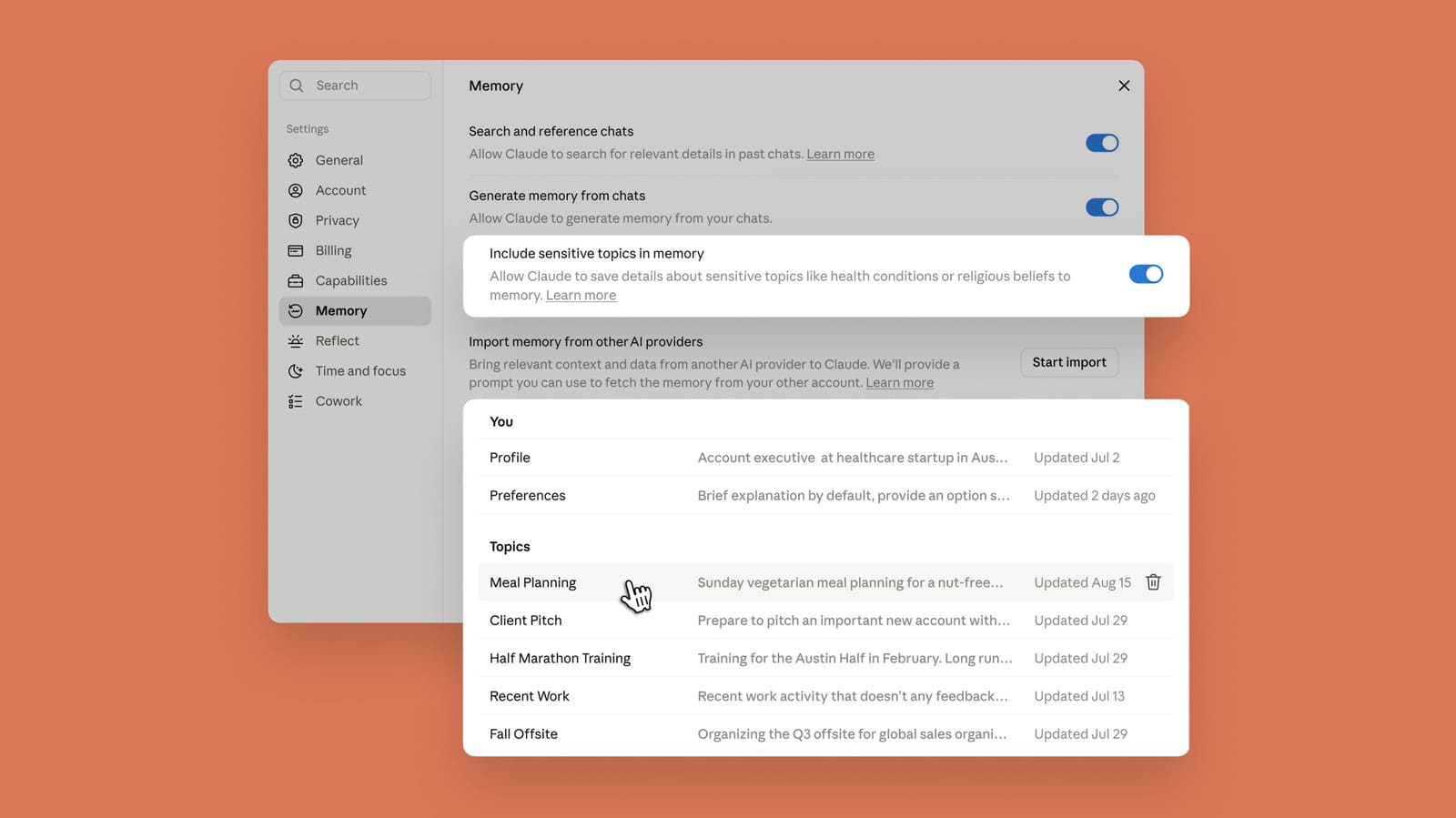
Alongside the unification, Anthropic is introducing a set of new controls that let users decide what Claude is allowed to remember. Over the past few weeks, the company quietly rolled out a topic-based memory view in Claude's settings menu. Users can now see memories organized by category and edit or delete individual entries.
The headline addition is a toggle labeled "include sensitive topics in memory." By default, Claude does not retain information related to health, race, ethnicity, religious beliefs, political views, gender identity, or similar categories. Flipping the toggle allows Claude to store those details, but each time it does, the interface surfaces a notification so you know exactly what has been saved.
Anthropic frames the feature as a response to user feedback. What one person considers sensitive, another might find essential for Claude to remember in order to be useful. A user managing a chronic health condition might want Claude to recall medication schedules and dietary restrictions. Someone working on political data analysis might need the model to remember party affiliations and legislative priorities. The toggle hands that decision to the user rather than imposing a blanket policy.
Even with the sensitive-topics toggle enabled, certain categories remain off-limits. Claude will not store social security numbers, criminal history, or immigration status under any circumstance. Anthropic also emphasizes that enabling the feature does not trigger retroactive scanning of past conversations; only new interactions contribute to memory going forward, and users can disable the feature or purge stored topics at any time.
The Broader Memory Arms Race
Anthropic is not alone in racing to solve the memory problem. OpenAI introduced persistent memory for ChatGPT in early 2024, and Google has been experimenting with context retention in Gemini. The challenge is technical as much as it is conceptual: large language models are stateless by design, and bolting memory onto them requires careful engineering to avoid hallucination, context bleed, and privacy leaks.
What differentiates Anthropic's approach is the emphasis on transparency and user agency. The topic-based memory view and per-category controls reflect lessons the company learned from its Constitutional AI research, which prioritizes alignment with user intent. The risk, of course, is that granular controls add friction. Users who don't want to think about memory settings may find the new toggles overwhelming, while power users may still want more fine-grained control than topic-level editing allows.
The unification across chat and Cowork also raises an interesting question about how context should propagate when an agent is acting on your behalf. If Cowork learns something about your workflow while automating a task, should that knowledge be immediately available in a casual chat session? Anthropic's answer is yes, but other companies may draw the line differently, especially as agents begin operating with higher degrees of autonomy.
Availability and Rollout
The updated memory features are live today for all Claude users, including those on Free, Pro, and Max plans. Memory is enabled by default, though users can disable it entirely from the settings menu. On mobile, the new controls require updating to the latest version of the Claude app on iOS or Android.
For Anthropic, the rollout represents a bet that users want their AI assistant to behave more like a colleague who remembers context than a stateless query engine. Whether that bet pays off will depend on how well the company navigates the tension between utility and privacy, and whether the new controls give users enough confidence to trust Claude with the details that make memory genuinely useful.
The memory arms race in AI is far from over. As models become more capable and agents more autonomous, the question of what they should remember, and for how long, will only grow more complex. For now, Anthropic is staking its claim on transparency, user control, and cross-surface continuity. The fragmentation is gone; what comes next is a test of whether users actually want a model that never forgets.