Chinese Humanoid Robots Break the 100-Meter Barrier in Beijing Competition
Two bipedal machines clocked faster times than Usain Bolt's 2009 world record during heats at the World Humanoid Robot Games, signaling a new benchmark for legged robotics.
The New Sprint Benchmark
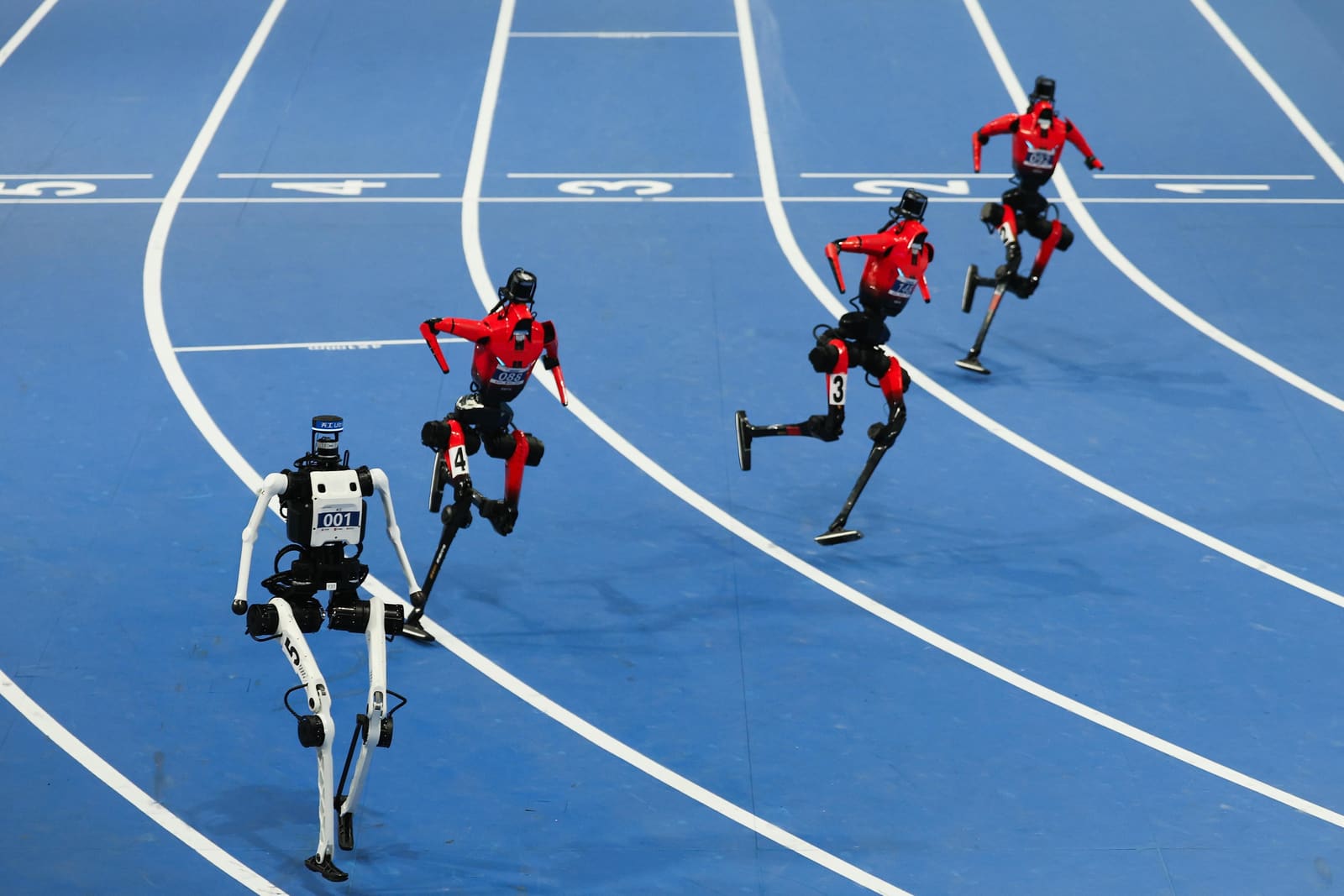
A seventeen-year-old athletics record fell this weekend, not to another human sprinter but to a pair of humanoid robots competing in Beijing. Tiangong Ultra, built by the Beijing Humanoid Robot Innovation Center, covered 100 meters in 9.39 seconds during a preliminary heat on Saturday. Close behind, Honor's Lightning platform clocked 9.47 seconds. Both times are faster than the 9.58-second mark Usain Bolt set in Berlin in 2009, a figure that has defined the outer edge of human speed ever since.
At DailyTechWire, we've tracked bipedal robotics for years, and the trajectory has been clear: balance and gait control improve incrementally, then suddenly someone rewrites the playbook. This weekend's performances are less about beating a human champion and more about demonstrating that the core engineering problems of high-speed bipedal locomotion - dynamic stability, power-to-weight ratio, real-time terrain sensing - are yielding to iteration and investment.
Inside the World Humanoid Robot Games
The competition took place at the World Humanoid Robot Games, an annual event that functions as both showcase and proving ground for legged robotics. Launched in 2025, this year's edition drew 2,056 robots from 16 countries, a participation count that underscores how quickly the field has grown beyond research labs and into commercial development pipelines. The event structure mirrors Olympic athletics: heats, finals, and a medal podium, but the athletes are actuators, carbon-fiber limbs, and vision systems running inference loops at kilohertz frequencies.
Tiangong Ultra also set a 400-meter record during the same meet, according to organizers, though specific times have not yet been published. That combination of sprint speed and middle-distance endurance points to advances in battery density and thermal management, two constraints that have historically forced designers to choose between peak power and sustained operation.
Why Speed Matters for Humanoid Design
Sprint performance is not a vanity metric. Running at nine-and-a-half seconds over 100 meters requires a humanoid to manage ground-contact forces several times its own weight, adjust its center of mass in real time, and recover from perturbations without falling. These are the same capabilities needed for a logistics robot navigating a crowded warehouse floor, a disaster-response unit crossing rubble, or a manufacturing assistant moving quickly between workstations.
The engineering leap from walking to running is non-trivial. Walking gaits keep at least one foot on the ground at all times, which simplifies balance. Running introduces a flight phase, where both feet leave the surface, and the machine must predict landing conditions and adjust limb angles on the fly. The control algorithms that enable this are directly applicable to any scenario where a robot must move quickly through unpredictable environments.
Beijing Humanoid Robot Innovation Center, the organization behind Tiangong Ultra, is part of a broader Chinese push into embodied AI and robotics. The center has received backing from municipal government funds and private investors, and its work sits at the intersection of hardware design, reinforcement learning, and low-latency sensor fusion. Honor, better known for consumer electronics, has been expanding its robotics division since 2024, and Lightning represents its first public demonstration of bipedal sprint capability.
The Asia Sprint in Legged Robotics
China's performance at the Games reflects a larger regional dynamic. Across Seoul, Shenzhen, and Tokyo, humanoid robotics has moved from speculative research to product roadmaps. Companies are building not just prototypes but manufacturing pipelines, training datasets, and go-to-market strategies. The capital flowing into the sector is substantial: venture rounds for humanoid startups in Asia topped $1.2 billion in the first half of 2026 alone, according to data from PitchBook.
South Korea's entries at the Games included models from Hyundai's robotics subsidiary and two university-backed teams. Japan fielded machines optimized for precision tasks rather than raw speed, a design philosophy consistent with the country's focus on elder care and service applications. The diversity of approaches on display in Beijing suggests that the category is still open, with no dominant architecture or control paradigm yet established.
What Comes After the Record
Breaking Bolt's time is a symbolic milestone, but the real test for these platforms is utility. Can a humanoid maintain this level of performance over varied terrain? Can it carry payload while running? Can it navigate autonomy - choosing routes, avoiding obstacles, reacting to unexpected events - without human supervision? These are the questions that will determine whether sprint records translate into commercial deployment.
The next iteration of the World Humanoid Robot Games is scheduled for 2027, and organizers have hinted at new event categories, including obstacle courses and multi-robot coordination tasks. For developers, the competition serves as both benchmarking tool and recruiting pitch: a fast time in Beijing attracts engineering talent, investor attention, and partnership inquiries.
At DailyTechWire, we expect the 9.39-second mark to fall within the next twelve months. The gap between hardware capability and algorithmic optimization is still wide, and the teams that competed this weekend are already iterating on sensor latency, actuator response curves, and training regimes. The sprint record will continue to drop, but the more interesting story will be how these machines perform when the track is uneven, the lighting is poor, and the task is something other than running in a straight line.