China's Biren Technology Eyes 21x Revenue Jump as Domestic AI Chip Demand Explodes
Shanghai GPU maker joins Hygon and Cambricon in capturing soaring orders, signaling deepening localization in China's semiconductor stack amid persistent export restrictions.
A Breakout Half for Shanghai's GPU Specialist
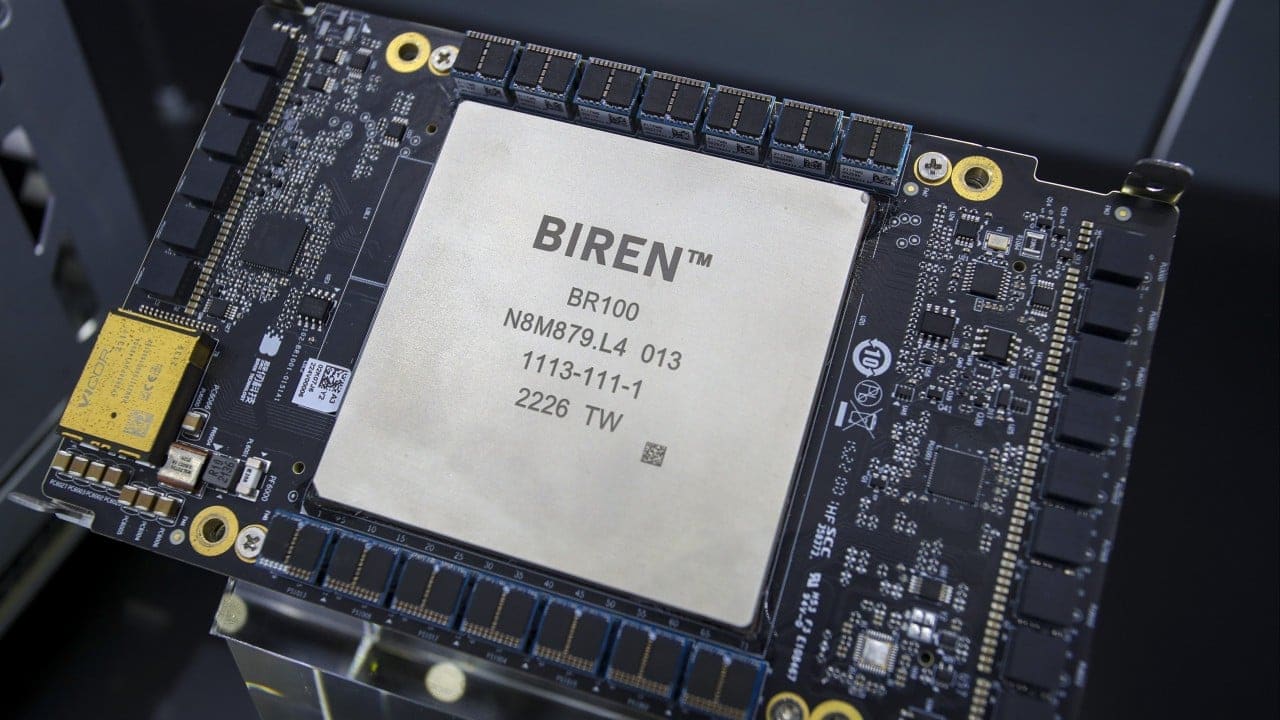
Biren Technology, the Shanghai-based GPU designer that listed in Hong Kong seven months ago, expects first-half 2026 revenue to land between 1.15 billion yuan and the high end of guidance, a surge that would represent roughly 2,100 percent year-on-year growth. The projection, disclosed in a trading update last week, underscores how quickly China's AI hardware ecosystem is absorbing locally manufactured accelerators now that U.S. export controls have effectively closed the door on Nvidia's H100 and newer data-center GPUs.
At DailyTechWire, we've tracked a consistent pattern across Chinese chipmakers over the past eighteen months: companies that once struggled to convert design wins into volume shipments are now reporting order backlogs that stretch into the second half of the year. Biren's guidance puts it in the same cohort as Hygon Information Technology and Cambricon Technologies, both of which have reported triple-digit revenue increases in recent quarters. The common thread is not a sudden technical breakthrough but rather a structural shift in procurement behavior. Hyperscalers, cloud providers, and AI labs inside China no longer have the luxury of waiting for export-license exceptions; they are designing systems around whatever silicon is available domestically, even if that means accepting narrower memory bandwidth or higher per-operation latency.
Policy Pressure Meets Market Pull
Washington's October 2023 update to the export-control framework drew the performance threshold low enough to catch most training-class accelerators, leaving Chinese buyers with three options: smuggle chips through third countries (risky and expensive), redesign models to run on older or export-compliant hardware (slow), or buy from domestic fabs. Biren, Cambricon, and Hygon have become the default beneficiaries of that third path. The Shanghai Municipal Government and several provincial investment arms have also channeled subsidies and procurement commitments toward local GPU projects, creating a floor of guaranteed demand that helps these companies achieve the unit volumes necessary to bring manufacturing cost per die down.
Biren's BR100 series, fabbed on a seven-nanometer process, targets inference workloads and lighter training runs. Independent benchmarks suggest the chip delivers roughly 40 to 50 percent of an A100's throughput on transformer models, but at a price point that Chinese data-center operators find acceptable given the alternative is zero supply. The company has also emphasized its software stack, releasing a CUDA-compatible runtime and a set of kernel libraries that let developers port existing PyTorch and TensorFlow code with minimal refactoring. In conversations we've had with engineers at two Beijing-based AI startups, both cited tooling maturity as the decisive factor in choosing Biren over competing domestic offerings; raw FLOPS matter less when the model can be deployed in weeks rather than months.
Revenue Scale and the Path to Profitability
Reaching 1.15 billion yuan in half-year revenue would place Biren's annualized run rate above 2.3 billion yuan, still modest by Nvidia or AMD standards but large enough to cover mask costs, sustain a couple of tape-outs per year, and fund a sales organization across tier-one cities. Gross margin remains the critical unknown. Biren has not disclosed first-half margin guidance, and historical figures show the company operated at a loss through 2025 as it ramped production and built channel partnerships. If average selling prices hold near current levels and foundry allocations remain stable, the path to positive operating income likely depends on shipping more than 50,000 units per quarter, a threshold that requires both sustained hyperscaler orders and penetration into the long tail of regional cloud providers.
The Hong Kong listing in January brought in roughly $400 million in primary proceeds, giving Biren a cushion to weather near-term cash burn. Investors who participated in that IPO are now sitting on paper gains, but the real test will come in the second half of 2026 when several next-generation designs from Cambricon and a revamped Hygon lineup enter volume production. Competition among Chinese GPU makers is intensifying precisely because the addressable market, while growing fast, is still bounded by export-control walls; no one can easily sell these chips outside China, so every player is fighting for share in the same domestic pool.
Implications for the Broader Stack
Biren's revenue trajectory offers a concrete data point on a question that has occupied semiconductor analysts and policy researchers for the past two years: can China build a self-sufficient AI compute stack quickly enough to keep its large-language-model and computer-vision industries advancing at a pace that matches or approximates the rest of the world? The answer, based on the numbers we're seeing, is a qualified yes. Chinese labs are training models in the 30-billion to 70-billion parameter range using clusters built entirely on domestic accelerators, and inference latency for production deployments has improved as software optimizations catch up to hardware capabilities.
That progress comes with trade-offs. Frontier-scale training, the kind that pushes into the trillion-parameter regime, remains out of reach without access to the memory bandwidth and interconnect fabric that Nvidia's latest generation provides. Chinese researchers are exploring model-parallelism techniques, sparsity, and quantization to work around those limitations, but each workaround introduces its own engineering overhead. The result is a bifurcated AI landscape: China continues to iterate rapidly on applications and verticals where 70-billion-parameter models suffice, while cutting-edge research that requires more compute either moves at a slower cadence or relocates to jurisdictions with fewer restrictions.
For Biren and its peers, the strategic imperative is clear. They must continue closing the performance gap, not by matching Nvidia spec-for-spec, which would trigger fresh export scrutiny on the equipment needed to manufacture such chips, but by optimizing for the specific workloads that dominate the Chinese market: recommendation engines, video understanding, speech processing, and localized large-language-model inference. If the company can deliver a credible second-generation product by late 2027 and maintain gross margins above 30 percent, it will have proven that a viable, vertically integrated AI hardware industry can exist within export-constrained borders. If margins stay compressed and hyperscaler buyers begin designing their own ASICs, Biren's window may close faster than its twenty-fold revenue surge would suggest.