Beijing's Booster Recovery Narrows SpaceX's Launch Economics Lead
A state-owned Chinese aerospace firm has landed an orbital rocket on a ship, signaling the end of SpaceX's near-monopoly on cost-cutting reusability and opening a new front in satellite services competition across the Global South.
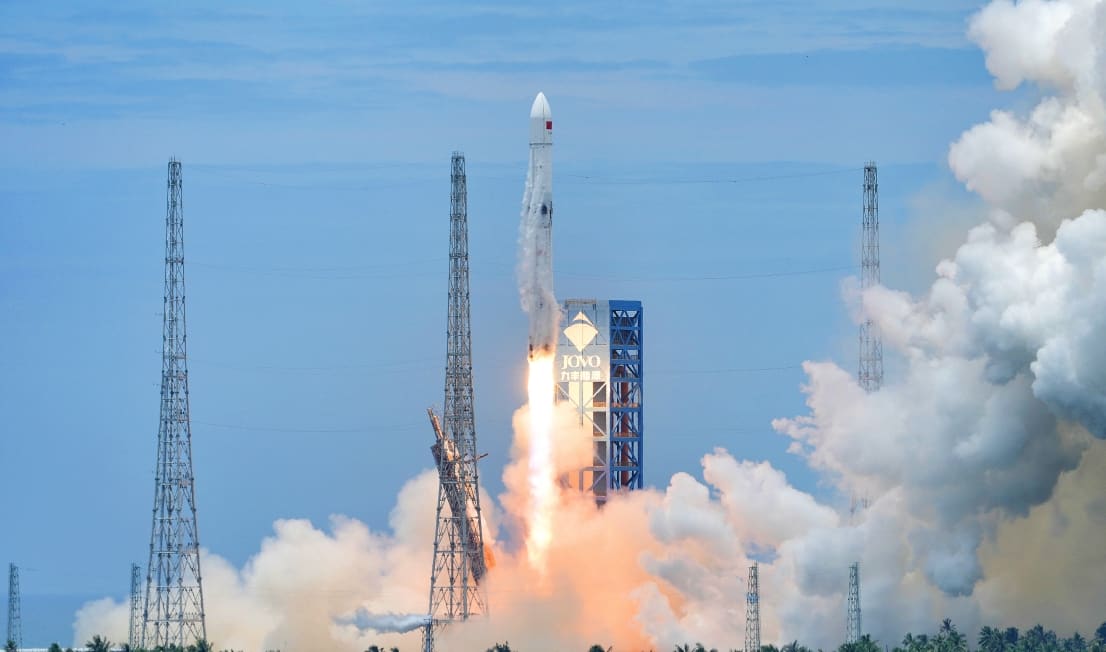
A Milestone in the South China Sea
On Friday, China's Aerospace Science and Technology Corporation achieved something only one other entity has managed: guiding an orbital-class rocket booster through a controlled descent and capturing it aboard a seagoing vessel. The demonstration marks a turning point in global space economics, signaling that the cost advantages SpaceX has wielded for nearly a decade may soon face serious competition from Beijing.
The Long March booster in question carries roughly the same payload capacity as the Falcon 9, the workhorse vehicle that underpins SpaceX's dominance in commercial and government launches. CASC announced plans to refly the recovered hardware before year-end, a timeline that would compress into months what took SpaceX years to refine.
What makes Friday's event significant is not the landing itself but the engineering stack it represents. Bringing a rocket stage back to a moving platform in open water demands precision guidance software, resilient sensors, and engines capable of restarting mid-flight after surviving the thermal and mechanical stresses of atmospheric re-entry. These are not trivial problems, and solving them at scale is what separated SpaceX from every other launch provider for the better part of a decade.
A Different Capture Mechanism, the Same Physics
CASC's approach diverges from SpaceX's in one visible way: instead of unfolding landing legs and settling the booster onto a platform, the Chinese system uses a large netted frame stretched across the recovery ship to catch the descending stage. The technique shifts some mechanical complexity from the rocket to the vessel, but the core challenge remains identical. The booster must slow itself, orient correctly, and arrive at a precise point in space and time, all while managing propellant reserves and engine throttle in real time.
The engineering underneath that final capture is what matters. Guidance algorithms must account for wind shear, sea state, and the booster's shifting center of mass as propellant drains. Engines must fire reliably after minutes of freefall through plasma. Structural components must withstand forces they were not originally designed to endure, since expendable rockets are optimized for a one-way trip.
At DailyTechWire, we've tracked the incremental progress of China's reusable rocket programs for the past three years, watching static-fire tests, hop flights, and suborbital demonstrations build toward this moment. The speed of iteration has been notable, particularly given that CASC is a state-owned enterprise historically known for conservative, methodical development cycles rather than the rapid prototyping culture that defines SpaceX.
The Economics of Reuse
Reusability matters because it rewrites the unit economics of space access. A Falcon 9 booster can fly ten or more times, amortizing its construction cost across multiple missions and reducing the marginal expense of each launch to propellant, refurbishment labor, and operational overhead. This is the mechanism that allowed SpaceX to undercut legacy providers and enabled the capital-intensive buildout of Starlink, which now operates thousands of satellites and serves customers on every continent.
If CASC can achieve similar reuse rates, the implications ripple across multiple markets. China's own satellite communications networks, including state-backed constellations intended to rival Starlink, would gain a significant cost advantage over the expendable rockets they rely on today. Hypothetical orbital data centers, a concept Chinese aerospace entities have explored in recent white papers, would become more economically viable.
More immediately, a reusable Chinese rocket would alter the competitive landscape for launch services in regions where geopolitical alignment matters more than technical specifications. National security export controls effectively partition the global launch market: U.S. and European customers contract with Western providers, while Russian and Chinese rockets serve a different client base. But that second group includes much of Africa, the Middle East, and Southeast Asia, regions where demand for satellite connectivity is growing and where Starlink's first-mover advantage is not yet entrenched.
Victoria Samson, chief director for Space Security and Stability at the Secure World Foundation, framed the development as a potential shift in soft power dynamics. A reusable Chinese rocket could enable Beijing to offer launch services to partner nations at prices that undercut current alternatives, deepening economic and technological ties in the process.
Starlink's Advantage Under Pressure
For SpaceX, the strategic concern is not direct competition for U.S. government contracts, which remain legally restricted to domestic providers. The worry is that a cost-competitive Chinese launch capability accelerates the deployment of rival satellite networks, eroding Starlink's dominance in international markets before the constellation has fully monetized its capital expenditure.
Starlink's success in providing battlefield connectivity in Ukraine has already drawn attention from adversaries. A consortium of investigative journalists recently published documents indicating that China and Russia are exploring methods to degrade or disrupt the network, recognizing its role in enabling distributed military communications that are difficult to jam or interdict.
A reusable Long March rocket does not directly threaten Starlink's satellites, but it does enable faster, cheaper deployment of competing constellations. If Chinese operators can launch at comparable cost and cadence, the economic moat that SpaceX has built narrows considerably.
The U.S. Response Remains Fragmented
SpaceX's most ambitious response is Starship, a fully reusable heavy-lift vehicle designed to carry an order of magnitude more payload than Falcon 9. The program has faced setbacks, including a recent launch attempt that ended with mixed results. Another test flight is expected this month, and a static-fire test of the booster stage completed successfully, suggesting the program is still progressing despite public scrutiny and technical challenges.
Beyond SpaceX, the U.S. launch sector includes several companies pursuing reusability with varying degrees of progress. Blue Origin, the venture backed by Jeff Bezos, recovered a booster in 2025 and reflew it earlier this year, but a launch pad explosion in May has delayed further attempts. Rocket Lab is developing Neutron, a medium-lift rocket with a reusable first stage, while Stoke Space is working on a fully reusable design it hopes to test before year-end.
None of these efforts have yet achieved the operational tempo or cost structure that SpaceX has demonstrated with Falcon 9, and none are positioned to respond immediately to a Chinese competitor entering the reusable launch market. The U.S. lead in space economics, once taken for granted, now depends on continued iteration and successful execution of next-generation systems.
What Comes Next
CASC's stated goal is to refly the recovered booster within six months. If that timeline holds, the next milestones to watch will be turnaround time, refurbishment cost, and the number of reflights the hardware can sustain. SpaceX needed years to optimize these variables; whether China can compress that learning curve will determine how quickly the competitive landscape shifts.
For policymakers and military planners in Washington, the demonstration is a reminder that technological leads are temporary. The sensors, software, and materials science required for rocket reusability are no longer exclusive to one company or one country. The question now is not whether others will catch up, but how quickly they can translate technical capability into operational advantage.