Auto Giants Pour Billions Into Humanoid Robots as EV Margins Collapse
Chinese carmakers are racing to replicate Tesla's robotics pivot, betting that machines can deliver the profits that vehicles no longer can.
From Wheels to Walking Machines
Xpeng's robotics division closed a $900 million funding round this week at a post-money valuation exceeding $6.3 billion, marking the largest single private round in China's embodied AI sector. IDG Capital led the investment, with Tencent, Alibaba, and Gaorong Ventures joining. The capital influx underscores a broader strategic shift: automakers are no longer content to build cars alone.
The timing is telling. Electric vehicle margins across China have compressed to single digits, and in some cases turned negative, as price wars intensify. For manufacturers who once projected double-digit returns on next-generation platforms, the reality has been sobering. Humanoid robots, by contrast, promise higher-margin hardware sales, recurring software revenue, and - crucially - a path out of the commoditization trap that has ensnared the EV industry.
Xpeng founder He Xiaopeng and co-president Brian Gu personally invested roughly $100 million into the recent round, a signal of conviction that goes beyond corporate strategy. Their vehicle business may be scaling, but the profit outlook remains bleak. Robots, they believe, offer a different equation.
A Playbook Borrowed from Palo Alto
Michael Dunne, CEO of advisory firm Dunne Insights, describes Xpeng as the Chinese automaker most attuned to Tesla's moves. The company was early to autonomous driving, and it is now first among its domestic peers to commit significant capital to humanoid robotics. The parallel is deliberate: Tesla's Optimus project has served as both proof-of-concept and competitive benchmark.
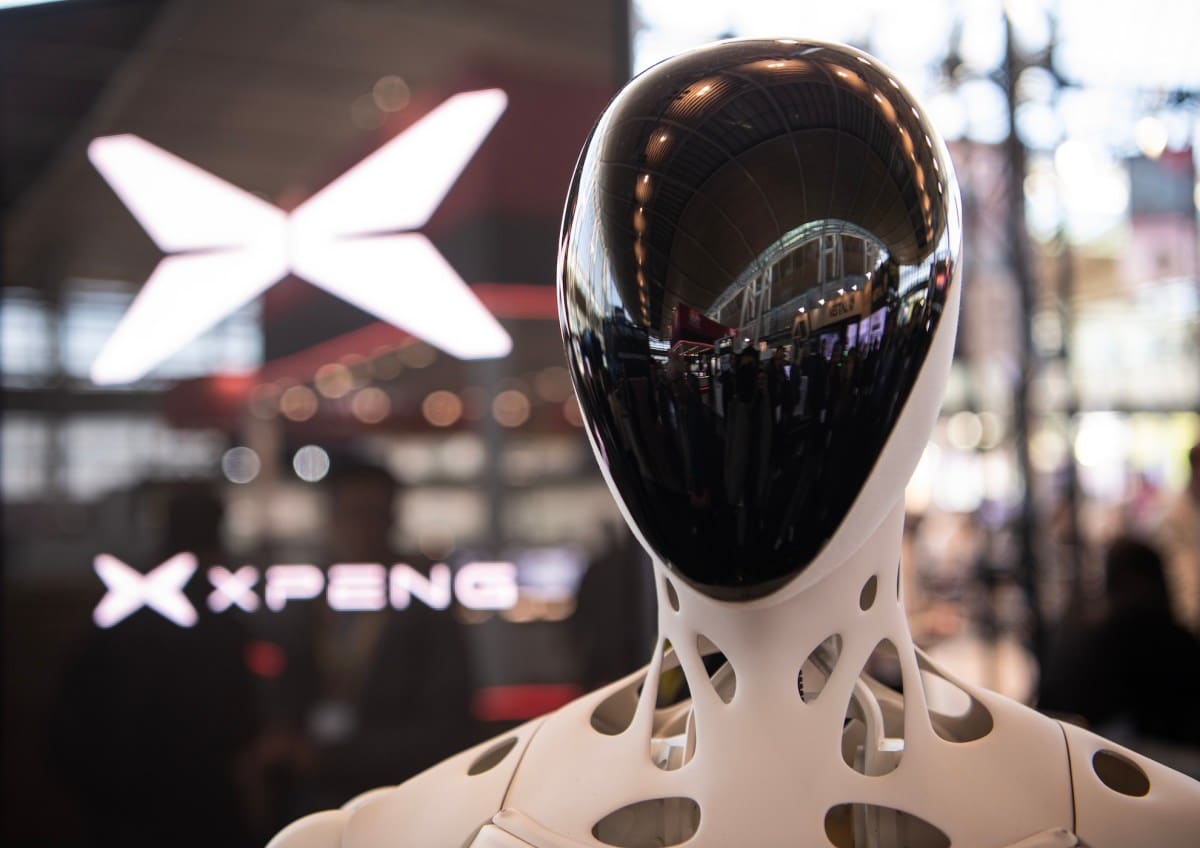
Xpeng's Iron robot is designed with a human-analogous form factor and built for commercial deployment, not laboratory demonstration. The unit's $6.3 billion valuation reflects investor confidence that the technology can transition from prototype to production within a compressed timeline - a capability Chinese manufacturers have demonstrated repeatedly in hardware categories from drones to smartphones.
Yet the manufacturing advantage is only half the story. Dunne points out that Chinese automakers possess the supply chain depth, fabrication know-how, and cost discipline to produce robots at scale. The open question is whether they can match the AI capabilities that underpin task learning and real-time adaptation. That software layer, where Tesla has invested heavily through its full-self-driving work, remains the harder problem.
The Broader Stampede
Xpeng is far from alone. Chery Automobile's robotics unit, AiMOGA, is reportedly preparing for a public listing, while BYD introduced its Xiao Di humanoid earlier this month. Changan, GAC, Li Auto, SAIC, and Seres have all disclosed humanoid development programs. The convergence suggests a shared calculus: the skills required to build electric vehicles - battery integration, motor control, sensor fusion, software orchestration - translate directly to robotics.
Outside China, the momentum is equally pronounced. Hyundai plans to deploy Boston Dynamics' Atlas humanoid at its Georgia manufacturing facility later this year, with full parts-sequencing tasks targeted for 2028. The Korean conglomerate has partnered with Google DeepMind to accelerate the robot's learning stack and is opening a dedicated Robot Metaplant Application Center to train machines on lift-and-turn movements at industrial scale.
Automotive supplier Mobileye acquired humanoid startup Mentee Robotics for $900 million earlier this year, while Rivian spun out Mind Robotics to explore non-humanoid form factors. The pattern is clear: companies with deep expertise in actuators, perception systems, and real-time compute are extending those capabilities into bipedal machines.
Why Humanoids, Why Now
Two technical tailwinds have converged to make humanoid robots commercially plausible. First, hardware has matured. Actuator efficiency, battery energy density, and sensor miniaturization have all crossed thresholds that enable sustained operation in unstructured environments. Robots can now walk, balance, and manipulate objects with a level of dexterity that was unattainable five years ago.
Second, the AI techniques that power large language models - transformer architectures, reinforcement learning from human feedback, multimodal training - are proving applicable to embodied systems. Researchers have shown that robots can learn complex tasks from video demonstrations, natural language instructions, and simulated environments, then transfer that knowledge to physical hardware. The result is a machine that can generalize across tasks rather than require bespoke programming for each operation.
For automakers, this convergence is both opportunity and threat. Factories already employ thousands of stationary industrial robots; humanoids promise to handle the remaining tasks that require mobility, fine motor control, or decision-making in variable conditions. The same machines could eventually be sold into logistics, healthcare, and hospitality sectors, opening revenue streams far larger than the automotive market.
The Economics of Embodied AI
At DailyTechWire, we've tracked the capital flows into robotics over the past eighteen months, and the pattern is unmistakable: investors are betting that humanoid robots will follow the cost curve that smartphones and EVs traced - expensive prototypes giving way to mass-market products within a decade. The difference is that robots are not consumer devices. They are capital goods, and their buyers will demand rapid payback periods.
That creates pressure to prove commercial viability quickly. Companies like Agility Robotics, Apptronik, and Figure are all racing toward the same milestone: deployment at scale in real-world settings, not controlled demos. The winners will be those who can deliver robots that justify their purchase price within two to three years of operation, a benchmark that requires both hardware reliability and software that minimizes downtime.
Chinese automakers enter this race with a structural cost advantage. Their supply chains are optimized for high-volume, low-margin production, and their engineering teams are accustomed to rapid iteration. But the AI layer remains unproven. Training robots to handle edge cases, recover from errors, and improve over time demands data infrastructure and algorithmic sophistication that few companies outside the AI research labs have mastered.
What Happens When Cars Build Robots
The automotive industry's pivot into robotics carries implications beyond product roadmaps. If humanoid robots achieve commercial traction, the companies that manufacture them will control a new category of infrastructure - machines that reshape labor markets, redefine factory layouts, and potentially displace human workers in sectors from warehousing to elder care. The policy and ethical questions that follow are not trivial.
For now, the focus remains on proving technical feasibility and economic viability. Hyundai's Georgia deployment will serve as a high-profile test case, as will the rollout of Xpeng's Iron units in Chinese factories and logistics hubs. If those deployments succeed, expect the capital flowing into humanoid robotics to accelerate further.
The automakers making these bets are not abandoning vehicles. They are acknowledging that the next frontier of profitability lies in machines that walk, not roll. Whether that bet pays off will depend on execution, timing, and the willingness of customers to trust robots with tasks that humans have always performed. The funding rounds suggest that investors, at least, are ready to find out.