Alibaba's ABot Merges Five Robot Functions Into One System
The mapping unit's new architecture collapses navigation, manipulation, and cognition layers into a unified framework, intensifying the embodied AI race across Chinese tech giants.
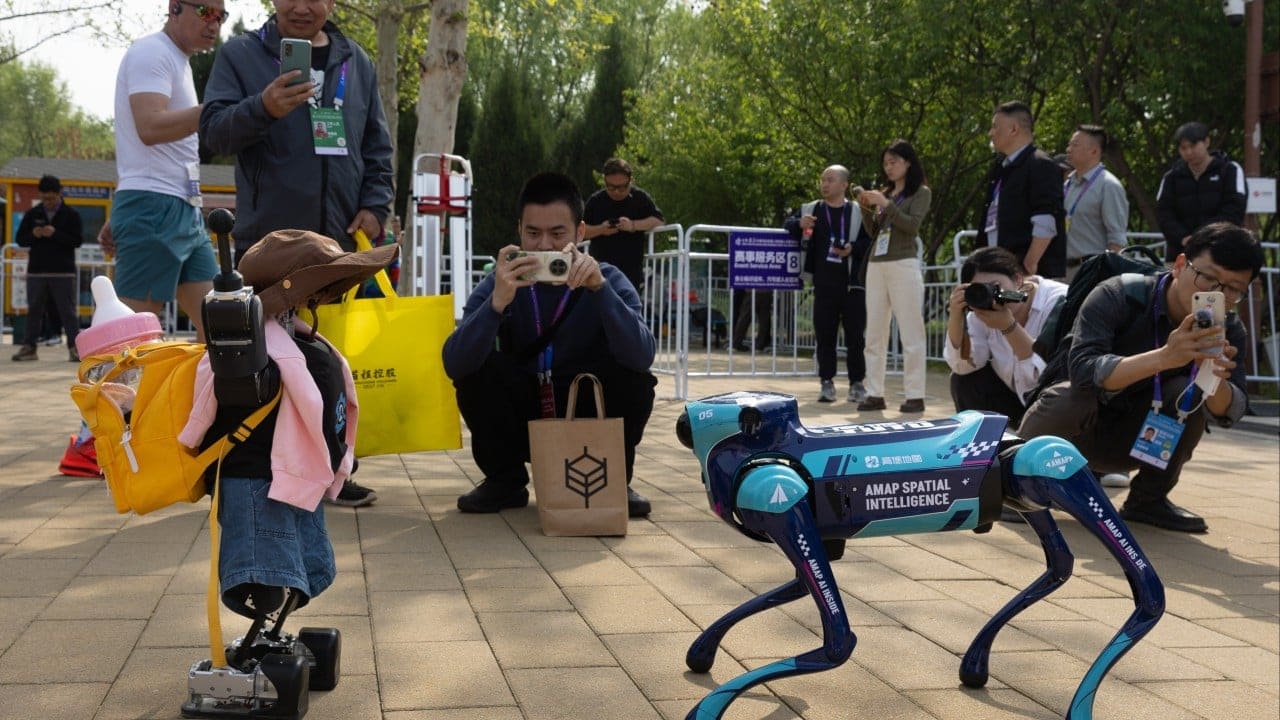
A Single Architecture for the Whole Machine
Amap, the navigation and mapping division inside Alibaba Group, has released an upgraded robotics platform it calls ABot, designed to unify five traditionally separate subsystems: locomotion, manipulation, reasoning, sensory processing, and motor execution. According to Amap, the framework represents the first commercially oriented architecture to collapse these layers into one end-to-end model, eliminating the handoffs that slow down most current robots.
The announcement arrives as mainland firms accelerate their push into embodied intelligence, the discipline of building machines that can reason about the physical world and act on it in real time. Where large language models handle text and images, embodied systems must fuse vision, force feedback, and spatial memory to pour a cup of coffee or navigate a warehouse aisle. ABot's design treats all five functions as modules inside a single neural network, trained jointly rather than bolted together after the fact.
At DailyTechWire, we've tracked a marked uptick in embodied AI investment across Shenzhen, Beijing, and Hangzhou over the past eighteen months. Venture rounds for humanoid and logistics robot startups in the region have exceeded 12 billion yuan in the first half of this year alone, according to data from the China Robot Industry Alliance. That capital is chasing a narrow technical window: whoever ships a robot that can learn new tasks without days of retraining will command the next wave of factory automation and eldercare contracts.
Why Unification Matters
Most industrial robots today run three-tier stacks. A vision module identifies objects, a planning layer decides how to grasp them, and a control layer sends joint commands to actuators. Each tier uses a different model, often from different vendors, and every boundary introduces latency and error accumulation. If the planner misreads the vision output by a few millimeters, the gripper closes on air.
Amap's approach folds perception, high-level reasoning, and low-level motor control into one transformer-based architecture. Sensor data flows into a shared embedding space, where the same set of weights predicts both the next navigation waypoint and the next finger position. Because gradients propagate through the entire stack during training, the system learns which visual features matter for grasping and which matter for obstacle avoidance, rather than guessing at module boundaries.
The practical payoff shows up in task generalization. A robot trained to stack cardboard boxes in a distribution center can, in principle, transfer much of that knowledge to stacking plates in a hotel kitchen, because the perceptual and motor representations live in the same latent space. Traditional pipelines require retraining each module separately, and the vision system has no gradient signal from the gripper's success or failure.
The Embodied Intelligence Sprint in China
Amap is far from alone. Xiaomi, which entered the humanoid robot market last year, has been refining its CyberOne platform with similar end-to-end architectures. Tencent's Robotics X lab published a preprint in June describing a unified model that handles bipedal locomotion and dual-arm manipulation for domestic tasks. Baidu's AI Cloud division offers a pre-trained embodied foundation model as a cloud service, targeting logistics customers who lack the compute to train from scratch.
The common thread is scale. Chinese labs have access to enormous datasets: millions of hours of factory-floor video, sensor logs from delivery drones, and human teleoperation recordings collected by contract workers in rural provinces. Embodied models are data-hungry. A single manipulation policy can consume tens of thousands of pick-and-place demonstrations before it generalizes to novel objects. The firms that can gather, clean, and label that data fastest will set the performance baseline for the rest of the industry.
Export controls on high-end GPUs have pushed some teams toward more efficient architectures. Amap has not disclosed ABot's parameter count or training hardware, but the emphasis on unification suggests a design that reduces redundant computation. If one set of attention layers can serve both navigation and manipulation, the same cluster of domestic AI accelerators can train a more capable robot than two separate models would allow.
Open Questions and Integration Risk
Unifying five subsystems into one model solves some problems and creates others. A single network is harder to debug. When a traditional robot fails to grasp an object, an engineer can isolate the vision module, check its bounding boxes, and retrain just that component. In an end-to-end system, failure modes are entangled. The same weights influence obstacle detection, path smoothness, and grip force. A gradient update that improves navigation might degrade manipulation, and teasing apart those effects requires careful ablation studies that many deployment teams skip.
Amap's rollout strategy will be telling. If ABot debuts in controlled environments like warehouse aisles or hotel corridors, it signals that the company understands the system's limits. If marketing materials promise general-purpose domestic robots within a year, it suggests the usual gap between research demos and production reliability. The history of robotics is littered with unified architectures that worked beautifully in the lab and failed when a child left a toy on the floor.
Another variable is regulatory. China's Cyberspace Administration has signaled that embodied AI systems processing video in public or private spaces will fall under the same data-security rules that govern autonomous vehicles. That means ABot deployments in malls or office buildings may require on-device inference, which constrains model size, or encrypted upload to approved cloud regions, which adds latency. Either path narrows the performance envelope.
What Comes Next
The next twelve months will clarify whether unified embodied architectures are a genuine step change or a research fashion. Amap has promised a developer preview of ABot in the fourth quarter, and several Hangzhou-based logistics firms have reportedly signed pilot agreements. If those pilots produce measurable cost savings compared to incumbent robotic systems, expect a wave of follow-on deployments and, shortly after, a wave of acqui-hires as larger industrial players buy the teams that built competing stacks.
The deeper question is how much task diversity one model can handle. A robot that navigates, manipulates, and reasons in a warehouse is impressive. A robot that does all three in a warehouse, then walks into a kitchen and sets a table, then climbs a ladder to change a lightbulb, would be transformative. No embodied system today comes close to that breadth, and the data requirements grow combinatorially with each new domain. Amap's unified architecture is a bet that shared representations will carry across contexts. Whether that bet pays off depends on how much structure the physical world actually shares, and how much is irreducible domain knowledge that still requires separate training.
For now, ABot represents the kind of vertical integration Chinese tech giants excel at: mapping data feeds perception, cloud infrastructure feeds training, and an enormous domestic market feeds deployment feedback. The result is a faster cycle time than most Western labs can match, and faster cycles tend to win in machine learning. The race is no longer just about who has the best algorithm. It is about who can close the loop from deployment back to training quickly enough to compound their advantage before the window closes.