Synthesia Adds Live AI Coaching to Prove Training Actually Works
The London startup is betting enterprises will pay more for measuring behavior change than for generating sleek training videos.
From Video Generator to Performance Tracker
For the past several years, Synthesia has sold enterprises on a straightforward value proposition: replace expensive, time-consuming training video production with AI-generated avatars that can deliver scripted content in minutes. This week, the London-based company introduced a product that signals a different ambition - proving that the training actually changed how employees behave.
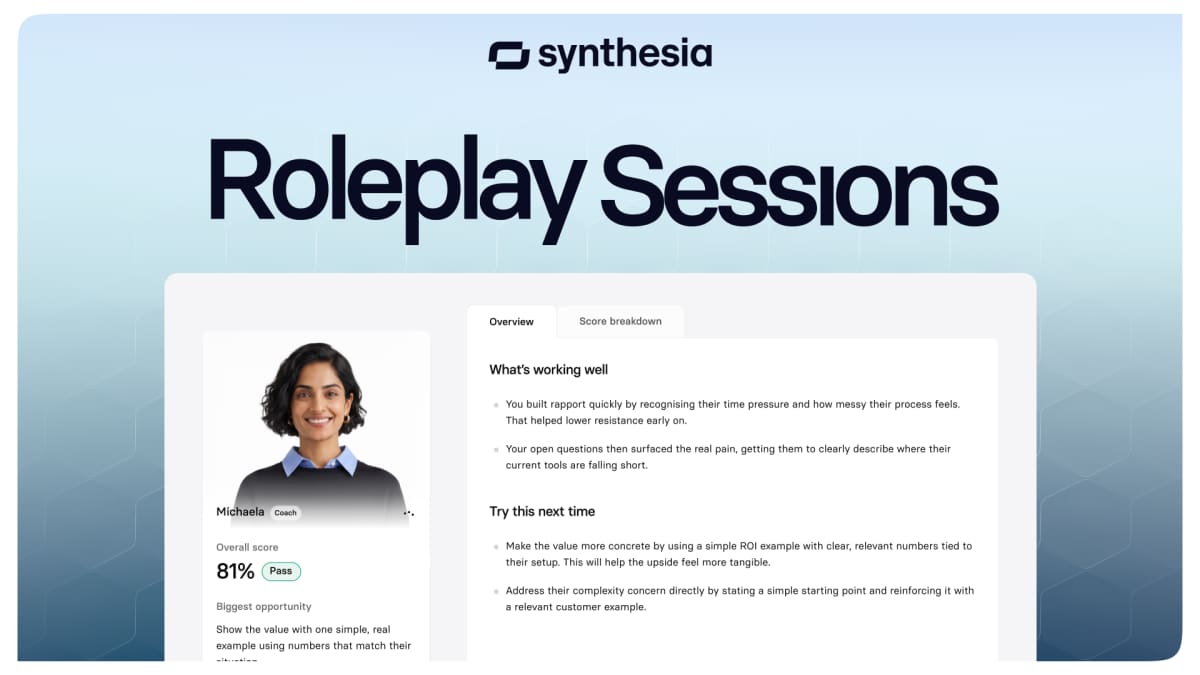
Roleplay Sessions allows workers to rehearse high-pressure scenarios - sales conversations, performance reviews, customer escalations - opposite an AI avatar that responds dynamically, objects when appropriate, and evaluates the exchange against a predefined rubric. The product launched Wednesday and represents the first module in a broader "Sessions" platform that Synthesia intends to expand into candidate screening and interview preparation.
The timing reflects a broader shift in enterprise AI procurement. Companies that spent heavily on generative tools in 2023 and 2024 are now asking whether those investments delivered measurable returns. At DailyTechWire, we've tracked this accountability wave across sectors - CFOs demanding ROI dashboards, procurement teams writing performance clauses into SaaS contracts, and vendors scrambling to instrument their products with analytics.
Why Video Alone Does Not Stick
Synthesia's pivot rests on a claim drawn from learning science meta-analyses: most corporate training - video included - informs but does not durably change behavior. Employees watch, nod, and return to old habits. What reliably moves the needle, according to the research Synthesia cites, is practice combined with feedback loops.
Victor Riparbelli, Synthesia's CEO and co-founder, framed the limitation candidly. Video outperforms static documents and text-heavy modules, he noted, but it still falls short of the retention and skill transfer that come from doing the thing you're supposed to learn. Roleplay Sessions attempts to close that gap by letting learners fail, adjust, and try again in a low-stakes environment before facing a real customer or direct report.
The design is straightforward. A company uploads training objectives, rubrics, and any existing instructional material. Employees then engage in simulated conversations with an avatar powered by Synthesia's proprietary voice and video synthesis - backed by OpenAI's reasoning models for dialogue. After each session, the system scores the interaction on dimensions like clarity, objection handling, empathy, or adherence to company policy.
The Real Product Is the Data Layer
The more defensible bet Synthesia is making is not the avatar technology itself - though the company has invested heavily in natural-sounding voice cloning and expressive video generation - but the performance infrastructure underneath. By capturing granular interaction data, Synthesia positions itself as a talent-mapping tool rather than a content vendor.
Riparbelli highlighted the managerial interest this unlocks. If an entire sales organization practices pitches through Roleplay, leadership gains visibility into skill distributions, coaching gaps, and readiness at the individual and team levels. That kind of intelligence has historically required expensive assessment centers, external consultants, or manager observation that does not scale.
The company already counts a handful of large customers piloting Roleplay at scale, including a top-three European company by market capitalization, a top-five Fortune 100 firm, and a major global recruitment company, according to a Synthesia spokesperson. The two dominant use cases so far are sales enablement and leadership development - particularly around soft skills like delivering difficult feedback or navigating objections.
Customers can either build their own training scenarios using Synthesia's platform or work with the company's consulting team to design bespoke programs that incorporate existing documentation, compliance requirements, and company-specific language.
From Enterprise to Broader Markets
For now, Roleplay remains an enterprise offering with pricing tailored to large deployments. But Synthesia intends to open access to small businesses, individual professionals, and educational institutions in the coming months as inference costs decline. The economics of running real-time conversational AI have improved materially over the past year, driven by more efficient models and competition among cloud providers.
Riparbelli sees this as part of a broader maturation in how companies evaluate AI tools. The era of viral demos and splashy product launches is giving way to a more sober calculus: does this tool produce a business outcome I can measure? Can I show my board that spending on this platform reduced onboarding time, improved win rates, or cut attrition?
That shift favors vendors who can instrument their products with the kind of analytics that map cleanly onto existing performance metrics. Synthesia's move into live, interactive coaching is a bet that the next wave of enterprise AI adoption will reward platforms that do more than generate artifacts - they will need to prove those artifacts led to tangible change.
What This Means for the Training Market
Synthesia's expansion into interactive coaching reflects a pattern we've observed across Asia and Europe: enterprises are consolidating spend around fewer, deeper platforms rather than assembling point solutions. A vendor that offers video creation, live practice, and analytics in one contract is more attractive than three separate tools that require integration work and multiple procurement cycles.
It also intensifies competition in the corporate learning space. Companies like BetterUp, Gong, and various LMS providers have staked claims on adjacent territory - coaching, conversation intelligence, and skills tracking. Synthesia's advantage is that it already sits inside many of these organizations as the video layer; expanding into behavior measurement is a natural upsell rather than a net-new wedge.
The longer-term question is whether the performance data Synthesia collects will become a moat in its own right. If the company can demonstrate that its rubrics and scoring algorithms predict real-world outcomes - higher quota attainment, lower complaint escalation, faster promotion readiness - it could build a proprietary dataset that competitors cannot easily replicate, even if they match the avatar quality.
For now, Roleplay represents a pragmatic acknowledgment: the most impressive AI-generated video is worth little if the person watching it forgets everything an hour later. The companies that solve for retention, not just production, are the ones more likely to survive the current enterprise AI shakeout.