A Startup Wants to Cool Down AI Chips Using AI-Discovered Materials
Discovered Materials deploys agent swarms to hunt thermal solutions for semiconductors, raising $9M to tackle data center heat
The Heat Problem Nobody Talks About
Data centers running AI workloads face a quiet crisis: the chips get dangerously hot. That heat demands vast cooling infrastructure and drives electricity consumption skyward. Now a Bay Area startup is proposing to fight fire with fire, using AI itself to discover materials that might keep semiconductors cooler.
Discovered Materials announced a $9 million seed round led by Lightspeed India Partners, with backing from Peak XV Partners and angels including Paul Graham, Gokul Rajaram, and Thariq Shihipar. The company emerged from Y Combinator earlier this year and is betting that thermal management, not general materials discovery, is where the commercial opportunity lies.
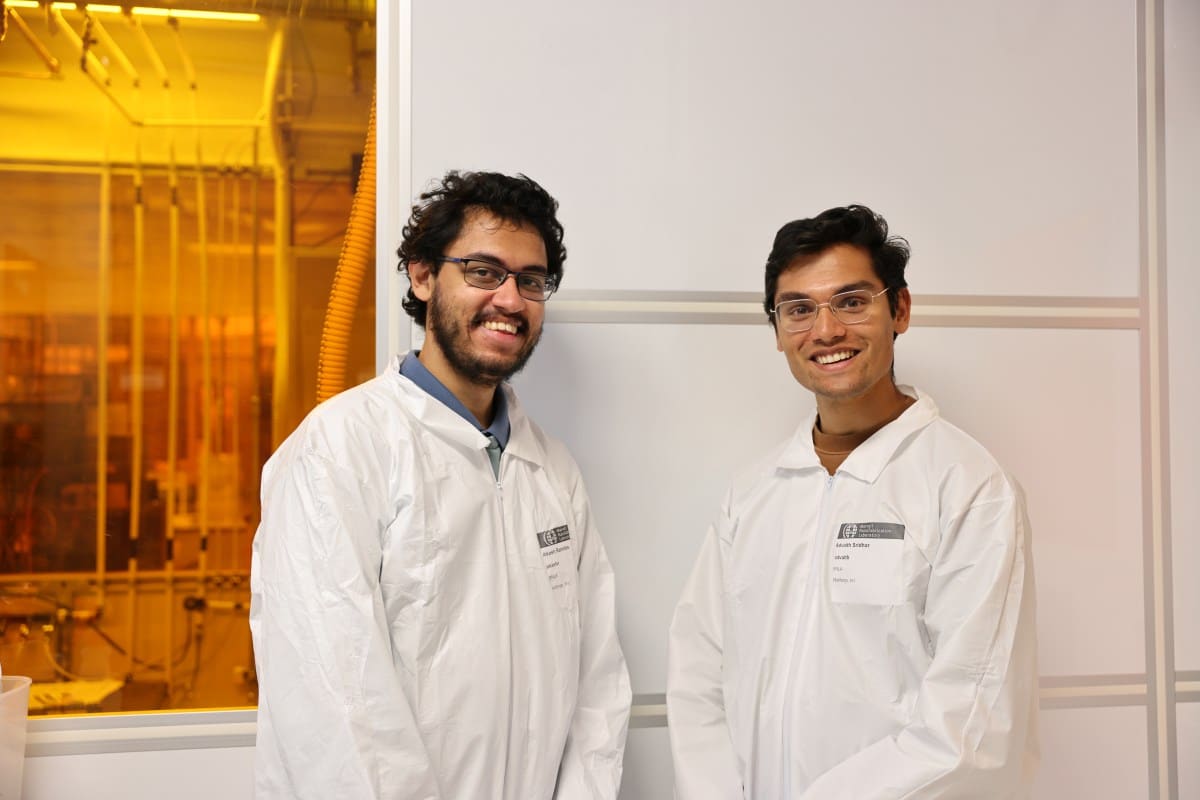
Co-founders Advaith Sridhar and Akash Ramdas built a software pipeline that deploys swarms of AI agents to generate and validate material candidates around the clock. Ramdas holds a doctorate in materials science from Stanford; Sridhar previously worked on agent systems at Persona AI and Luma Labs. Their approach combines Anthropic's models in a custom harness with proprietary physics simulations to filter promising leads from noise.
Thousands of Guesses Per Day
The velocity is the pitch. During his doctoral work, Ramdas might have tested twenty material hypotheses in a day. The startup's agent system now runs thousands of simulations daily, exploring research directions continuously on cloud infrastructure.
The company released examples of hundreds of novel materials alongside a "Material Discovery Bench" designed to benchmark how frontier models handle this class of problem. The bench aims to track progress as models improve, though Discovered Materials isn't alone in the space. MatNex, SandboxAQ, and CuspAI have all launched similar efforts in recent months.
What sets this team apart, they argue, is the narrow focus. Rather than chasing every category of material science, they are zeroing in on the thermal characteristics of semiconductor materials. Heat dissipation and heat generation are the twin constraints they want to crack.
The startup claims it has already identified several materials that match the thermal and electrical properties of substances currently used by major chipmakers, though it declined to share specifics for competitive reasons.
Playing Whack-a-Mole at the Atomic Level
Hemant Mohapatra, the Lightspeed partner who led the round, described the challenge as a high-dimensional search problem. A material might excel at thermal dissipation but prove impossible to manufacture at scale. Or it might reduce heat generation while compromising electrical conductivity. Every property must converge simultaneously for a candidate to be commercially viable.
Mohapatra expects the prediction layer to commoditize as models continue advancing. Where Discovered Materials might sustain an edge, he believes, is in Ramdas's domain expertise and the team's ability to run a lab that can quickly synthesize and validate candidates. The founders say they have already begun wet-lab experiments on several materials.
When they identify valuable candidates, the plan is to patent either the use of those materials in GPUs or the manufacturing process required to integrate them into chips. The company would then license the IP to chipmakers. Sridhar hopes to have patentable materials within the next year.
The Commercial Reality Check
For all the momentum in AI-driven materials discovery, commercial deployment remains elusive. No drug or material discovered primarily through AI has yet reached large-scale market adoption. The closest example in pharmaceuticals is Insilico Medicine's Renterosib, the first generative-AI-discovered drug to enter Phase II clinical trials.
On the materials side, promising leads have surfaced. MatNex announced rare-earth-free permanent magnets; Panasonic and Citrine Informatics collaborated on new semiconductor materials. But none have shipped in volume.
Mohapatra argues that candidate generation is no longer the bottleneck. Filtering correctly and synthesizing at scale are the hard parts. That reality shapes Discovered Materials' strategy: the company is building lab capacity alongside its software pipeline, acknowledging that validation cannot be automated away.
Sridhar is candid about the timeline. While the startup's proprietary data and Ramdas's expertise might help it compete with better-funded frontier labs, much of the work ahead involves physical experimentation. Wet-lab synthesis, he noted, is a process that cannot be sped up arbitrarily.
Asia's Semiconductor Stakes
The thermal challenge is especially acute in Asia's semiconductor ecosystem. Taiwan, South Korea, and increasingly China are home to the world's most advanced chip fabs, where process node shrinkage has pushed power density to new extremes. Cooling infrastructure now represents a meaningful share of fab capital expenditure, and any material that improves thermal performance could ripple through supply chains.
At DailyTechWire, we've tracked a pattern: venture dollars flowing into the materials layer of the AI stack have accelerated sharply since late 2025, as investors recognize that compute bottlenecks are increasingly physical rather than algorithmic. Discovered Materials is part of that wave, but its success will hinge on whether the transition from simulation to synthesis can happen fast enough to matter.
What Comes Next
The company is ramping hiring for both computational roles and lab scientists. It plans to publish benchmarking results from its Material Discovery Bench to establish credibility in the research community. And it is beginning conversations with chipmakers about collaboration frameworks, though no partnerships have been announced.
The broader question is whether this generation of AI-native materials startups can break through where previous computational chemistry efforts stalled. The tools are better, the models are faster, and the commercial pressure from AI infrastructure demand is immense. But the gap between a promising simulation and a chip you can buy remains wide, measured not in months but in years of engineering and validation.
Discovered Materials is making a calculated bet: that focus wins, that thermal optimization is the wedge, and that speed in the lab can compound speed in the cloud. Whether that thesis holds will depend less on the elegance of its agent swarms and more on how quickly it can turn atomic structures into semiconductors that ship.