Someone Turned a Las Vegas Flight Into a Security Lab
Passenger on Delta flight set up rogue Wi-Fi network mid-air, forcing crew to shut down legitimate connectivity and raising new questions about in-flight security protocols.
An Unexpected Network in the Sky
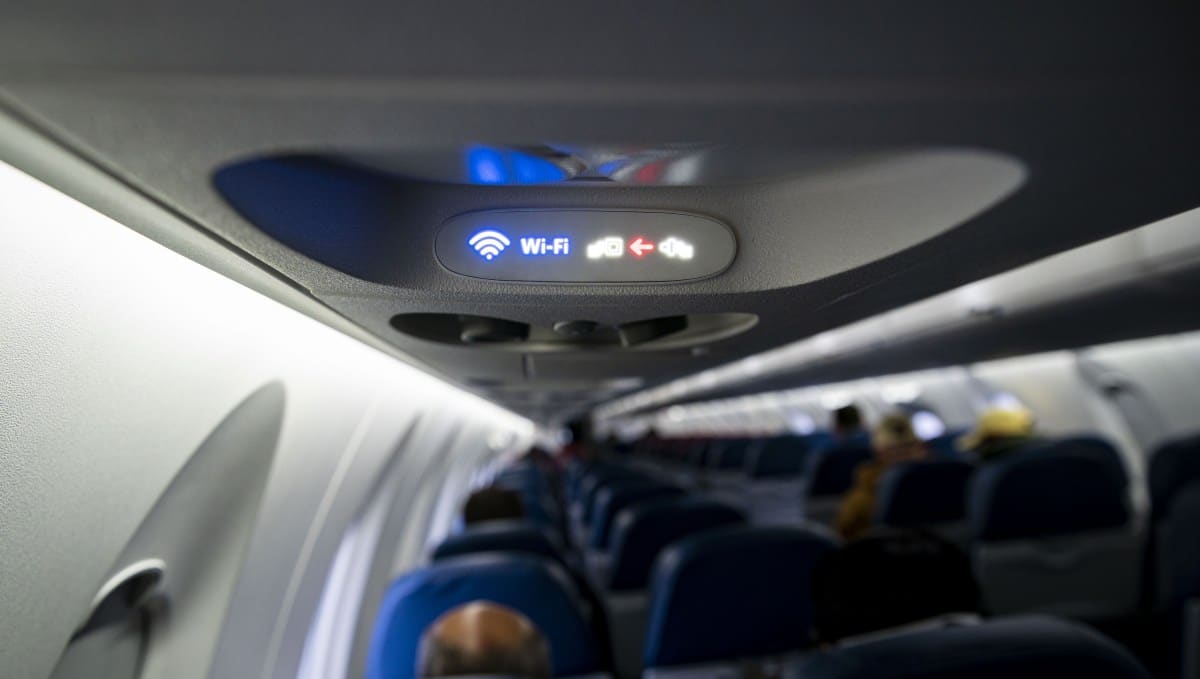
A passenger aboard a Monday morning Delta flight transformed the cabin into an impromptu security testing ground, setting up a rogue Wi-Fi access point that mimicked the aircraft's legitimate network. The incident, which occurred on a route from Las Vegas to Atlanta, forced the flight crew to disable the plane's actual wireless service for roughly 30 minutes while pilots alerted air traffic controllers to the situation.
According to Delta, aircraft safety systems remained untouched throughout the episode. The airline's legitimate in-flight network was not breached, and no operational systems were compromised. Still, the event has triggered a full investigation involving federal law enforcement and aviation regulators, underscoring how easily passenger devices can create security theater at 35,000 feet.
The DEF CON Factor
When the pilots radioed air traffic control, they noted an unusual detail: multiple passengers on the flight had just attended cybersecurity conferences in Las Vegas. The timing aligns with Black Hat and DEF CON, two of the industry's largest annual gatherings, which had concluded days earlier. DEF CON in particular attracts penetration testers, security researchers, and hobbyists who routinely demonstrate vulnerabilities in everyday systems, from ATMs to voting machines to, apparently, the assumptions passengers make about in-flight Wi-Fi.
The flight crew's decision to mention the conference attendance suggests they suspected the rogue network was less a criminal act than a poorly judged experiment. At DailyTechWire, we've tracked how security conferences often spill over into the real world: attendees leave Vegas with new tools, fresh techniques, and occasionally a disregard for the boundary between research and disruption.
How Simple It Is
Creating a fake Wi-Fi network requires minimal technical skill and hardware that costs less than a decent pair of headphones. Devices like the Wi-Fi Pineapple, a pocket-sized tool marketed to penetration testers and educators, can spoof legitimate network names and capture traffic from devices that auto-connect. The attacker simply broadcasts an SSID that matches or closely resembles a trusted network; phones and laptops often connect automatically, assuming they've rejoined a familiar hotspot.
Once a device connects to the rogue access point, the operator can intercept unencrypted traffic, inject phishing pages, or log credentials for services that lack proper transport security. Modern HTTPS protections mitigate much of the risk, but not all applications enforce encryption end-to-end, and users trained to click through certificate warnings remain vulnerable.
On an aircraft, the operational risk is lower than the perception problem. Planes rely on isolated avionics networks that passengers cannot access from the cabin. But the psychological impact is real: travelers expect the environment to be controlled, and a rogue network shatters that assumption. It also raises questions about what else might be running undetected in a confined space where hundreds of devices compete for spectrum.
Regulatory Gray Zones
Federal authorities have yet to file a formal report on the Delta incident. The Federal Aviation Administration confirmed it has not received documentation, and the FBI declined to comment. The Atlanta Police Department deferred to federal investigators, a typical pattern when jurisdiction over in-flight incidents remains ambiguous.
Current regulations prohibit interference with aircraft systems and crew instructions, but they were written before the proliferation of software-defined radios and commodity hacking tools. Setting up a Wi-Fi access point does not, strictly speaking, interfere with avionics. It may, however, violate computer fraud statutes if the intent was to deceive users or capture credentials. Prosecutors would need to prove intent, and the line between a prank, a research demo, and a crime is often drawn after the fact.
The incident also highlights a gap in cabin security protocols. Flight attendants are trained to spot suspicious behavior, unattended bags, and tampering with doors or emergency equipment. They are not trained to detect rogue wireless networks, nor do they have the tools to do so. Airlines rely on passengers to use in-flight connectivity responsibly, an assumption that breaks down when one passenger decides the flight is an acceptable venue for a live security demonstration.
Asia's In-Flight Connectivity Push
The Delta episode arrives as Asian carriers accelerate their own in-flight Wi-Fi rollouts. Singapore Airlines, Cathay Pacific, and ANA have invested heavily in satellite-based connectivity, viewing it as a differentiator in premium cabins. China's three major carriers have begun trials on domestic routes, navigating regulatory requirements that mandate content filtering and data localization.
These systems face the same vulnerabilities as their Western counterparts. A rogue access point can be set up on any flight, in any region, by any passenger with the right hardware and knowledge. The difference lies in regulatory appetite: authorities in Singapore and Japan have shown greater willingness to prosecute cybersecurity offenses on aircraft, treating them as threats to public order rather than pranks gone wrong.
South Korea's aviation authority issued guidance last year requiring carriers to monitor for unauthorized wireless transmissions in the cabin, a response to incidents during domestic flights where passengers set up hotspots to share pirated content. The guidance stops short of mandating detection equipment, but it signals a shift toward treating the cabin as a contested electromagnetic environment.
What Airlines Can Do
Short of confiscating all passenger electronics, airlines have limited options. Some carriers have experimented with spectrum monitoring tools that alert crew to unexpected signals, but these systems are expensive and prone to false positives in an environment dense with Bluetooth earbuds, smartwatches, and medical devices. Another approach is network authentication: requiring passengers to accept terms of service or enter a unique code before connecting, making it harder for a spoofed network to pass as legitimate.
Education remains the most scalable defense. Passengers who understand the risk of auto-connecting to unfamiliar networks are less likely to fall for a rogue access point. Airlines could include security reminders in their pre-flight announcements or in-flight entertainment systems, much as they remind travelers to keep seatbelts fastened.
For now, the Delta incident serves as a reminder that the cabin is no longer an isolated bubble. It is a network edge, a place where hundreds of personal devices interact with shared infrastructure under minimal supervision. The person in seat 23C might be watching a movie, checking email, or running a penetration test. The crew has no way to know until something breaks or someone complains.
The Investigation Ahead
Delta's investigation will likely focus on identifying the passenger and determining intent. If the goal was to demonstrate a vulnerability, the airline may refer the case to the FBI's cyber division, which has jurisdiction over computer fraud aboard aircraft. If the intent was malicious, capturing credentials or distributing malware, federal prosecutors could pursue charges under multiple statutes.
The outcome will set a precedent. Security researchers often operate in legal gray areas, testing systems without explicit permission and justifying their actions as public service. The industry has developed norms around responsible disclosure, but those norms were built for corporate networks and software vendors, not for airplanes full of passengers who did not consent to be part of an experiment.
At DailyTechWire, we've watched how the boundary between research and recklessness continues to shift. What counts as a harmless demo at DEF CON can look very different when performed at 35,000 feet, where the crew has limited recourse and passengers have no opt-out. The challenge for regulators, airlines, and the security community is to preserve space for legitimate research while making clear that some environments are off-limits, regardless of intent.