A Playdate Developer Built Full 3D Environments on Hardware Nobody Thought Could Handle Them
Cristina Ramos is proving the handheld's constraints are more flexible than anyone expected, rendering Mirror's Edge-style parkour on a device designed for 2D.
Pushing Past the Monochrome Ceiling
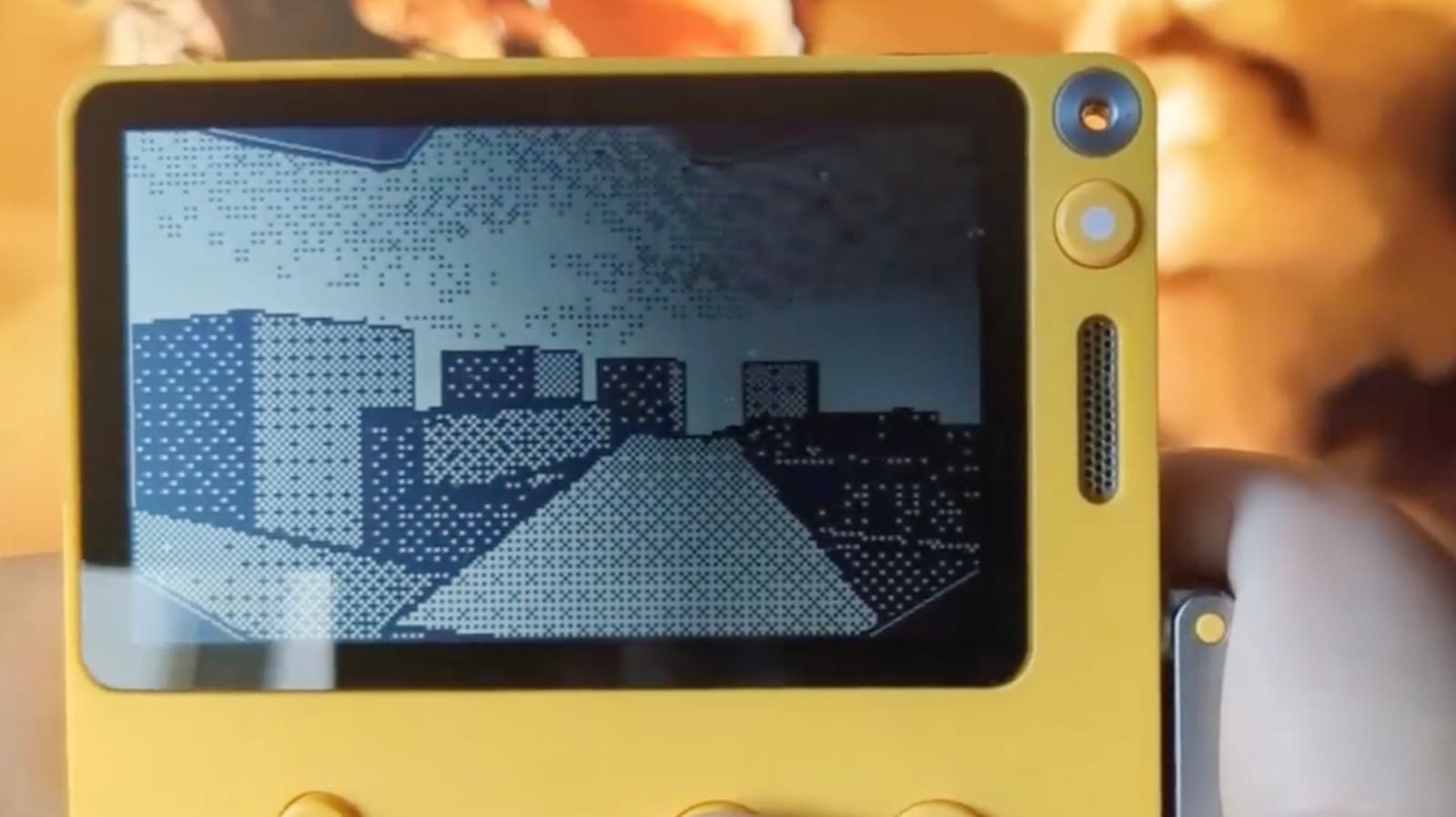
The Playdate handheld has earned a devoted following for what it is: a deliberately constrained device with a 1-bit black-and-white screen, a crank controller, and a catalog of inventive 2D games. Its charm lies precisely in those limitations. Yet developer Cristina Ramos recently shared footage that flips that script, demonstrating a work-in-progress 3D engine running natively on hardware most assumed would never support it.
The demo video shows first-person movement through an interior vertical space, climbing upward via platforming mechanics, then emerging onto a rooftop where the player navigates open-air parkour sequences reminiscent of Mirror's Edge. The geometry is clean, the frame rate stable, and the sense of depth unmistakable, all rendered in stark monochrome on a screen that measures 2.7 inches diagonally.
Ramos posted the clip on social media with a pointed caption: she was told 3D was impossible on Playdate, then told outdoor environments were beyond reach. She built both anyway.
Why This Matters for Handheld Dev Culture
At DailyTechWire, we've tracked the Playdate ecosystem since its 2021 launch, and the pattern has been consistent: developers treat the device as a creative proving ground rather than a commercial platform. The installed base remains modest, Panic has not disclosed sales figures beyond initial pre-order batches of around 20,000 units, but the software library has grown to more than 180 titles, many distributed through the company's seasonal catalog model or via itch.io sideloading.
Ramos's demo matters less for its immediate gameplay potential and more for what it signals about the relationship between constraints and ingenuity. The Playdate ships with a 180 MHz Cortex-M7 processor and 16 MB of RAM. By comparison, the Nintendo Game Boy Advance, a handheld from 2001 that supported 3D rendering in titles like Doom and Star Fox, ran at 16.78 MHz with 256 KB of working memory. The Playdate is more powerful on paper, but its SDK and display pipeline were not architected with 3D in mind.
What Ramos has done is write a renderer that sidesteps those assumptions. The technical approach is not yet public, she has not released source code or a detailed breakdown, but the visible result suggests a combination of software rasterization, aggressive polygon budgeting, and clever use of dithering to convey depth on a 1-bit display.
The Mirror's Edge Reference Is Not Accidental
The rooftop sequence in the demo is a deliberate homage. Mirror's Edge, released by DICE in 2008, was notable for its minimalist visual language: stark whites, primary color accents, and clean geometric environments that emphasized spatial navigation over texture detail. That aesthetic maps surprisingly well to the Playdate's monochrome screen, where shading and contrast become the primary tools for communicating form.
Ramos appears to have leaned into this fit. The demo's outdoor section features simple rectangular rooftops, sharp edges, and a skybox rendered as flat white, a design choice that reduces rendering overhead while preserving readability. The player's movement is smooth, suggesting the engine maintains a frame rate close to the Playdate's 50 FPS refresh ceiling, a non-trivial achievement given the processing cost of perspective projection and clipping.
The interior section is equally instructive. Vertical platforming in confined spaces reduces the number of visible polygons at any given moment, a natural culling strategy that keeps the frame budget under control. The camera movement is deliberate, likely locked to avoid the computational expense of free-look, and the geometry is modular, suggesting a tile-based level design approach that reuses assets efficiently.
Constraints as Creative Fuel
The Playdate has become a case study in how artificial scarcity can drive innovation. Panic, the device's creator, designed it with explicit limitations: no backlight, no color, a crank input that few games use as a primary control, and a seasonal release model that bundles games rather than relying on an open storefront. These decisions were commercial risks, the handheld launched at $179 in a market dominated by the Nintendo Switch and mobile gaming, but they created a design space that attracts a specific kind of developer.
Ramos's work sits within a broader wave of boundary-testing projects. Earlier this year, another developer demonstrated a working Game Boy emulator running on Playdate hardware, a feat that required cycle-accurate CPU emulation on a device with minimal headroom. Separately, Panic revealed that a Playdate unit has been installed at the Elizabeth Tower in London, where it helps synchronize the chimes of Big Ben, a use case nobody anticipated during the device's design phase.
These examples share a common thread: they are not about making the Playdate competitive with modern handhelds. They are about exploring what becomes possible when you strip away assumptions and work directly with the metal.
What Comes Next
Ramos has not announced a release timeline or confirmed whether the demo will evolve into a full game. The technical foundation is clearly in place, but shipping a 3D title on Playdate would require solving additional problems: level design that remains engaging within the constraints of low-polygon environments, control schemes that work with the device's limited inputs, and performance optimization to ensure the engine holds up across longer play sessions.
There is also the question of distribution. Playdate's official catalog is curated, and Panic has not historically prioritized technically ambitious projects over conceptually inventive ones. Sideloading via itch.io remains an option, but it reaches a smaller audience and bypasses the discoverability that comes with inclusion in a seasonal bundle.
Regardless of whether this specific project ships, the demo has already shifted the conversation. The Playdate is no longer just a 2D device with a crank. It is a platform where the boundaries are negotiable, and where a single developer with enough determination can rewrite the technical consensus. That is the kind of energy that keeps niche hardware ecosystems alive long after the initial hype fades.
We will be watching to see whether other developers pick up the thread, and whether Ramos shares the tools or techniques that made this possible. In the meantime, the footage stands as a reminder that constraints are only as rigid as the people working within them choose to make them.