A Paralyzed Patient Now Works Full-Time With a Brain Implant That Translates Thought Into Speech
Researchers at UC Davis have kept a brain-computer interface running for three years in daily use, achieving 99 percent accuracy in controlled tests and enabling meaningful employment for someone who cannot move or speak.
From Lab Curiosity to Daily Utility
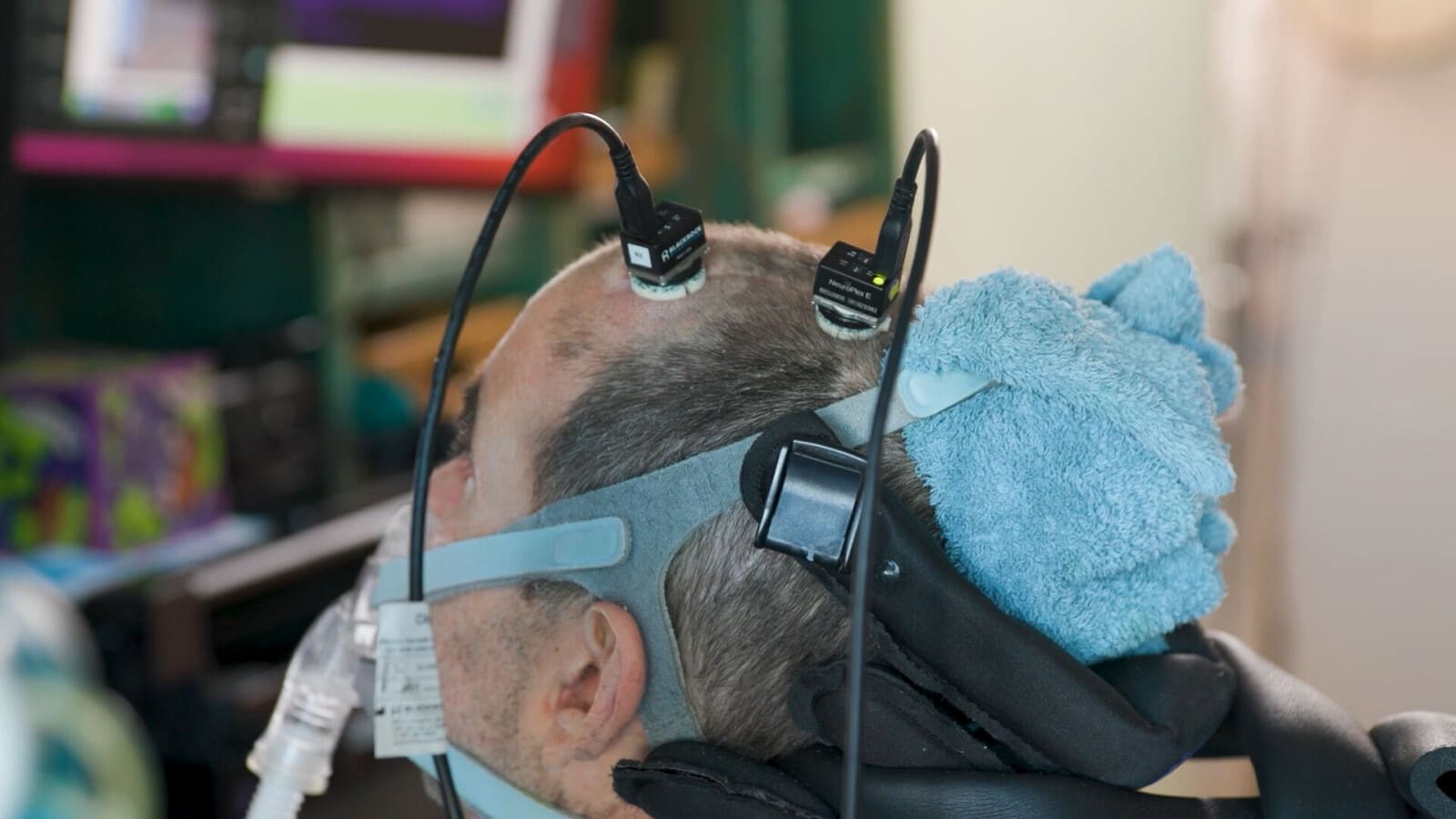
Casey Harrell has not spoken with his own voice since amyotrophic lateral sclerosis destroyed the motor neurons that control his mouth and jaw. Yet he holds down a full-time position as an environmental advocate, converses with his young daughter, and has logged more than 3,800 hours on a brain-computer interface that turns his neural activity into synthesized speech. The implant, placed in 2023 by a team at the University of California, Davis, remains functional today with a level of precision that crosses a threshold researchers have chased for years: 99 percent sentence-level accuracy in controlled settings, and 92 percent in the unstructured chaos of daily life.
At DailyTechWire, we have tracked the slow march of neural interface technology across labs in Hangzhou, Seoul, and Stanford, watching as venture capital poured into startups promising to decode thought. Most demonstrations remained tethered to research environments, requiring on-site supervision and yielding short bursts of data. The UC Davis work, detailed in a paper published this week by the BrainGate consortium, marks a departure. Harrell's home care team connects him to the system without specialist oversight. The average daily use over the study period exceeded five hours, a utilization rate that signals the technology has migrated from proof-of-concept to tool.
David Brandman, the neurosurgeon who implanted the device and co-led the research, frames the achievement as de-risking. His analogy is the pacemaker: a technology that began in the 1950s as a wall-tethered contraption and evolved into a same-day outpatient procedure. Brain-computer interfaces today occupy the clunky, external-battery stage of that arc. The question is no longer whether neural decoding works in principle but whether it can survive the friction of real-world use, insurance reimbursement timelines, and the regulatory gauntlet that separates academic success from clinical availability.
The Software Layer That Made It Stick
The hardware in Harrell's skull is not novel. UC Davis used an existing electrode array from Blackrock Neurotech, a established supplier in the BCI space. The leap lies in the software platform the lab built, known as BRAND (Brain-computer interface for Rapidly Adaptive Neural Decoding). Postdoctoral researcher Nick Card developed machine learning models that sit inside BRAND, interpreting electrical signals from Harrell's ventral precentral gyrus, the cortical region responsible for motor commands to the face and vocal apparatus.
The decoding pipeline runs in stages. Algorithms first map neural firing patterns to English phonemes, the smallest units of sound. A second layer assembles phonemes into words, then words into grammatically coherent sentences. The system does not rely on a fixed vocabulary or pre-programmed phrases. Harrell forms thoughts as he would have before paralysis; the software infers intent from the preparatory motor signals his brain still generates, even though those commands no longer reach muscle.
This architecture differs from earlier approaches that treated BCI decoding as a classification problem with a limited set of outputs. By modeling language at the phoneme level, BRAND can synthesize novel sentences without retraining. The trade-off is computational overhead. Harrell remains connected to external computers that handle the inference workload, a setup that limits mobility but proves sufficient for seated work and conversation. The BrainGate consortium now uses BRAND across multiple study sites, creating a shared substrate for further iteration.
What Three Years of Continuous Use Reveals
Implant longevity has been a quiet concern in the neural interface field. Scar tissue can insulate electrodes, signal quality can degrade, and infection risk does not disappear after the initial healing period. Harrell's system has been active since 2023, a duration that provides the first substantial dataset on chronic performance outside a controlled trial window. The 99 percent accuracy figure comes from structured lab sessions where researchers know the intended sentence in advance. The 92 percent self-reported accuracy during daily use, while lower, reflects the messier reality of fatigue, distraction, and the variable contexts in which Harrell communicates.
Those numbers matter for product design. A system accurate 70 percent of the time frustrates users and creates ambiguity in professional settings. At 92 percent, errors become manageable, similar to the correction load in voice-recognition software a decade ago. The gap between lab and field performance also highlights where further gains must come from: adaptive algorithms that adjust to the user's cognitive state, better noise rejection in the signal chain, and interface design that lets users flag and correct mistakes quickly.
Harrell's ability to work full-time introduces a dimension rarely captured in clinical endpoints. Employment requires sustained cognitive output, the ability to handle asynchronous communication, and enough reliability that colleagues can depend on responsiveness. The fact that his role as an environmental advocate remains viable suggests the system clears a functional bar beyond basic communication. It also raises questions about workplace accommodation, insurance coverage for occupational use, and whether labor law will recognize BCI operation as a reasonable assistive technology.
The Competitive Landscape and What Comes Next
UC Davis operates within the BrainGate consortium, a multi-university effort funded in part by the U.S. Department of Veterans Affairs. The collaborative structure contrasts with the venture-backed model pursued by Neuralink, Synchron, and Paradromics, each racing toward commercial deployment with proprietary hardware and surgical techniques. Brandman has worked with Paradromics on safety studies, giving him a view across both academic and industry timelines. His assessment is that multiple approaches will coexist: some optimized for minimally invasive placement, others for high channel counts and spatial resolution.
Neuralink's publicized demonstrations have focused on cursor control and gaming, applications that showcase responsiveness but sidestep the linguistic complexity Harrell's system tackles. Synchron's endovascular approach, which threads electrodes through blood vessels rather than opening the skull, offers lower surgical risk but captures fewer signals. The trade space involves bandwidth, invasiveness, longevity, and the specific functions a user needs. For speech synthesis, dense cortical coverage in motor areas appears necessary. For simple yes-no communication or device control, less invasive options may suffice.
The UC Davis team did not build hardware, a strategic choice that decouples their software progress from the capital-intensive, regulatory-heavy process of device manufacturing. BRAND can, in principle, interface with any electrode array that meets basic specifications. This modularity positions the platform as a potential standard layer in a market that does not yet have one. If the BrainGate consortium open-sources elements of BRAND or licenses it broadly, the software could become infrastructure atop which multiple hardware vendors compete.
Risks, Limits, and the Path to Scale
Harrell's case demonstrates feasibility, not yet scalability. Implanting electrodes in the motor cortex requires a craniotomy, a procedure with infection risk, anesthesia complications, and a recovery period measured in weeks. The surgery is not trivial, and candidacy screening will exclude patients with certain comorbidities. Regulatory approval for broader use will hinge on long-term safety data, ideally from cohorts larger than the handful of participants BrainGate has enrolled so far. The consortium is currently recruiting, but the pipeline from enrollment to publication spans years.
Cost remains opaque. Neither the UC Davis team nor BrainGate has disclosed the expense of the implant, surgery, and ongoing technical support. Pacemaker analogies suggest that once volume manufacturing begins and competition intensifies, prices will fall. But the early adopter phase, likely lasting through the end of this decade, will see systems priced in the range of advanced prosthetics or cochlear implants, accessible primarily through research participation or specialized insurance coverage.
There is also the question of what happens when something breaks. Harrell's system has remained stable, but electrode arrays can fail, connectors can corrode, and software updates carry the risk of regression. The medical device industry has established protocols for post-market surveillance and version control; BCI platforms will need equivalent rigor. A user who depends on the system for employment cannot tolerate multi-week repair timelines or the loss of learned calibration data.
Ethical considerations layer on top of technical ones. Harrell has expressed a desire to see the technology become routine, to shed the label of experimental subject. That transition requires not only regulatory clearance but also training programs for surgeons, support infrastructure for home users, and clarity around data ownership. Neural data is uniquely sensitive. The signals that reconstruct speech could, with different algorithms, reveal other cognitive states. Governance frameworks for BCI data are still nascent, and the industry has not yet faced the privacy challenges that will emerge at scale.
A Threshold Crossed, Not a Finish Line
Harrell's daughter has never heard his biological voice. The synthesized speech his implant produces is functional, not affective; it lacks the prosody and emotional coloring that define a person's vocal identity. Future iterations may incorporate models that learn intonation and stress patterns, adding a layer of personalization. Research groups in Seoul and Singapore are exploring affective computing approaches that could map neural correlates of emotion onto speech synthesis parameters, a direction that would make BCI-generated communication feel less mechanical.
The broader arc of assistive technology suggests that breakthroughs in one domain accelerate adjacent fields. Advances in low-power inference chips, originally driven by smartphone and edge AI demand, now enable more computation to happen on-body rather than tethered to desktop hardware. Improvements in biocompatible materials, spurred by cardiac and orthopedic device research, reduce the foreign-body response that degrades electrode performance. The UC Davis work benefits from these parallel developments and, in turn, provides a dataset that hardware teams can optimize against.
Brandman's framing - that his role is to derisk the technology - captures the current phase. Venture capital has already flowed into the sector; Synchron and Paradromics have raised tens of millions, and Neuralink's valuation, while privately held, is rumored in the billions. The UC Davis results offer evidence that the core technical challenge, translating thought into language with high fidelity over long durations, is solvable. What remains is the grinding work of manufacturing scale, regulatory navigation, and clinical workflow integration.
Harrell's case will not be the last. BrainGate continues to enroll participants, and competing efforts in Asia, Europe, and North America are generating their own datasets. The next few years will reveal whether the 99 percent accuracy achieved in controlled settings can be replicated across diverse patient populations, neurological conditions, and use cases. If it can, the technology moves from research milestone to clinical standard. If it cannot, the field will need to reckon with the gap between best-case performance and the messy variance of real-world deployment.
For now, a man who cannot move his limbs or speak with his own voice works a full-time job, talks to his daughter, and uses a computer with his thoughts. That is not a vision of the future. It is a datapoint from 2023, still running, still accurate, still waiting for the rest of the world to catch up.