Iran's Suspected Water System Campaign Reveals Critical Infrastructure Weakness
A coordinated wave of intrusions across more than a dozen US states exposes fragmented defenses and prompts intelligence agencies to privately point toward Tehran's Revolutionary Guard.
A Coordinated Threat Emerges
Late July brought an unusual development in critical infrastructure security: water treatment facilities across more than thirty communities in Minnesota reported coordinated intrusions within hours of each other. Within forty-eight hours, the FBI confirmed that utility operators in at least seven states had logged incidents, some resulting in degraded operations.
The geographic spread quickly widened. Beyond Minnesota, facilities in Arkansas, Georgia, New Jersey, and Michigan reported compromises. For a sector comprising more than 150,000 independent water systems, many operated by small municipalities with lean budgets and minimal security staff, the synchronized nature of the campaign stood out. At DailyTechWire, we've tracked infrastructure targeting across Asia and North America for years; this cluster represents a departure from the isolated, opportunistic probes that typically characterize attacks on utilities.
The Attribution Puzzle
No US government agency has issued a public attribution statement. Yet multiple threads point toward Tehran. Days before the Minnesota incidents, the Cybersecurity and Infrastructure Security Agency refreshed an April advisory warning that Iranian operators were scanning for vulnerable internet-connected devices in water and energy networks. The timing aligned closely with the first reported intrusions.
The Water Information Sharing and Analysis Center, a nonprofit coordinating body for the sector, privately informed members that observed tactics matched the campaign CISA had flagged, according to industry reporting. This week, intelligence officials told journalists they hold high confidence that Iran's Islamic Revolutionary Guard Corps orchestrated the operation, though they have not determined which IRGC unit executed it.
Political complications cloud the picture. President Donald Trump publicly dismissed the notion of an Iranian cyber operation, instead suggesting state-level failures in Minnesota, a Democratic stronghold led by Governor Tim Walz. Officials may hesitate to formalize attribution that contradicts the president's statement, even as classified assessments converge on Iranian responsibility.
Iran's cyber units have targeted US critical infrastructure intermittently over the past decade, but with limited operational impact. The current campaign, if confirmed as IRGC-directed, would mark a significant expansion in both scale and coordination. It may reflect retaliation strategy linked to the ongoing six-month conflict, a timeline that overlaps with the uptick in scanning and intrusion attempts.
Earlier this year, a group called Handala, later linked by US authorities to Iran's Ministry of Intelligence and Security, disrupted operations at medical technology firm Stryker and claimed access to FBI Director Kash Patel's personal email. Those incidents, while symbolic, did not approach the breadth of the current water utility campaign.
Exposure at Scale
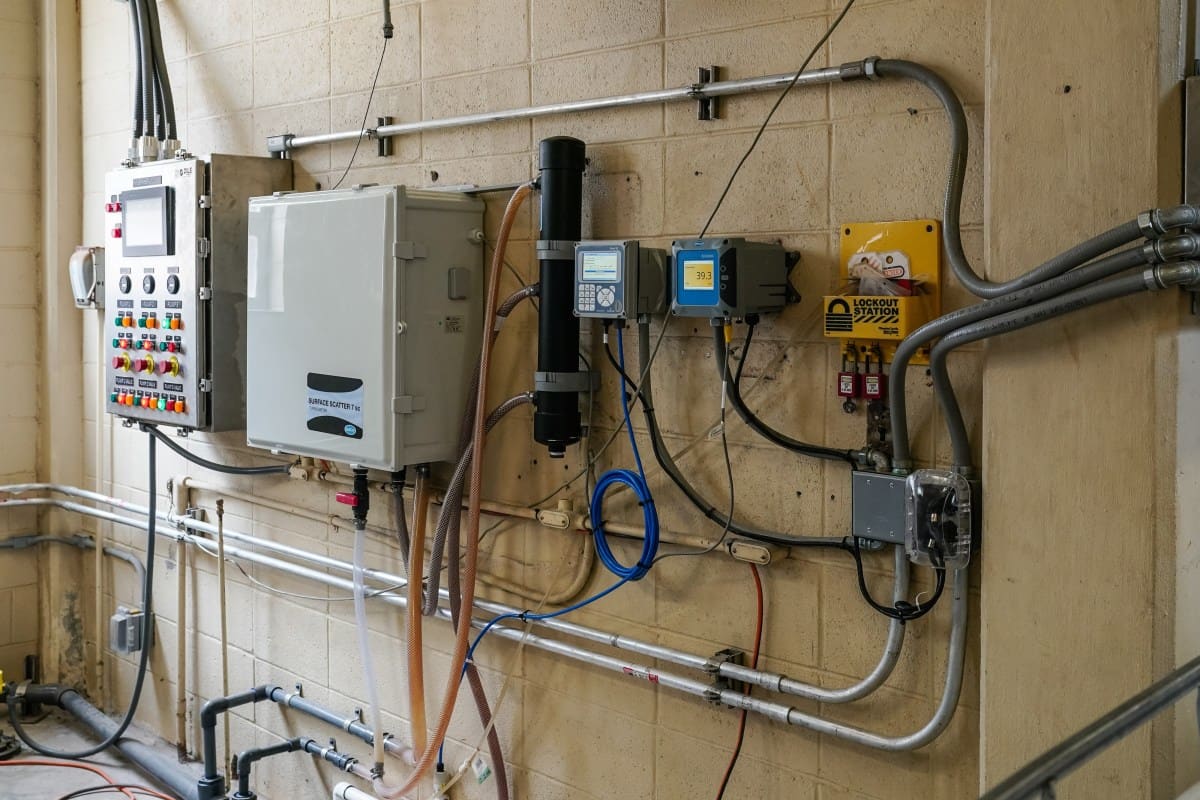
Cybersecurity researchers have documented the problem for years: thousands of industrial control devices used in water treatment sit exposed on the public internet, discoverable through basic scans. A recent survey by Forescout identified more than 2,800 controllers in US water systems reachable without authentication barriers.
Exposure does not guarantee exploitability, but the barrier to entry is lower than it should be. In the recent wave, the FBI noted that some intrusions caused pressure drops in distribution systems, a condition that can allow untreated groundwater to infiltrate pipes. Other incidents triggered localized flooding.
In Braham, Minnesota, a town of roughly 1,700 residents, operators took the water plant offline for several hours and issued conservation notices. Maple Plain, also in Minnesota, briefly declared a state of emergency. Officials in a Georgia county outside Atlanta advised residents to boil water as a precaution, though no confirmed contamination occurred.
The physical consequences remained contained. The psychological effect, however, rippled further. National and local media coverage amplified public concern about the safety of municipal water supplies, a resource most Americans take for granted. For attackers seeking to erode confidence in government services and critical infrastructure resilience, perception management may be as valuable as operational disruption.
Fragmentation as Vulnerability
The decentralized structure of US water infrastructure cuts both ways. On one hand, the sheer number of independent systems makes it difficult for adversaries to achieve nationwide impact through a single operation. On the other, it creates a sprawling attack surface populated by operators with widely varying resources.
Large metropolitan utilities can afford dedicated security teams, threat intelligence subscriptions, and regular penetration testing. Small rural systems, often run by part-time staff or municipal departments stretched thin, lack those luxuries. A coordinated scanning campaign can identify the weakest links and exploit them in parallel, as appears to have happened here.
Federal agencies have long recognized this gap. CISA's advisories and the Water ISAC's information-sharing efforts aim to bridge it, but advisories are only effective if recipients have the capacity to act on them. Many small utilities lack the in-house expertise to interpret technical indicators, patch systems promptly, or segment operational technology from corporate networks.
The current campaign underscores the difficulty of defending critical infrastructure when adversaries can cherry-pick targets. Iranian operators, historically characterized by opportunistic tactics rather than sophisticated toolchains, may have identified a scalable approach: mass scanning for exposed devices, followed by automated or semi-automated exploitation of the easiest targets.
Implications for Policy and Defense
The absence of a formal public attribution complicates the policy response. Without an official statement from US intelligence or the Department of Homeland Security, utilities cannot be certain whether they face a state-sponsored threat or a different actor. That ambiguity hampers coordination and may delay the deployment of tailored defensive measures.
If the IRGC attribution solidifies, it would represent the most significant Iranian cyber escalation against US critical infrastructure to date. Previous campaigns focused on espionage, website defacements, or denial-of-service attacks. Intrusions that degrade physical operations, even temporarily, cross a threshold that invites retaliation and raises the stakes for future exchanges.
The incident also highlights the limitations of existing information-sharing mechanisms. CISA issued its updated advisory days before the Minnesota attacks, yet dozens of facilities were still compromised. Either the warnings did not reach all relevant operators in time, or those operators lacked the resources to implement recommended mitigations. Both scenarios point to structural weaknesses in the current model.
For policymakers, the episode reinforces arguments for mandatory cybersecurity standards in critical infrastructure sectors. Voluntary frameworks and advisory bulletins have proven insufficient when adversaries move quickly and exploit the long tail of under-resourced targets. Regulation remains politically contentious, especially in sectors dominated by local and private operators, but the alternative is a persistent vulnerability that adversaries can exploit at will.
What Comes Next
As intelligence agencies finalize their assessments, the water sector faces a period of heightened vigilance. Operators are scanning their networks for indicators of compromise, reviewing access logs, and hardening internet-facing systems. Federal support, including incident response assistance and threat briefings, has ramped up in affected states.
The broader question is whether this campaign represents a one-time escalation or a new baseline for Iranian cyber operations. If Tehran perceives the attacks as successful in achieving strategic goals, whether operational disruption or psychological impact, it may attempt similar campaigns in other sectors or geographies. The energy grid, transportation networks, and healthcare systems all present comparable vulnerabilities.
For now, the water utility incidents serve as a stark reminder that critical infrastructure security remains a work in progress. The United States has invested heavily in defending high-value targets like financial institutions and defense contractors. The thousands of small, under-resourced operators that underpin daily life represent a different challenge, one that requires sustained attention, funding, and coordination across federal, state, and local lines. The recent intrusions suggest adversaries have already figured out how to exploit that gap.