Hyundai Commits $6 Billion to Physical AI Ambitions Beyond the Assembly Line
South Korea's automotive giant is building an entire AI-focused urban center as it pivots toward robotics and embodied intelligence
A Carmaker's Transformation Play
Hyundai Motor Group is placing a $6 billion wager on a future where cars are just one chapter in a much larger story. The South Korean conglomerate has committed that sum to developing what it calls the "Saemangeum AI Valley," a purpose-built urban center designed to accelerate its transformation into a leader in physical artificial intelligence and robotics.
At DailyTechWire, we've tracked the steady convergence of automotive and robotics engineering across Asia, from Toyota's experimental Woven City to the robotaxi deployments in Shenzhen. What sets Hyundai's move apart is the scale of capital commitment and the explicit ambition to transcend vehicle manufacturing entirely. The company is signaling that its engineering muscle, honed over decades of building machines that move through the physical world, is directly transferable to the next wave of embodied AI.
Physical AI, often called embodied intelligence, refers to systems that perceive, reason, and act in three-dimensional space: humanoid robots, autonomous vehicles, warehouse automation, surgical assistants. Unlike large language models that process text, these systems must navigate friction, gravity, and the unpredictability of real-world environments. The technical challenge is steep, and so is the capital requirement.
Why an Entire AI Valley
According to Hyundai Motor Group, the Saemangeum project will serve as an integrated development and testing environment for robotic systems, blending research labs, manufacturing facilities, and live deployment zones. The site sits on reclaimed land on South Korea's western coast, a location chosen for both its scale and proximity to Seoul's talent pool.
The investment reflects a broader strategic shift. Hyundai has spent the past five years assembling robotics assets: it acquired Boston Dynamics in 2021, launched Hyundai Robotics as a dedicated division, and began deploying AI-powered robots in its U.S. manufacturing plants. The Saemangeum hub is designed to tie these threads together, creating a flywheel where hardware development, software iteration, and real-world testing happen in close proximity.
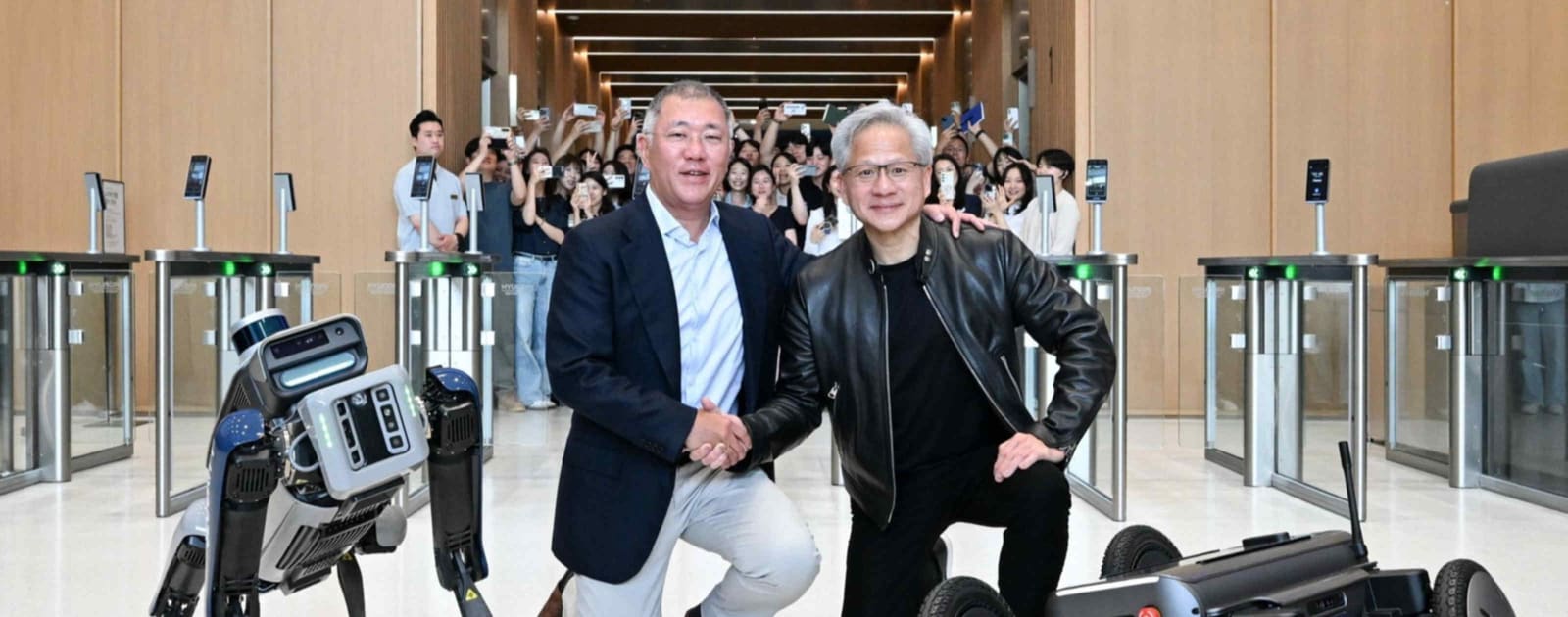
Executive Chair Chung Euisun has framed the initiative as part of a generational pivot. In public appearances, including a June meeting with Nvidia CEO Jensen Huang in Seoul, Chung has emphasized that Hyundai's future lies in "mobility solutions" rather than automobiles alone. That phrase, vague as it sounds, encompasses autonomous delivery bots, factory logistics systems, and even humanoid assistants.
The Asia-Pacific Context
Hyundai's move arrives amid a broader wave of industrial AI investment across the region. Samsung and SK Group recently joined a $700 billion U.S.-Korea AI initiative, while Japan's Ministry of Economy, Trade and Industry has outlined plans to reclaim leadership in factory robotics through AI-powered systems. China, meanwhile, continues to dominate in manufacturing volume, even as export controls and supply-chain realignments create openings for competitors.
The dynamics are different from the cloud AI race. Physical AI requires tight integration of sensors, actuators, real-time inference chips, and simulation environments. It rewards companies with manufacturing expertise, supply-chain depth, and the ability to iterate hardware at scale. These are precisely the strengths that Asian conglomerates like Hyundai, Toyota, and Foxconn bring to the table.
Nvidia's involvement is notable. The chipmaker has been courting automotive and robotics partners across Asia, positioning its Jetson edge computing platforms and Omniverse simulation tools as the substrate for physical AI development. Huang's visit to Seoul underscores the strategic importance of these partnerships: Nvidia supplies the compute architecture, while companies like Hyundai provide the domain expertise and deployment channels.
Risks and Open Questions
The $6 billion figure is significant, but it also raises questions about return timelines and competitive moats. Building an AI-focused urban center is conceptually appealing, but the value ultimately depends on execution: whether Hyundai can attract top-tier AI talent, whether the facility generates proprietary datasets that improve model performance, and whether the company can commercialize robotic systems faster than rivals.
There's also the challenge of market definition. Physical AI is still a nascent category. Humanoid robots remain expensive and limited in capability. Autonomous vehicles face regulatory and liability hurdles. Factory automation is mature but commoditizing. Hyundai's bet is that convergence across these domains, enabled by advances in reinforcement learning and simulation, will create new product categories. That thesis is plausible but unproven at this scale.
Competition is intensifying. Tesla is developing its Optimus humanoid robot. Chinese firms like Ubtech and Fourier Intelligence are shipping commercial units. Even Toyota, Hyundai's traditional rival, is building its own experimental town as a proving ground for integrated mobility and robotics systems. The window for differentiation may be narrower than it appears.
What It Signals for the Industry
Hyundai's commitment reflects a broader realization among Asian manufacturers: the next decade of industrial competitiveness will hinge on the ability to embed intelligence into physical systems. This is not a software play. It requires end-to-end control of hardware, supply chains, and deployment environments, areas where traditional tech companies often lack leverage.
The Saemangeum project also represents a hedge. If autonomous vehicles take longer to scale than expected, or if regulatory barriers slow adoption, Hyundai will have diversified into adjacent robotics markets. If physical AI takes off as predicted, the company will have built the infrastructure to lead. Either way, the investment positions Hyundai as more than a carmaker, a narrative that matters both for talent recruitment and investor perception.
The real test will come in the next three to five years, as the first systems developed at Saemangeum move from prototype to production. At that point, we'll know whether this $6 billion bet was visionary or premature, and whether Hyundai's engineering culture can adapt to the faster iteration cycles and software-centric workflows that physical AI demands.