Humanoid Robots Compete in Tennis and Track at Beijing Tournament
Chinese manufacturers demonstrated bipedal machines that recover from falls and execute athletic movements, signaling progress in dynamic balance control
Athletic Machines Take the Court
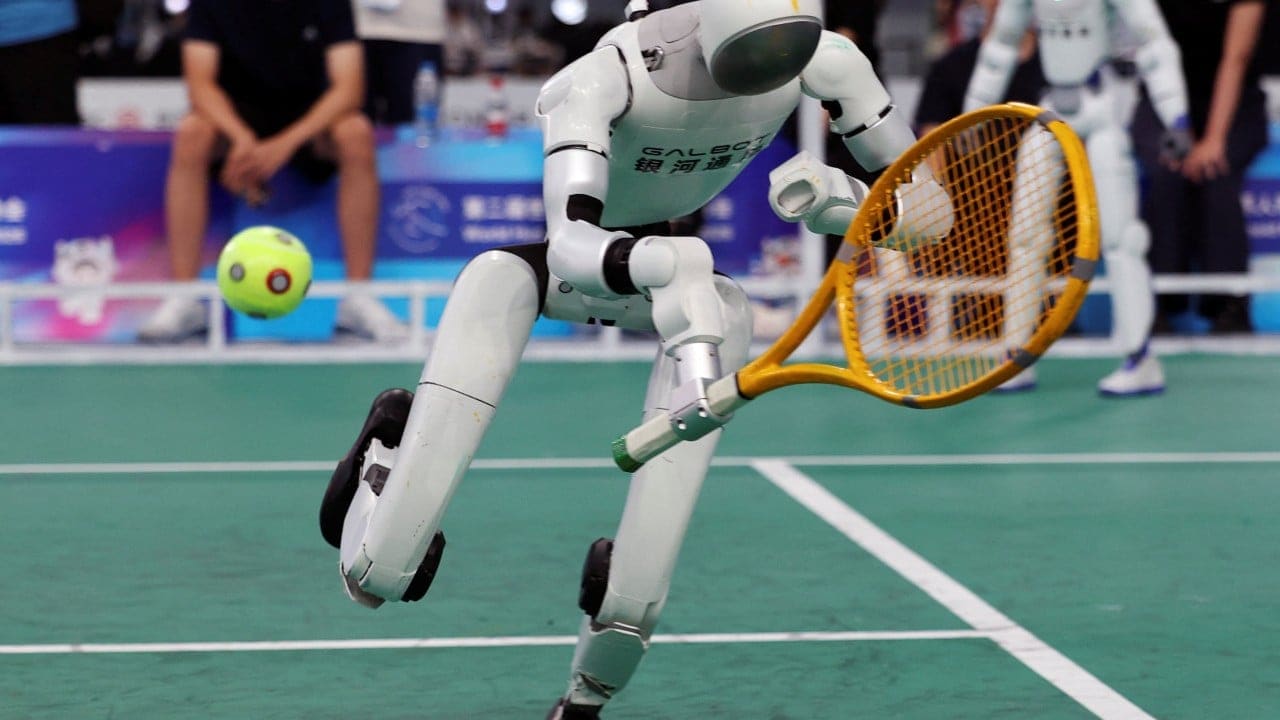
A bipedal robot positioned itself across the net, tracking an incoming tennis ball. It shifted laterally in rapid increments, adjusted its stance, and drove the racquet through to return the shot. The exchange continued through multiple volleys, alternating between forehand and backhand strokes during both singles and mixed-doubles formats involving human participants.
Mid-rally, the machine overextended while pursuing a wide ball and fell backward onto the court surface. After a brief moment on the ground, it executed a self-recovery sequence, rolling to one side, planting its hands, and pushing upright to resume play. The incident drew audible reactions from spectators but underscored a capability that engineers consider essential for real-world deployment: autonomous recovery from unplanned falls.
The demonstration took place during a multi-day competition in Beijing that brought together humanoid platforms from manufacturers across China. Alongside tennis, the event featured sprint races, obstacle navigation, and manipulation tasks designed to test locomotion stability, sensor integration, and real-time decision-making under dynamic conditions.
Speed and Stability on the Track
Track events provided a different proving ground. Robots competed in 100-meter sprints, with the fastest recorded times approaching speeds that would have been considered implausible for bipedal machines only two years ago. Engineers present at the venue noted that achieving consistent forward velocity without catastrophic balance failure requires tight coordination between joint actuators, inertial measurement units, and predictive algorithms that anticipate ground reaction forces.
One platform completed the distance in under 15 seconds, a benchmark that reflects both mechanical refinement and advances in control software. The machine maintained an upright gait throughout, though several competitors stumbled or slowed dramatically in the final stretch as battery reserves depleted and thermal limits constrained motor output.
At DailyTechWire, we've tracked the gradual convergence of hardware capability and algorithmic sophistication in the humanoid space. The performance gap between these demonstration units and earlier prototypes is narrowing, driven in part by the availability of higher-torque actuators, lighter composite materials, and improved sim-to-real transfer techniques that allow control policies trained in simulation to generalize to physical robots.
What Falls Reveal About Control Architecture
The tennis robot's ability to stand after a fall is more than a crowd-pleasing trick. Autonomous recovery demands that the machine maintain situational awareness even when its expected orientation is violated. Sensors must continue to provide accurate data about limb position and contact state, and the control stack must switch rapidly from a locomotion mode to a recovery mode without human intervention.
Industry observers point out that this capability is necessary for deployment scenarios beyond sports demonstrations. Warehouse robots, inspection units operating on uneven terrain, and service machines in public spaces all face environments where falls are probabilistic rather than exceptional. A robot that requires manual reset after every loss of balance becomes operationally impractical.
Chinese manufacturers have invested heavily in dynamic balance research over the past 18 months, often publishing control algorithms and sharing hardware specifications in open forums. This collaborative approach has accelerated iteration cycles and allowed smaller teams to adopt proven techniques without reinventing foundational components.
Regional Context and Manufacturing Scale
The concentration of humanoid development activity in China reflects both policy priorities and supply-chain advantages. Domestic access to electric motor production, battery cell manufacturing, and precision machining reduces lead times and component costs compared to manufacturers sourcing internationally. Government-backed research institutes have also allocated funding specifically for bipedal robotics, viewing the technology as strategically relevant for logistics, eldercare, and industrial automation.
Several platforms demonstrated at the Beijing event are built on modular architectures that allow rapid reconfiguration for different tasks. Swapping end-effectors, adjusting leg length, or integrating additional sensors can be accomplished in hours rather than weeks, a design philosophy that mirrors practices in the drone and electric-vehicle sectors where Chinese firms have achieved scale.
The competitive format of the event also serves a commercial function. Potential customers, including logistics operators and municipal governments exploring service-robot pilots, attend to assess readiness and benchmark performance across vendors. Demonstrations that include failure modes, such as the fall and recovery in tennis, provide more credible signals of robustness than curated highlight reels.
Implications for Deployment Timelines
While the tournament showcased measurable progress, engineers interviewed at the venue emphasized that competition performance does not yet translate to continuous operation in uncontrolled settings. Battery endurance remains a limiting factor, with most platforms running for 30 to 60 minutes under high-intensity activity before requiring recharge. Sensor reliability in variable lighting, dust, and temperature conditions also requires further validation.
Cost remains another barrier. Current-generation humanoid platforms carry price tags in the range of industrial robotic arms, limiting adoption to well-funded pilot programs and research labs. Manufacturers are targeting cost reductions through vertical integration and volume production, but widespread commercial deployment likely requires another generation of hardware refinement and software maturation.
The funding rounds we've followed across the region indicate sustained investor interest in humanoid robotics, with several Chinese startups securing Series B capital in recent quarters. These investments are predicated on the assumption that the technology will achieve cost-performance parity with wheeled robots for a subset of tasks within the next three to five years.
Next Milestones
Upcoming competitions are expected to introduce manipulation challenges that combine locomotion with object handling, testing whether robots can walk to a target location, pick up an item, and transport it without dropping or losing balance. Such tasks more closely approximate real-world scenarios in retail, hospitality, and light manufacturing.
The Beijing tournament also attracted international participants, though the majority of platforms originated domestically. Cross-border collaboration in control algorithm development and benchmark dataset creation is growing, even as hardware manufacturing remains regionally concentrated. Open-source frameworks for simulation and control are lowering entry barriers, enabling academic teams and startups outside China to contribute to the broader research agenda.
For manufacturers, the path forward involves iterating on durability, refining human-robot interaction protocols, and demonstrating sustained operation over weeks rather than minutes. The tennis-playing robot's ability to stand after a fall is a visible proof point, but the less dramatic work of improving joint seals, optimizing power management, and hardening software stacks will ultimately determine whether humanoid machines transition from demonstration novelty to deployed tool.