GPT-Live Changes the Rhythm of AI Conversations
OpenAI's full-duplex voice architecture removes the awkward pauses that plagued earlier assistants, letting users interrupt, overlap, and converse without waiting for silence.
The End of Awkward Silence
Voice assistants have long struggled with a fundamental problem: they don't know when you've actually finished talking. A breath between thoughts, a moment to gather your words, and suddenly the system assumes you're done and starts responding. That friction has kept many users typing rather than speaking, even as the underlying language models grew more capable.
OpenAI's GPT-Live model, now shipping as the default voice experience in ChatGPT, addresses this with what the company describes as full-duplex architecture. The system can process incoming speech while simultaneously generating spoken output, a shift that mirrors how human conversation actually works. You can interrupt mid-response, overlap your words with the assistant's, and pause without triggering a premature reply.
The technical leap is significant. Earlier implementations of ChatGPT's voice mode relied on a three-stage pipeline: speech-to-text conversion, language model processing, then text-to-speech output. Even the subsequent Advanced Voice Mode, which collapsed some of these steps into a single multimodal model, operated on a turn-based structure. One party spoke, then the other. GPT-Live abandons that constraint entirely.
How the Architecture Differs
Full-duplex audio processing is not new to telecommunications, but applying it to generative AI introduces complexity. The model must track conversational state while listening, decide when a user's pause is substantive versus incidental, and generate responses that account for real-time interruptions.
GPT-Live handles this by maintaining a continuous audio stream in both directions. During user speech, the system occasionally injects brief acknowledgments like "mhmm" or "yeah," verbal cues that signal active listening without derailing the speaker's train of thought. These interjections are subtle but create the impression of presence, a quality that earlier assistants lacked.
When a query demands deeper reasoning or external search, GPT-Live offloads the task to more capable models in the background, including GPT-5.5, while keeping the conversational thread alive. This hybrid approach lets the system prioritize responsiveness for straightforward exchanges and escalate processing power only when necessary.
Access and Configuration
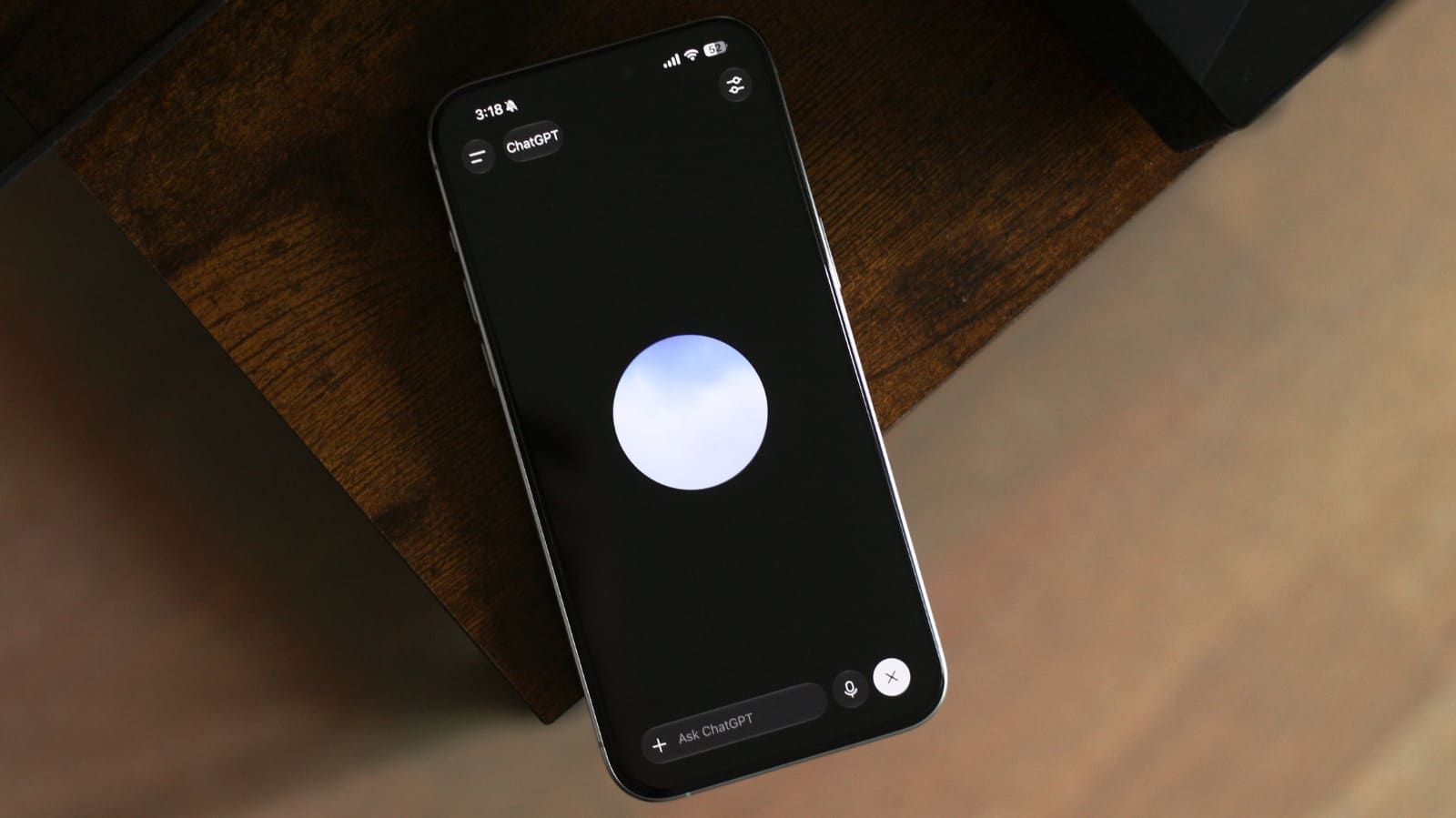
The model is available across ChatGPT's mobile apps on Android and iOS, as well as through web browsers. Paid subscribers on Pro, Plus, and Go tiers receive access to GPT-Live-1, while free-tier users interact with GPT-Live-1 mini, a lighter variant. The voice interface is triggered by tapping a waveform icon in the text input area, and once activated, the session persists even if the app is backgrounded or the device is locked.
Users on paid plans can adjust the intelligence level across three settings: Instant, Medium, and High. Instant mode prioritizes speed, handling routine queries with minimal latency. Medium and High introduce slight processing delays, measured in fractions of a second, to accommodate more complex reasoning. The GPT-Live-1 mini model does not offer this granularity.
The system also surfaces a live transcript as the conversation unfolds, and when a question benefits from visual context, it generates interactive widgets alongside the spoken answer. For tasks like real-time translation, the low-latency design proves particularly effective.
What Gets Sacrificed
GPT-Live currently does not support screen sharing or video input, features that remain available in the older Advanced Voice model. Users who need those capabilities can revert through the settings menu, selecting the previous model under the Voice section. The same menu allows customization of the assistant's voice, language, and whether voice mode launches by default when the app opens.
This trade-off reflects a broader tension in AI product design: adding one layer of sophistication often means deferring another. Full-duplex audio requires intensive real-time processing, and integrating visual streams would compound that load. OpenAI has opted to perfect the conversational flow first, leaving multimodal integration for a later iteration.
Why Conversational Latency Matters
At DailyTechWire, we've tracked voice interface development across the region, from Naver's Clova in Seoul to Alibaba's Tmall Genie in Hangzhou. The pattern is consistent: users tolerate functional limitations, but they abandon systems that feel unresponsive or interrupt their speech. Latency and turn-taking rigidity are among the top friction points cited in user studies.
GPT-Live's architecture directly targets this. The ability to interject without waiting for silence lowers the cognitive load of interaction. You no longer need to mentally parse whether the assistant has finished its thought or is simply buffering. The conversation becomes less of a protocol and more of an exchange.
This shift has implications beyond consumer convenience. In enterprise settings, where voice interfaces are being piloted for customer service, internal help desks, and field operations, the naturalness of interaction correlates with adoption rates. A system that requires users to modify their speech patterns to accommodate its limitations will see lower utilization than one that adapts to human cadence.
The Limits of Naturalness
Full-duplex conversation does not, however, solve the deeper challenges of generative AI: hallucination, context drift, and the tendency to present uncertainty as fact. GPT-Live makes the interaction smoother, but the underlying model still operates within the probabilistic constraints of large language models. A fluent response is not necessarily an accurate one.
OpenAI has embedded intelligence tiering as a partial mitigation. By allowing users to dial up reasoning depth for complex queries, the system acknowledges that speed and rigor exist in tension. But the onus remains on the user to assess when a question warrants higher processing and to verify outputs against external sources.
The model's lack of video and screen-sharing support also limits its utility in scenarios where visual context is essential. Troubleshooting hardware, navigating interfaces, or discussing design work all benefit from shared visual reference. Until GPT-Live integrates those streams, users in those contexts will need to toggle back to the older model or switch to a different platform.
What This Means for Voice-First AI
The release of GPT-Live signals a maturation point for voice-driven AI. The early promise of conversational assistants was undermined by their mechanical interaction patterns; users quickly learned to treat them as command interfaces rather than dialogue partners. By removing the turn-based bottleneck, OpenAI has made voice a viable default mode for a broader range of tasks.
This matters in markets where mobile-first usage predominates and typing is less convenient. In Jakarta, Mumbai, and Manila, voice input has long been preferred for messaging and search, but AI assistants have lagged behind in adoption. A model that respects conversational norms rather than imposing rigid protocols could shift that calculus.
The next test will be whether other providers can match or exceed this architecture. Google's Gemini Live and Anthropic's voice experiments are moving in similar directions, but full-duplex processing at scale remains computationally expensive. The degree to which these capabilities trickle down to free tiers and regional deployments will determine how quickly the industry standard evolves.
For now, GPT-Live represents the most fluid voice interaction available in a mainstream AI assistant. Whether that fluency translates into sustained usage depends on how well the underlying intelligence keeps pace with the conversational interface. A natural-sounding assistant that provides unreliable information is still, ultimately, unreliable.