Google Lets Publishers Fight Back Against AI Overviews With Embedded Preference Button
A new embeddable widget allows readers to mark favorite sources directly from publisher sites, as the search giant tries to offset the traffic erosion caused by its own AI features.
The Traffic Problem Google Created
When Google began rolling out AI-powered summaries and conversational search modes earlier this year, the immediate consequence for publishers was predictable: referral traffic started to drop. Readers who once clicked through to articles now found their questions answered directly in AI-generated overviews, with links buried below the fold or absent entirely. For media businesses that depend on advertising revenue tied to page views, the shift represented an existential squeeze.
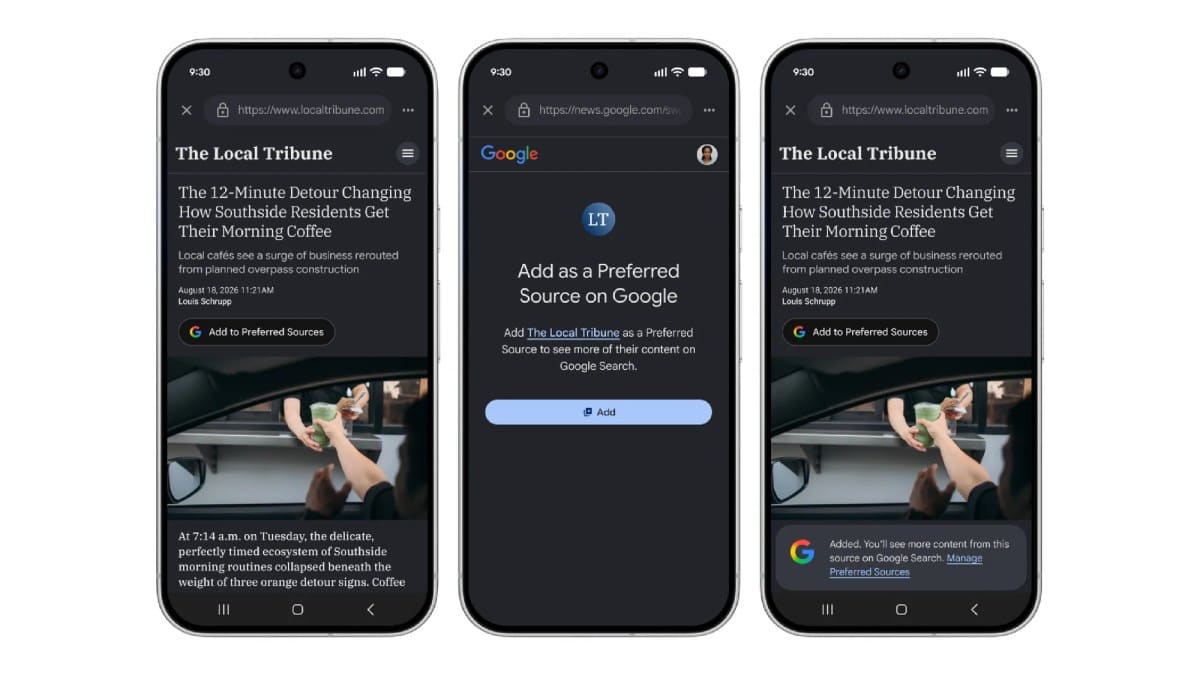
Now Google is offering what amounts to a partial remedy. The company announced that publishers can embed a new interactive button on their own websites, allowing readers to designate them as a "Preferred Source." Once a reader marks a site this way, links from that publisher will be surfaced more prominently across Google Search, Discover, and Google News, including within AI Mode and AI Overviews.
At DailyTechWire, we've tracked the growing tension between search platforms and content creators across Asia and globally. This move reflects Google's attempt to maintain goodwill with the publishing ecosystem even as its product roadmap continues to prioritize zero-click experiences. The question is whether it does enough to counteract the structural damage already underway.
How the Embeddable Widget Works
The new tool is a lightweight widget that publishers can place anywhere on their site, typically near the header or within article pages. When a reader clicks the button, it signals to Google that they want to see more content from that outlet in future search results, news feeds, and AI-generated responses.
Google first introduced the Preferred Sources concept in May, initially limiting it to a standalone preferences page and a feature within Top Stories. At that time, the company reported that users had already selected over 345,000 unique sources. The embeddable button extends that mechanism, making it easier for publishers to capture preference signals without relying on readers to navigate Google's settings manually.
The underlying incentive for publishers is clear. Google claims that users are twice as likely to click through to a preferred source when one is available. For media companies watching their organic reach erode, even a modest uplift in click-through rates can translate to meaningful revenue in aggregate.
The Broader Context: AI and the Zero-Click Web
Google's gesture arrives amid a broader reckoning over how generative AI reshapes the economics of the open web. As AI Overviews and conversational search modes become default experiences, the volume of queries that result in a click to an external site is declining. This isn't unique to Google. Microsoft's Bing, OpenAI's SearchGPT prototype, and Perplexity's answer engine all share the same dynamic: they synthesize information from multiple sources and present it inline, reducing the need for users to visit the original publishers.
For publishers in markets like South Korea, Japan, and Southeast Asia, where Google's dominance in search is even more pronounced than in the United States, the stakes are higher. Local news organizations and vertical media companies often lack the scale or diversification to weather prolonged traffic declines. The Preferred Sources button offers a lifeline, but only if readers know it exists and choose to use it.
Natural Language Feed Tuning and Audio Briefings
Alongside the embeddable button, Google is rolling out two additional features aimed at personalization. The first allows users to customize their Discover feed using natural language prompts. Instead of tapping through menus to adjust topic preferences, readers can simply tell Google what they want to see more or less of, and the feed adjusts in real time.
This capability mirrors recent moves by social platforms like Instagram, TikTok, and X, all of which have introduced user-controlled algorithmic tuning in response to criticism over opaque recommendation systems. The trend reflects a broader shift toward transparency and user agency in content curation, though it also raises questions about how these preferences interact with Google's existing ranking signals and advertiser interests.
The second feature targets Android users of the Google News app, enabling them to customize daily audio briefings. Users can specify topics they want covered in their morning or evening summaries, tailoring the experience to their routines and interests. It's a small but notable expansion of Google's ambient content strategy, positioning the app as a companion to commutes and workouts rather than a passive news aggregator.
Does It Solve the Underlying Problem?
The embeddable Preferred Sources button is a concession, not a solution. It acknowledges that AI Overviews and AI Mode are reducing traffic to publishers, and it offers a mechanism for readers to manually counteract that effect. But it places the burden on both publishers and their audiences. Publishers must integrate the widget, promote it, and hope readers click. Readers must actively signal their preferences, a step that most will never take.
From Google's perspective, the feature serves a dual purpose. It provides a public-facing response to publisher complaints, demonstrating that the company is "listening" and "partnering" with the media ecosystem. At the same time, it generates a new layer of preference data that Google can use to refine its AI systems and personalization algorithms.
The real test will be adoption and impact. If publishers see measurable traffic gains from the button, it will spread quickly. If the effect is marginal or confined to a small subset of highly engaged readers, it will be remembered as a symbolic gesture rather than a meaningful intervention.
What Publishers Should Watch
For media companies evaluating whether to implement the button, a few factors matter. First, does your audience already have a strong relationship with your brand? If so, the button may convert latent loyalty into tangible preference signals. If your traffic is driven primarily by incidental search queries, the button is unlikely to move the needle.
Second, how much of your traffic currently comes from Google Search, Discover, or News? If those channels represent a significant share, the button is worth testing. If you've already diversified away from Google, the ROI of implementation may be low.
Third, consider the broader trajectory of AI-driven search. Even if the button provides a short-term boost, the long-term trend is toward fewer clicks and more inline answers. Publishers should treat this as a tactical tool within a larger strategy that includes direct audience relationships, newsletters, apps, and platform diversification.
The Platform Dilemma Persists
Google's latest moves illustrate the structural tension at the heart of the modern web. The company depends on publishers to generate the content that trains its AI models and populates its search index. But its product incentives push toward keeping users on Google properties, where ad inventory and user data remain under its control.
The Preferred Sources button doesn't resolve that tension. It offers publishers a way to compete for visibility within a system that is fundamentally designed to reduce their reach. Whether that's enough depends on how aggressively Google continues to expand AI-driven features and how quickly publishers can build alternative distribution channels that don't depend on Mountain View's goodwill.
For now, the button is live, embeddable, and worth testing. But it's not a reset. It's a reminder that the rules of the game have changed, and publishers are still playing catch-up.