Google Pics Bets on Granular Control to Win Business Creatives
The Workspace design suite leans on object-level editing to sidestep the generic AI imagery that marketing teams have learned to avoid.
The Enterprise Image Problem
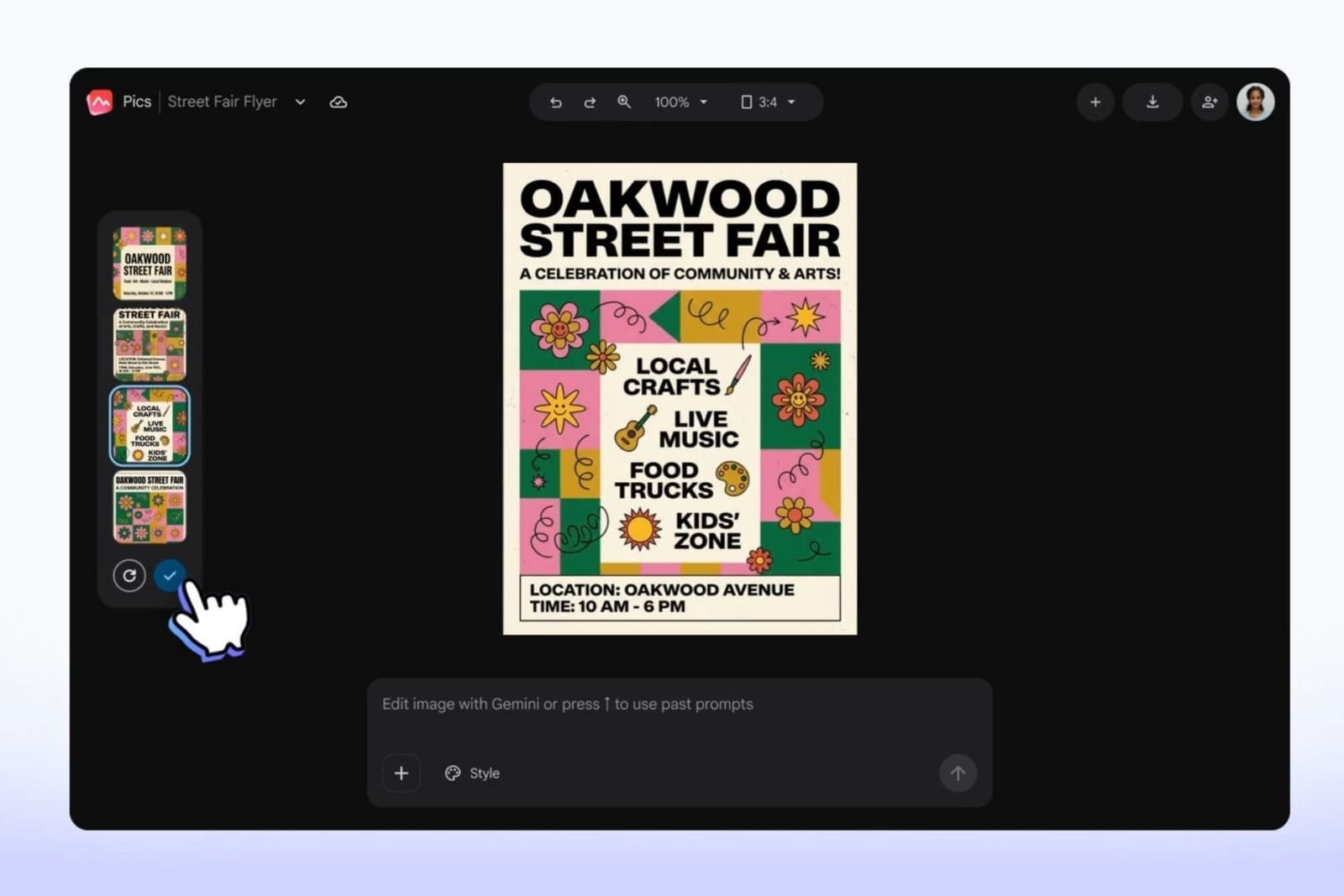
Google Workspace now includes a design toolset called Pics, aimed squarely at business users who need marketing and presentation visuals but have grown wary of the generic output most generative AI platforms produce. The suite combines editing and generation capabilities, built on Gemini and a newer model Google refers to as Nano Banana, with an interface designed to give users more surgical control over what gets changed and how.
At DailyTechWire, we've tracked the gap between consumer enthusiasm for AI image generation and enterprise hesitation. The tools that work well for personal memes or one-off illustrations often fail when a brand manager needs a hero image that aligns with style guides, avoids awkward hands, and doesn't look like every other AI-generated stock photo flooding LinkedIn feeds. Google Pics appears to be a direct response to that friction.
Object-Level Editing, Not Just Prompts
The core mechanic centers on tap-to-edit interactions. Users can select specific objects, text elements, or regions within an image and describe only what they want altered, rather than re-prompting an entire scene. This approach addresses one of the most frustrating aspects of current generative tools: the all-or-nothing regeneration that forces users to roll the dice repeatedly until something usable emerges.
By isolating edits to discrete elements, Google is betting that business users will spend less time wrestling with prompts and more time iterating on assets that already meet most requirements. The system is designed to preserve context around the edited region, a technical challenge that has plagued earlier attempts at localized AI manipulation. Whether Nano Banana delivers on that promise at scale will depend on how well it handles edge cases like overlapping objects, lighting consistency, and brand color fidelity.
Workspace Integration as Distribution
Google positioned Pics inside Workspace rather than as a standalone consumer app, a deliberate choice that leverages existing enterprise relationships and embeds the tool directly into workflows where marketing collateral, pitch decks, and internal comms are already being assembled. The integration means assets can flow from Pics into Slides, Docs, or Sites without export friction, and access controls align with existing Workspace permissions.
This distribution strategy mirrors how Google has rolled out other Gemini-powered features across its productivity suite, turning Workspace into a bundled AI platform rather than a collection of discrete tools. For IT buyers already committed to Workspace, Pics becomes part of the package rather than a separate procurement decision, lowering the barrier to adoption and making it harder for standalone design platforms to compete on convenience alone.
The Canva Comparison No One Asked For
Google framed Pics in relation to Canva during early briefings, a comparison that reveals both ambition and anxiety. Canva has become the default visual creation tool for millions of small businesses and marketing teams, largely by making design accessible to non-designers through templates and drag-and-drop simplicity. Google's pitch is that Pics takes that accessibility further by replacing template hunting with generative flexibility, while adding the precision editing that templates inherently lack.
The risk is that Canva has already integrated its own AI generation features and commands significant user loyalty, design marketplace momentum, and a head start on understanding what business users actually need from a creative tool. Google Pics will need to prove that its object-level editing and Workspace integration are compelling enough to shift behavior, especially among teams that have already standardized on Canva workflows and built template libraries there.
Model Architecture and the Nano Banana Wildcard
Google disclosed that Pics relies on both Gemini and a model it calls Nano Banana, though technical details remain sparse. The dual-model setup suggests Gemini handles broader generative tasks while Nano Banana may specialize in localized edits or style consistency, but without published benchmarks or architectural specifics, it's difficult to assess how differentiated the underlying technology is from competing approaches by Midjourney, Stability AI, or Adobe Firefly.
The name Nano Banana itself is unusual for an enterprise-facing product, hinting at internal project nomenclature that survived into the launch. Whether the model represents a genuine advance in controllable generation or is primarily a repackaging of existing Gemini capabilities tuned for editing use cases will become clearer as users push the system's limits and edge-case failures surface.
Professional-Grade Claims Meet Real-World Scrutiny
Google described the output as "professional-grade," a phrase that will face immediate scrutiny from designers, brand managers, and creative directors who have learned to spot AI artifacts and compositional tells. The bar for professional acceptability varies widely: a LinkedIn carousel graphic has different requirements than a product launch hero image or a billboard visual. If Pics can consistently clear the lower bar, it will find traction in high-volume, low-stakes content creation. If it aims for the higher bar, it will compete directly with Adobe and specialized agencies, a much harder sell.
The emphasis on avoiding "ugly results" signals that Google is aware of the aesthetic fatigue setting in around generic AI imagery. Stock photo sites are already flooded with over-smooth skin, uncanny lighting, and compositional clichés that AI models trained on commercial datasets tend to reproduce. Breaking out of that aesthetic rut will require either stronger style controls or model training that prioritizes visual diversity, neither of which is trivial to deliver at scale.
What Google Needs to Prove
For Pics to succeed beyond novelty adoption, Google will need to demonstrate three things. First, that object-level editing actually saves time compared to full regeneration or manual touch-up in existing tools. Second, that the output quality is consistent enough to reduce the review and revision cycles that make AI tools frustrating for deadline-driven teams. Third, that Workspace integration creates genuine workflow value rather than just convenience lock-in.
The broader question is whether businesses want a generative design tool at all, or whether they want better templates, faster asset search, and tighter brand governance, problems that AI generation alone doesn't solve. If Pics can thread that needle by making generation feel like editing rather than gambling, it has a shot at changing how marketing teams approach visual production. If it becomes another prompt lottery with a Google logo, it will join the long list of enterprise AI features that launch with fanfare and fade into optional menu items no one remembers to use.