Ford Taps Apple Maps for EV Platform as Detroit Bets on Software Integration
The automaker's Universal Electric Vehicle architecture will embed MapKit for Automotive, signaling a shift from third-party infotainment to platform-native navigation.
Native Integration Over Bolt-On Solutions
Ford has committed to embedding Apple Maps as the core navigation system across its forthcoming Universal Electric Vehicle platform, a decision that reflects the automaker's broader strategy to treat software as architecture rather than accessory. The integration relies on Apple's MapKit for Automotive SDK, a toolkit released to simplify the process of weaving iOS-native mapping into vehicle operating systems without the friction of traditional CarPlay mirroring.
At DailyTechWire, we've tracked the slow convergence of automotive and consumer software stacks, and this partnership represents a meaningful step beyond the bolt-on infotainment systems that have defined the past decade. Instead of drivers casting their phone screens onto dashboard displays, Ford's UEV architecture will treat Apple Maps as a first-class citizen, rendering directions, traffic data, and routing options directly on the vehicle's native interface.
The move sidesteps the fragmentation that has plagued in-car software. Legacy automakers have struggled to match the polish of Tesla's vertically integrated stack, often resorting to clunky Android Automotive builds or proprietary systems that age poorly. By adopting Apple's mapping layer, Ford gains access to a continuously updated dataset and interface language millions of users already understand, while Apple secures a foothold in the cockpit without the capital expenditure of building a car.
BlueCruise and the Road-Level Data Play
The partnership extends beyond turn-by-turn directions. Ford intends to feed road-level data from Apple Maps into BlueCruise, its hands-free driver assistance system. The company frames this as enabling a "more seamless on-ramp-to-off-ramp experience," industry shorthand for Level 2+ autonomy that can handle highway merges, lane changes, and exits with minimal driver input.
This marks Apple's first public collaboration tied to autonomous driving, albeit indirectly. MapKit for Automotive does not itself enable self-driving, but the granular lane geometry, curvature data, and real-time traffic feeds it provides are foundational inputs for any system attempting to navigate without constant human correction. Ford is essentially offloading a portion of its mapping workload to Apple, allowing its engineering teams to focus on sensor fusion, control algorithms, and the safety validation that regulators demand.
The strategic calculus here is clear: mapping is expensive, and maintaining a global dataset with centimeter-level accuracy requires satellite fleets, street-level imagery, and constant over-the-air updates. By partnering with Apple, Ford avoids duplicating that infrastructure while still differentiating on the features that matter to buyers, such as towing assistance, off-road routing, and commercial fleet integration.
The $30,000 Midsize Pickup and the UEV Roadmap
Ford's UEV platform is not an abstract concept. The automaker has confirmed that a midsize pickup truck, priced around $30,000, will arrive in 2027 as the first vehicle built on the architecture. That price point, if Ford can hold it through production, would undercut nearly every electric truck on the market and position the company as a credible challenger in the volume segment where internal combustion still dominates.
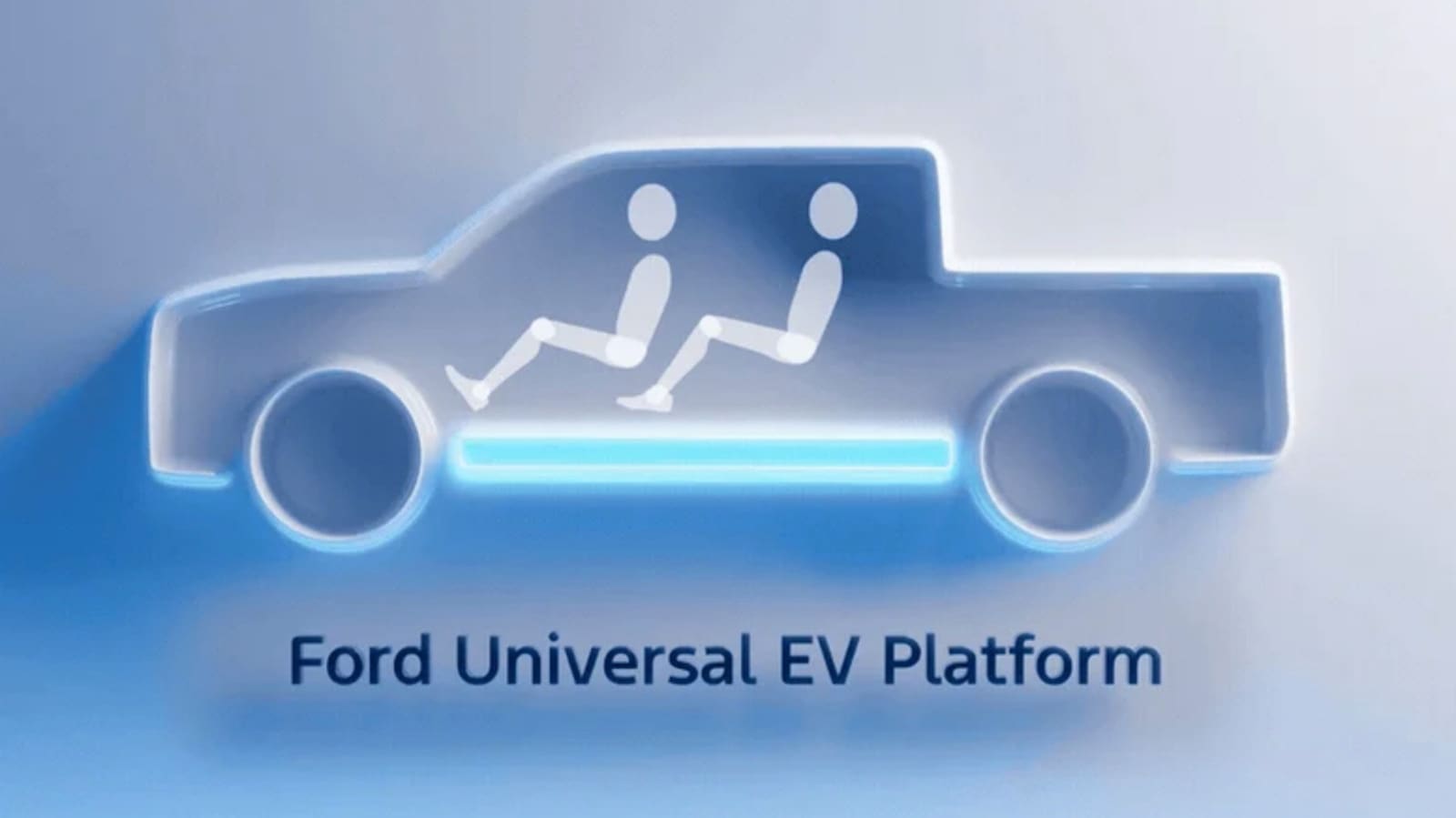
The company has been deliberately vague about subsequent models, releasing only a promotional film that teases SUVs and sedans without hard timelines. What Ford has committed to is a pricing promise: its UEV-based EVs will cost less than a three-year-old used Tesla Model Y, a benchmark that currently hovers around $35,000 to $40,000 depending on region and condition. That framing is telling. Ford is not competing on range or acceleration but on accessibility, betting that the mass market will prioritize affordability and familiarity over bleeding-edge specs.
The UEV platform itself is designed for cost efficiency. By standardizing battery packs, drive units, and software across multiple body styles, Ford can amortize development costs and negotiate better terms with suppliers. The Apple Maps integration fits this logic: rather than building a bespoke navigation system for each model, Ford deploys a single SDK across the entire lineup, reducing engineering overhead and ensuring consistency.
Why Apple Chose Automotive Over the Apple Car
Apple's decision to license MapKit for Automotive rather than launch its own vehicle represents a pragmatic retreat from a decade of automotive ambition. The company reportedly spent billions on Project Titan, exploring everything from full autonomy to novel battery chemistries, before scaling back to focus on software and services. Partnering with established automakers allows Apple to monetize its mapping investment without the regulatory, manufacturing, and liability challenges of building cars.
For Apple, the upside is data. Every Ford EV running MapKit will generate telemetry on road conditions, traffic patterns, and user behavior, feeding back into Apple's broader mapping and machine learning infrastructure. That data can improve routing algorithms, refine voice guidance, and train models for future autonomous systems, all without Apple needing to own the vehicle or the customer relationship.
The partnership also keeps Apple relevant in the automotive conversation as competitors like Google deepen their own integrations. Android Automotive, which powers infotainment systems in vehicles from Volvo to General Motors, has been aggressively marketed as a turnkey solution for automakers looking to offload software complexity. Apple's response, at least in this instance, is not to build a rival operating system but to embed its services where users already expect them, leveraging brand loyalty and ecosystem lock-in.
The Broader Shift Toward Affordable EVs
Ford's pricing rhetoric reflects a market correction underway across the industry. The first wave of electric vehicles targeted early adopters willing to pay premiums for range and performance. Now, with adoption curves flattening in key markets and inventory piling up on dealer lots, automakers are racing to the bottom, competing on price rather than prestige.
The $30,000 midsize pickup, if it materializes as promised, would represent a significant milestone. Most electric trucks currently start above $50,000, and the few budget offerings that have emerged, such as bare-bones work trucks with no stereo or power windows, have generated buzz precisely because they are so rare. Ford's bet is that a fully featured, software-rich EV at that price point can capture fleet buyers, contractors, and suburban families who have been priced out of the electric transition.
The challenge will be execution. Automakers have a poor track record of hitting aggressive cost targets, particularly when battery prices remain volatile and supply chains for critical minerals remain concentrated in geopolitically unstable regions. Ford's ability to deliver on its pricing promise will depend on battery procurement, manufacturing scale, and its willingness to accept thinner margins in exchange for volume.
What This Means for the Infotainment Wars
The Ford-Apple partnership is unlikely to be exclusive for long. Other automakers will watch closely to see whether MapKit for Automotive delivers on its promise of seamless integration and whether Apple's data-sharing terms are palatable. If the collaboration succeeds, expect similar deals with European and Asian manufacturers looking to differentiate their EV offerings without the cost of building proprietary navigation stacks.
For consumers, the immediate benefit is clarity. Instead of learning a new interface with each vehicle purchase, drivers who already use Apple Maps on their phones will find the same visual language and interaction patterns in their Ford EV. That continuity reduces cognitive load and makes advanced features like real-time rerouting and natural language search more likely to be used.
The longer-term implication is that the car is becoming a node in a broader software ecosystem rather than a standalone product. Ford is not just selling a truck; it is selling access to Apple's services, over-the-air updates, and the promise of continuous improvement. That shift aligns the incentives of automakers and tech companies in ways that were impossible a decade ago, when cars were mechanical assets with twenty-year lifespans and software was an afterthought.