China's Robot Makers Pivot to Wheels Over Walking
At Beijing's World Robot Conference, the industry's center of gravity is shifting from crowd-pleasing humanoids to practical, deployable machines that can generate revenue today.
The Spectacle Gap
Unitree Robotics' booth drew the largest crowds at this year's World Robot Conference in Beijing, where humanoid machines played table tennis and engaged in choreographed sparring matches. The demonstrations showcased balance algorithms and motor control that would have been impossible three years ago. Yet the real story unfolded in the less-trafficked aisles, where wheeled platforms and task-specific machines occupied floor space without fanfare.
At DailyTechWire, we've tracked a pattern across robotics expos in Shenzhen, Seoul, and Tokyo over the past eighteen months: the ratio of humanoid prototypes to deployed non-humanoid units keeps widening. The spectacle remains concentrated in bipedal form factors, but the purchase orders flow elsewhere.
Form Follows Function, Eventually
The appeal of humanoid design rests on a seductive premise. Environments built for human bodies, staircases and doorways and elevator buttons, theoretically favor robots shaped like us. That logic works in edge cases: a hospital ward, a residential care facility, a retail stockroom with legacy shelving. But most industrial and logistics settings do not privilege human morphology. Warehouses install conveyor systems; factories build assembly lines at ergonomic heights that favor wheeled platforms with adjustable arms.
Chinese manufacturers are internalizing this lesson faster than their counterparts in the United States and Japan, where humanoid development still attracts venture capital on the strength of long-term optionality. The calculus in Hangzhou and Suzhou is more immediate. Revenue timelines matter when subsidies taper and export markets tighten.
The Deployment Arithmetic
Wheeled robots solve a narrower set of problems, but they solve them profitably. A four-wheeled platform with a manipulator arm can navigate a flat factory floor, pick components from bins, and return to a charging dock without the computational overhead required to maintain bipedal balance. The cost differential is meaningful: a capable wheeled unit can be built and deployed for roughly one-third the bill of materials of a humanoid prototype with comparable payload capacity.
Speed to deployment compounds the advantage. Bipedal machines require months of tuning for specific environments, testing gait algorithms on different floor surfaces, adjusting for slopes and thresholds. Wheeled platforms reach operational status in weeks. For a manufacturer evaluating return on investment, the comparison is stark.
Where Humanoids Still Make Sense
The pivot away from humanoid design is not absolute. Certain applications genuinely benefit from legs and articulated torsos. Disaster response scenarios, where rubble and uneven terrain dominate, reward machines that can step over obstacles. Inspection tasks in legacy industrial plants, built decades before automation was a consideration, occasionally demand the ability to climb ladders or squeeze through narrow passages designed for human maintenance crews.
But these represent niche deployments, not the volume market that will sustain the robotics sector's growth trajectory in China. The companies we spoke with at the conference framed humanoid development as a research track, valuable for advancing motor control and perception algorithms, but distinct from their commercial roadmaps.
The Capital Efficiency Question
Venture investors in Shenzhen and Beijing are recalibrating their theses. Early-stage robotics startups that pitched humanoid platforms eighteen months ago are now presenting hybrid portfolios: a flagship bipedal model for brand visibility and a wheeled product line for revenue. The shift reflects pressure from limited partners who want to see unit economics, not just technological milestones.
This dynamic mirrors the broader maturation of China's hardware ecosystem. The era of patient, government-backed capital willing to fund multi-year research projects without near-term commercialization is giving way to a more disciplined approach. Robotics companies are being held to the same standards as SaaS startups: demonstrate product-market fit, show a path to gross margin expansion, articulate a defensible moat.
What the Conference Floor Reveals
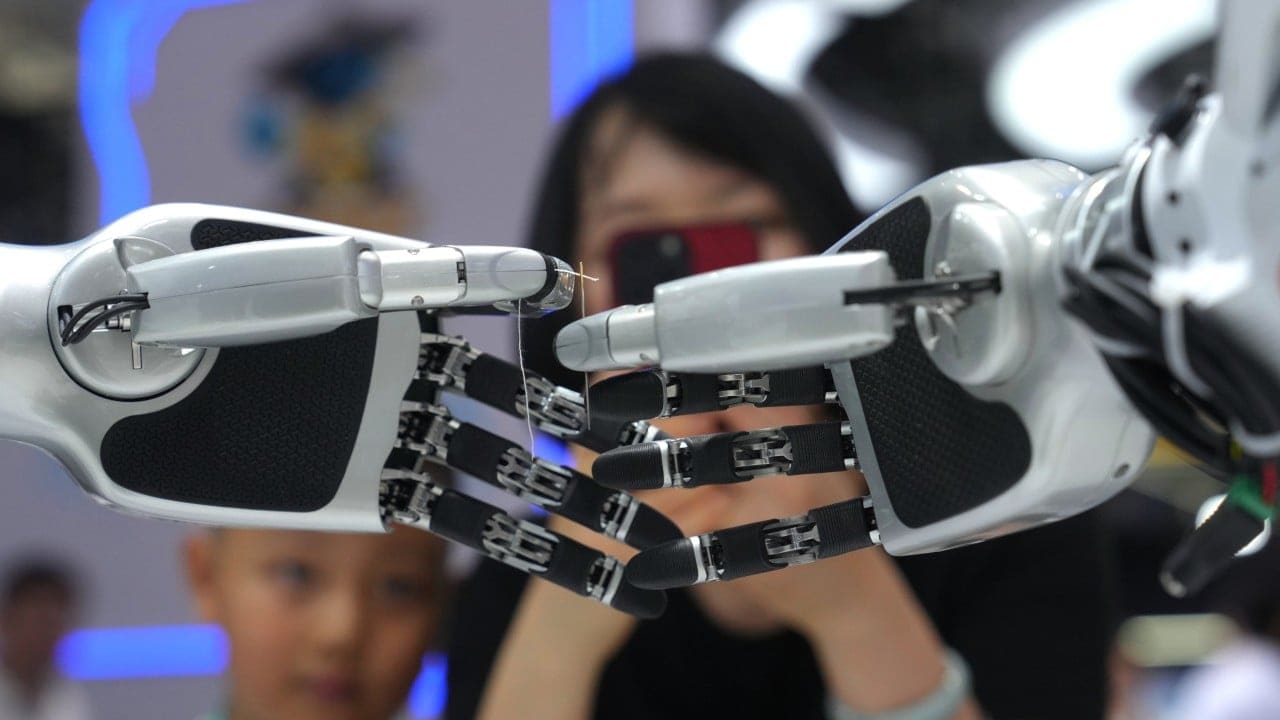
Walking the exhibit hall at the World Robot Conference offers a compressed view of this transition. Humanoid booths remain the most photographed, their demonstrations optimized for social media shareability. But the substantive conversations, the ones involving technical specifications and delivery schedules, happen around wheeled platforms and modular systems.
One exhibitor, a Suzhou-based manufacturer of logistics robots, reported that their wheeled units are now deployed across forty-two facilities in Southeast Asia and the Middle East. Their humanoid prototype, prominently displayed at the front of the booth, has yet to leave the testing phase. The prototype serves a function, generating press coverage and signaling technical capability, but it is not the business.
The Practical Path Forward
The robotics industry in China is maturing past the proof-of-concept stage. The challenge now is not whether machines can perform tasks, but whether they can do so at a cost structure that justifies displacing human labor or existing automation. Humanoid robots carry a higher burden of proof, both in capital expense and operational complexity.
Wheeled and specialized designs, by contrast, slot into existing workflows with less friction. They do not require rethinking facility layouts or retraining entire workforces. They can be deployed incrementally, one production line at a time, allowing manufacturers to validate performance before scaling.
This pragmatic approach is reshaping the competitive landscape. The companies that will dominate the next phase of robotics growth in Asia are not necessarily those with the most advanced humanoid prototypes. They are the ones that can deliver reliable, cost-effective automation solutions that solve today's problems, not the speculative challenges of a decade from now.
The crowd at Unitree's booth will keep growing, because bipedal robots remain genuinely impressive. But the orders will keep flowing to the less glamorous machines rolling quietly across factory floors, generating returns rather than applause.