ChatGPT Work Arrives as OpenAI Pushes Agent Ambitions Beyond Coding
The productivity agent unifies GPT-5.6 models, computer use capabilities, and cross-app orchestration in a single desktop experience, while Atlas browser faces August sunset.
The Desktop Super-App Materializes
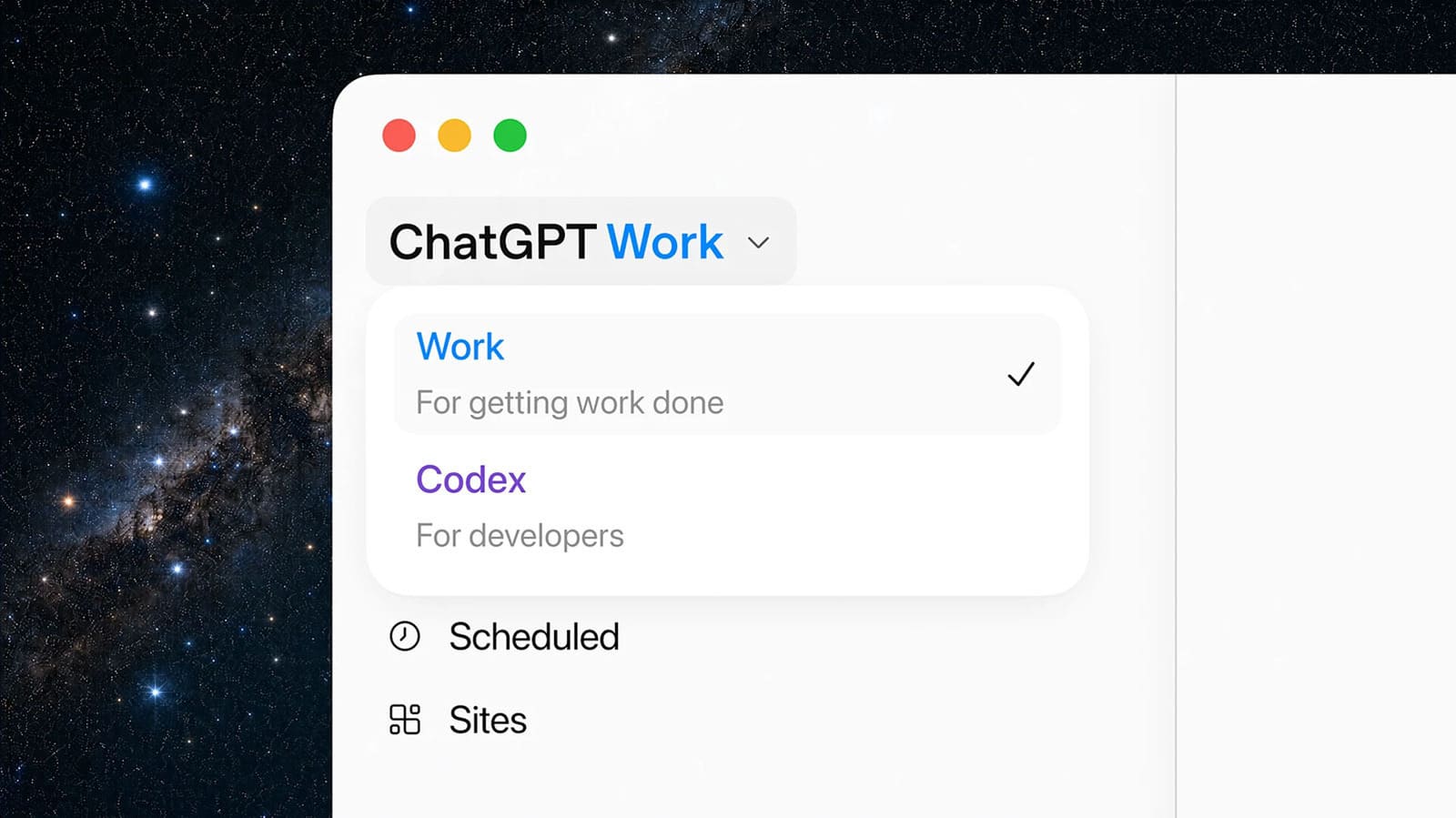
OpenAI introduced ChatGPT Work, a productivity agent that consolidates months of development across chat, coding, and browser tooling into a single desktop application. The release marks the company's most concrete move yet toward a unified agent platform, one that extends beyond the developer-centric Codex tool it shipped earlier this year.
At DailyTechWire, we've tracked OpenAI's March announcement of a "super app" strategy and the April groundwork that followed. ChatGPT Work represents the payoff: a general-purpose assistant that orchestrates tasks across applications, schedules work asynchronously, and generates live web interfaces on demand.
The agent runs on OpenAI's GPT-5.6 model family, which faced a temporary release delay attributed to U.S. administration review. That friction underscores the regulatory scrutiny advanced models now attract, particularly as they gain the ability to act autonomously across user environments.
Task Scheduling and Cross-Platform Continuity
ChatGPT Work introduces persistent task scheduling, allowing users to assign work from a mobile device and let the agent execute remotely. Progress tracking then resumes on desktop, either through a browser interface or the native ChatGPT application for macOS and Windows.
The desktop app includes computer-use capabilities that permit the agent to navigate local applications and move files as needed. That level of system access raises the stakes for permission models: OpenAI emphasizes user control over what the agent can touch, when it checks in, and which actions require explicit approval before execution.
For enterprise and power users, the promise is straightforward. Delegate a multi-step workflow in the morning, review outputs by afternoon, and intervene only when the agent flags ambiguity or risk. The architecture mirrors patterns we've seen in Anthropic's computer-use API and Google's Project Astra, but OpenAI's distribution advantage through ChatGPT's existing user base gives it a faster path to adoption.
Unified Plugin Directory and the "@" Syntax
A redesigned plugin directory now sits inside the ChatGPT interface. Users invoke integrations by typing "@" followed by an app name, prompting the agent to pull context or execute actions within that service. The chatbot also surfaces relevant apps mid-conversation, reducing the friction of discovering which tools are available.
OpenAI suggests automation use cases such as summarizing a week's worth of Slack messages or updating project trackers without manual input. The "@" pattern borrows from collaboration software conventions, Notion and Slack among them, making the interaction model familiar to knowledge workers already accustomed to slash commands and mentions.
The plugin ecosystem remains a competitive front. Microsoft's Copilot, Salesforce's Einstein, and Anthropic's integrations all vie for the same enterprise connectors. OpenAI's advantage lies in its installed base and the relative maturity of its developer platform, but interoperability standards are still fragmented across vendors.
Sites: Instant Web App Generation
ChatGPT Work includes a feature called Sites, which generates live web applications for dashboards, calendars, prototypes, and internal portals. The built-in browser in the desktop app renders these on the fly, eliminating the need for separate hosting or front-end tooling.
This capability positions OpenAI closer to low-code platforms like Retool or Glide, but with natural-language generation as the primary interface. For teams that need quick visibility into project status or operational metrics, Sites offers a faster alternative to commissioning custom development or wrestling with spreadsheet macros.
The trade-off is flexibility. Purpose-built tools still offer deeper customization and performance optimization. Sites will likely serve prototyping and internal use cases well, while production-grade applications continue to demand specialized engineering.
Atlas Deprecation Signals Strategic Consolidation
OpenAI confirmed it will discontinue Atlas, the standalone web browser it had positioned as a research and browsing agent. Deprecation is scheduled for early August, roughly three months after the browser's initial rollout.
The decision reflects a common pattern in fast-moving product organizations: ship early, learn quickly, fold successful features into a core platform, and retire the standalone experiment. Atlas's browsing and information-retrieval functions now live inside the ChatGPT desktop app, reducing the surface area OpenAI must maintain and support.
For users who adopted Atlas, the transition timeline is tight. OpenAI has promised further details, but the swift deprecation underscores the volatility of beta-stage AI tooling. Enterprise customers evaluating agent platforms should plan for similar consolidation cycles as vendors iterate toward stable product lines.
Access Tiers and Rollout Timeline
OpenAI began rolling out ChatGPT Work on July 9, with full availability expected within 24 hours. Free-tier users can access the agent through the desktop app on macOS and Windows. Plus and Pro subscribers gain additional access via the web client, alongside the desktop application.
The tiered release preserves OpenAI's freemium model while directing power users toward paid plans. As agent capabilities expand, compute costs rise, and the company will need to balance accessibility with unit economics. We expect further segmentation as task scheduling and computer use drive higher infrastructure loads.
Implications for the Agent Stack
ChatGPT Work consolidates three trends: multi-modal models with extended context, autonomous task execution, and cross-app orchestration. The combination moves OpenAI beyond conversational AI into the territory of robotic process automation and enterprise middleware.
The competitive landscape is crowded. Anthropic's Claude can operate computers. Google is embedding agents across Workspace. Microsoft has Copilot woven into Office 365. The differentiation will increasingly hinge on reliability, permission granularity, and the breadth of integrations each vendor can sustain.
For now, OpenAI holds momentum. The ChatGPT brand carries recognition, the plugin ecosystem is maturing, and GPT-5.6 models deliver the reasoning depth required for complex workflows. Whether that translates into durable enterprise adoption depends on how well the company navigates security audits, compliance frameworks, and the inevitable edge cases that arise when agents operate autonomously across sensitive data environments.