Beijing Signals Chip Self-Sufficiency Gains After Years of Equipment Push
China's top economic planner says domestic semiconductor supply chain security has improved markedly, pointing to progress across tools and materials despite US restrictions.
A Rare Public Scorecard
China's National Development and Reform Commission offered a cautiously optimistic assessment this week: the country's semiconductor supply chain is now "significantly" more secure than a year ago. The statement, delivered by vice-chairman Li Chao, marks one of the clearest official signals yet that Beijing's campaign to insulate its chip industry from external shocks is yielding tangible results.
At DailyTechWire, we've tracked this transition for three years - from emergency policy responses after the first wave of export controls in 2022 to today's industrial coordination across lithography, deposition tools, inspection equipment, and specialty gases. What Li described as a shift from "isolated technological breakthroughs" to "full-chain industrial synergy" reflects a strategic recalibration: China is no longer betting on leapfrog innovation alone, but on connecting dozens of previously siloed suppliers into a functioning ecosystem.
The NDRC's language is revealing. "Safer" does not mean self-sufficient, and "significantly improved" leaves room for continued dependence on foreign nodes and processes. But in a policy environment where officials rarely celebrate incremental wins, the public acknowledgement suggests internal confidence that the worst vulnerabilities - particularly in mature-node production - are receding.
Equipment and Materials: The Unglamorous Backbone
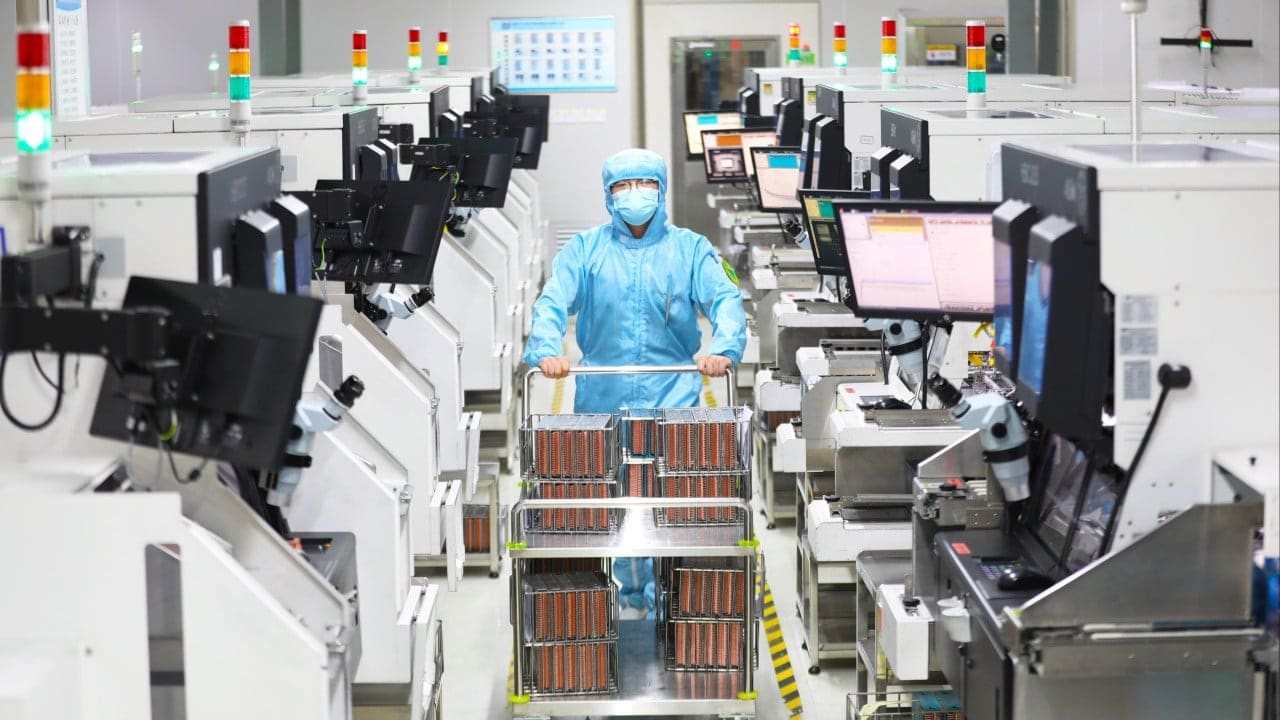
The most concrete progress cited by Li centers on chipmaking equipment and materials, the unglamorous but essential layers beneath wafer fabrication. Over the past eighteen months, Chinese manufacturers have shipped increasing volumes of etch tools, chemical-mechanical planarization systems, and ion implanters to domestic fabs. These are not cutting-edge 3-nanometer enablers, but they are critical for the 28nm and above processes that still account for the majority of global chip demand by volume.
Materials tell a similar story. Photoresists, ultra-high-purity gases, and silicon wafers - once overwhelmingly imported from Japan, South Korea, and Taiwan - are now being produced at scale by mainland suppliers. Quality gaps remain, particularly in advanced resists for extreme ultraviolet lithography, but for mature nodes the gap has narrowed enough that cost and lead time, not technical feasibility, drive procurement decisions.
This is the industrial base that underpins everything else. Without reliable deposition and etch, even a breakthrough in lithography becomes academic. China's approach has been to build capability horizontally across the stack, accepting that leading-edge logic may remain out of reach for years while securing the foundations for automotive, industrial, and consumer chips.
From Breakthroughs to Integration
Li's reference to "full-chain synergy" speaks to a shift in execution. Early in the self-sufficiency push, Chinese media celebrated individual milestones - a homegrown 28nm lithography tool here, a domestic ion implanter there - without asking whether these components could work together in a production line. Fabs need not just tools, but tools that integrate with process recipes, metrology, and yield management software. A single incompatible module can bottleneck an entire line.
The past year has seen more emphasis on integration. SMIC, Hua Hong, and regional fabs have quietly been qualifying multi-vendor domestic toolsets, running pilot lines that mix Chinese deposition with Chinese etch and Chinese inspection. These are not headline-grabbing announcements, but they are the operational proof points that matter to fab managers and equipment buyers.
We also see this in policy design. Subsidies are increasingly tied to ecosystem participation - equipment vendors that co-develop processes with fabs, materials suppliers that work with tool makers on chamber compatibility. The goal is to move from a collection of national champions to a functioning industrial network, where feedback loops between users and suppliers drive iterative improvement.
The Export Control Backdrop
None of this happens in a vacuum. US export controls have tightened repeatedly since 2022, most recently with restrictions on advanced packaging and AI chip design tools. Each new rule forces Chinese players to either find workarounds, accept performance penalties, or double down on domestic alternatives.
The NDRC's optimism must be read against this backdrop. If supply chain security has improved, it is partly because the definition of "secure" has shifted. Where three years ago Chinese fabs expected access to the best available foreign tools, today they plan around the assumption of persistent restriction. Progress is measured not against the global frontier, but against the ability to sustain production within a constrained perimeter.
This recalibration has strategic implications. A "safer" supply chain in Beijing's terms may be one that is less efficient, more expensive, and technologically trailing - but resilient to external cutoffs. That is a different optimization function than Silicon Valley or Seoul would choose, but it reflects China's prioritization of sovereignty over speed.
What Remains Fragile
The NDRC's statement does not erase the gaps. Extreme ultraviolet lithography remains entirely foreign, with no credible domestic alternative on the horizon. Advanced packaging, critical for chiplets and high-bandwidth memory, still relies heavily on equipment and materials from ASML, Tokyo Electron, and Applied Materials. Design automation tools - the software that turns circuit designs into manufacturable layouts - are dominated by Synopsys, Cadence, and Siemens, with Chinese alternatives years behind in both capability and ecosystem support.
Even in areas where China has made progress, scale and reliability are uneven. A tool that works in a pilot line is not the same as a tool that delivers 95 percent uptime over two years in high-volume manufacturing. Materials that meet spec on paper can still cause yield issues in production. The transition from "good enough for qualification" to "preferred by fab engineers" takes time, and there are few shortcuts.
The Regional Dimension
China's chip self-sufficiency is not a monolithic national project - it is also a regional competition. Shanghai, Beijing, Shenzhen, Wuhan, Hefei, and Chengdu are all racing to build semiconductor clusters, each with its own mix of fabs, equipment suppliers, and research institutes. The NDRC coordinates at the national level, but execution is distributed, and local governments compete for subsidies, talent, and anchor tenants.
This fragmentation has costs - duplicated R&D, incompatible standards, uneven quality - but it also creates redundancy and experimentation. If one regional ecosystem stumbles, others can step in. The "full-chain synergy" Li describes is emerging not from top-down mandates alone, but from competitive pressure among cities and provinces to prove they can support a viable semiconductor stack.
A Long Game, Not a Victory Lap
The NDRC's tone is measured, and for good reason. China's semiconductor challenge is not a two-year sprint but a decade-long industrial buildout. The progress cited this week is real, but it is also incomplete, uneven, and vulnerable to further external shocks.
What has changed is the trajectory. Three years ago, the question was whether China could build any kind of functioning domestic chip ecosystem under export controls. Today, the question is how capable that ecosystem will become, and how quickly. The answer will shape not just China's technology sector, but the global balance of semiconductor supply, the economics of electronics manufacturing, and the geopolitical calculus of technology competition.
For now, Beijing is signaling that the foundation is in place. The hard part - scaling, refining, and closing the performance gap - comes next.