Anthropic Rolls Out Granular Memory Editing Tools for Claude Users
The AI assistant now lets users modify and delete specific conversation memories, with new controls for sensitive topics and project-level context management.
Memory Gets an Upgrade
Anthropic has quietly shipped a feature that addresses one of the thorniest problems in conversational AI: what happens when your chatbot remembers something wrong, or something you'd rather it forget? Since mid-2025, Claude has been storing context from past interactions to personalize responses and reduce repetitive prompting. Now, users can surgically edit or remove those memories topic by topic, a level of control that sets a new baseline for what users should expect from stateful AI assistants.
At DailyTechWire, we've tracked memory implementations across major foundation models, and the pattern has been consistent: labs ship the feature fast, then scramble to retrofit privacy and correction tools after user complaints pile up. Anthropic's latest update suggests the company learned from that cycle. The new editing interface organizes memories by topic and surfaces them in both web and mobile clients, letting users rewrite or delete entries without nuking their entire history.
How the Editing Interface Works
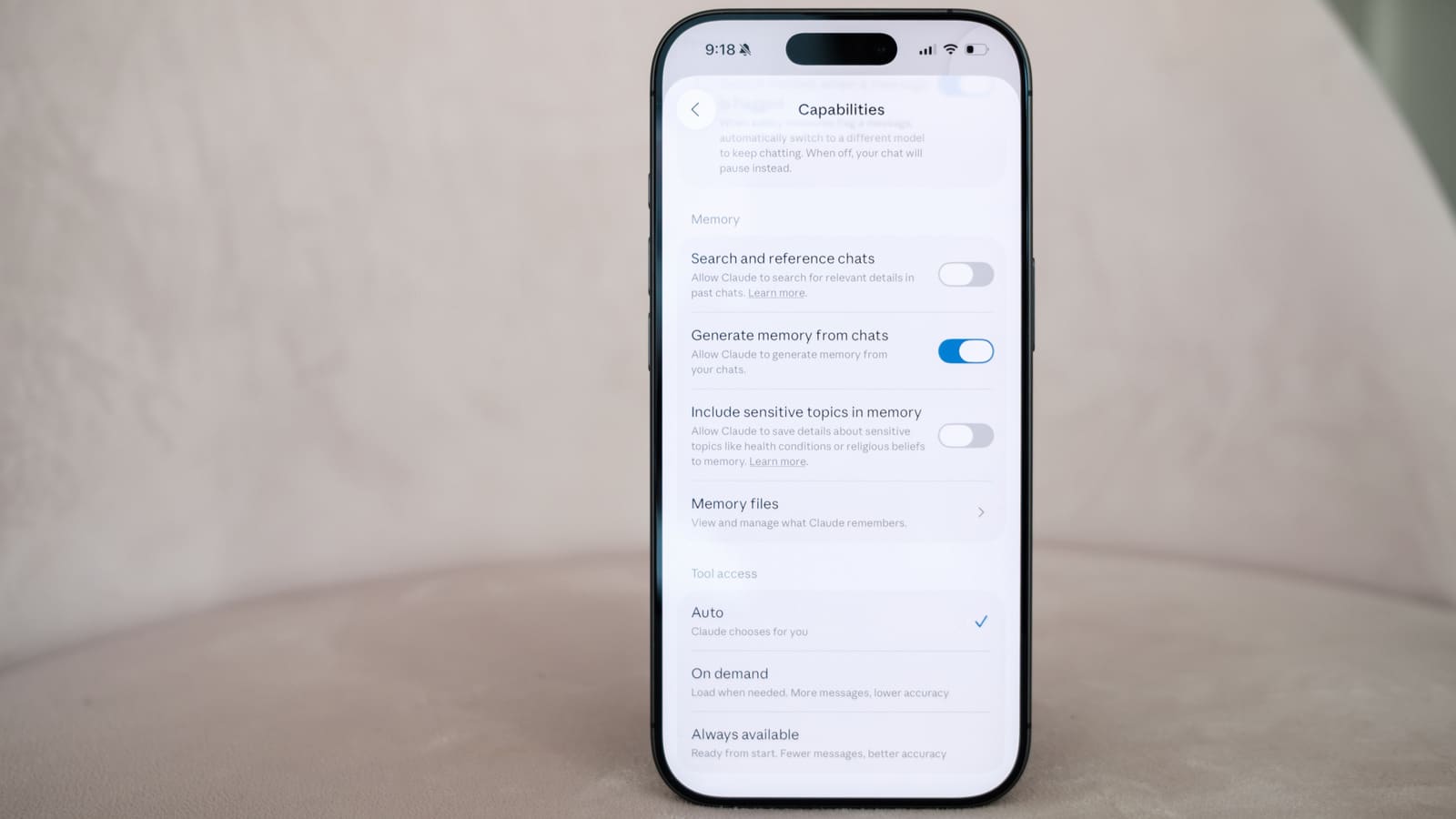
The mechanics are straightforward. On the web client, users navigate to Settings, then Memory, where Claude displays a Topics section. Each stored memory appears with Edit and Delete icons. Tapping Edit opens a prompt bar where users describe the change they want, and Claude rewrites the memory accordingly. The mobile flow mirrors this: tap the profile icon, navigate to Capabilities, then Memory files, and select a topic to modify or trash.
The simplicity hides a subtle design choice. Rather than exposing raw key-value pairs or timestamps, Anthropic presents memories as natural-language summaries grouped by subject. This makes the interface accessible to non-technical users but also means editing is mediated by another layer of language model inference. You're not directly rewriting a database entry; you're prompting Claude to rewrite its own understanding. Whether that indirection improves accuracy or introduces drift over repeated edits remains an open question.
Sensitive Topics Get Special Treatment
Anthropic has added a toggle called Include Sensitive Topics in Memory, disabled by default. Without it, Claude won't store information about health, race, ethnicity, religious beliefs, politics, or gender identity. Flip the switch, and the assistant begins recording those details, but with a catch: each time it saves something sensitive, a notice appears to confirm the action.
The feature reflects a broader industry reckoning around consent and scope. Early memory systems treated all user data as fair game for retention; newer designs force labs to draw explicit boundaries. Anthropic's approach is conservative, leaning toward under-collection unless users opt in. Even with the toggle enabled, certain data types such as government ID numbers remain off-limits.
One wrinkle: the sensitive-topic notice only appears on recent app versions. Older clients and some mobile builds won't display the confirmation, and in those cases Claude simply won't save the memory. Anthropic hasn't published a version compatibility matrix, which leaves users guessing whether their build supports the feature.
Project-Level Memory Silos
Claude organizes memory differently depending on context. In standalone chats, memories accumulate globally. Inside Projects, the tool Anthropic built for longer workflows, memories are siloed to prevent context window bloat. Users can shape project memory by adding comments, uploading documents, or pulling in code from GitHub through the right-side panel.
At the end of each day, Claude generates a work summary for the project, editable from the same interface. If a user accidentally starts a conversation outside a project, they can relocate it by tapping the three-dots menu and selecting Add to Project. For information that should persist everywhere, including projects, users can add it to the Profile section of the Memory menu.
This two-tier structure, global memory versus project memory, mirrors the way developers think about variable scope. It's elegant in theory but demands that users internalize a mental model of where their context lives. Casual users may find conversations bleeding into the wrong memory bucket, especially on mobile where the project switcher is less prominent.
Incognito Mode and Import Tools
Anthropic also surfaces an Incognito mode, activated via a ghost icon in the top-right corner. Conversations in this mode aren't saved, don't contribute to memory, and aren't used for model training. It's a straightforward escape hatch for ephemeral queries, though the name borrows heavily from browser parlance and may set expectations around privacy that differ from Anthropic's actual data handling.
In March, the company launched an import tool to pull conversations from competing chatbots. Users can trigger it by selecting Start Import next to Import Memory from Other AI Providers in the Memory menu. The feature is part of Anthropic's broader strategy to reduce switching costs for users committed to other platforms, though the quality of imported memories depends on how well Claude can parse chat logs from ChatGPT, Gemini, or other assistants with different formatting conventions.
What This Means for Stateful AI
The ability to edit memories granularly is table stakes for any AI assistant that claims to be personalized. But the real test isn't whether the feature exists; it's whether users can understand what the model has stored and trust that corrections stick. Anthropic's topic-based organization is a step forward, but it still abstracts away the mechanics. Users don't see how memories are encoded, how they're weighted during retrieval, or how edits propagate across different parts of the system.
Competitors are watching closely. OpenAI's memory implementation for ChatGPT remains opaque, with no public editing interface beyond deleting the entire memory store. Google's Gemini has experimented with activity controls but hasn't shipped topic-level granularity. If Anthropic's design proves intuitive, expect rapid convergence across the industry.
The broader question is whether memory editing will become a power-user feature or a mainstream expectation. Right now, most Claude users likely don't know the Memory settings exist. Anthropic hasn't built onboarding flows or proactive prompts to surface the tools. That may be intentional, a bet that the system works well enough out of the box that only edge cases require manual intervention. But as memory becomes more central to the value proposition of these assistants, ignorance of the controls could become a liability, especially if a stored memory causes a visible mistake in a high-stakes context.
The Limits of Forgetting
Anthropic offers two nuclear options: Pause Memory and Reset Memory. The first stops new memories from forming; the second wipes the slate entirely and cannot be undone. The company warns that re-enabling memory after a reset starts from scratch, with no way to recover prior context.
These blunt instruments highlight a gap in the current design. There's no way to selectively roll back memory to a specific date, no changelog showing what Claude learned when, and no version control for memory states. For enterprise users or anyone managing complex, long-running projects, the lack of auditability could become a friction point. If a bad memory corrupts Claude's understanding of a workflow, tracing the root cause means sifting through topics manually or resetting everything.
The absence of retroactive memory generation is another constraint. Claude won't scan old conversations to backfill memories after a user enables the feature or adjusts sensitivity settings. That's a privacy-forward choice, but it means users who want comprehensive memory coverage need to start fresh or manually prompt Claude to remember key details from past exchanges.
Where This Goes Next
Anthropic's memory editing tools are a pragmatic response to user demand, but they also hint at deeper architectural questions. As context windows expand and models gain access to larger swaths of user history, the line between memory and retrieval-augmented generation blurs. Is a stored memory a fixed belief the model holds, or is it just another document in a vector database, retrievable and reinterpretable on the fly?
The answer matters for how these systems scale. Fixed memories, like the ones Claude appears to use, risk staleness and require active maintenance. Retrieval-based systems stay fresh but introduce latency and complexity. Anthropic hasn't disclosed the technical implementation, but the user-facing behavior, topic summaries that can be rewritten via natural language, suggests a hybrid approach where memories are periodically re-encoded based on user input.
For now, the editing interface is a Band-Aid on the fundamental challenge of stateful AI: models that remember are more useful but also more fragile. Every stored fact is a potential error, every personalization a potential misfire. Anthropic's bet is that giving users direct control over the memory layer will build trust faster than trying to perfect the system behind the scenes. Whether that bet pays off depends on how many users discover the tools, and how many decide the hassle of memory gardening is worth the benefit of a chatbot that knows them.