Anduril Eyes $100 Billion Valuation as Defense Tech Funding Surges
The weapons maker is pursuing a two-stage fundraise that would triple its 2025 valuation, reflecting an industry-wide shift toward autonomous systems and expendable hardware.
A Tripling in Twelve Months
Anduril is negotiating a capital raise structured across two tranches that could value the defense technology company at roughly $100 billion, according to people familiar with the matter. The proposed valuation represents more than a threefold increase from the $30.5 billion the company commanded in June 2025 and a significant jump from the $61 billion valuation attached to its $5 billion round closed just two months ago in May.
The two-stage structure would bring in investors at different entry points, with the second tranche priced at a higher valuation than the first. Both stages could close before year-end, the sources said. Anduril declined to confirm specifics, stating that no decisions have been made regarding future financing and cautioning that claims about terms, structure, or timing are speculative.
At DailyTechWire, we've tracked the pace of defense tech fundraising across Asia, Europe, and North America over the past eighteen months, and the velocity of capital into the sector has been striking. What sets this moment apart is not just the quantum of money but the strategic doctrine driving it: a wholesale pivot toward cheaper, autonomous, and replaceable systems designed for the kind of attrition warfare unfolding in Ukraine and tested in Middle Eastern theaters.
The Numbers Behind the Revival
Venture funding into defense technology companies surged past $12 billion in the first half of this year alone, eclipsing the nearly $10 billion raised across all of 2025. That doubling in six months reflects a convergence of geopolitical urgency, proven battlefield demand for drones and autonomous platforms, and growing comfort among institutional investors with dual-use hardware.
Anduril itself reported revenue of $2.2 billion for 2025, more than double the prior year, driven by contracts with the U.S. Department of Defense, Air Force, and Army, as well as agreements with NATO, the Dutch Ministry of Defence, the U.K. Ministry of Defence, and Poland. The company's customer roster spans both traditional treaty allies and newer partnerships in Central and Eastern Europe, where procurement cycles have compressed dramatically since early 2025.
Other startups have captured similar momentum. Shield AI, which manufactures military aircraft, raised $1.5 billion in March. Mach Industries saw its valuation quadruple to $1.8 billion last month. Europe's Helsing closed a $1.8 billion round this month at an $18 billion valuation. Each of these deals shares a common thread: investors are betting on companies that can deliver volume, speed, and cost efficiency rather than exquisite, long-lived platforms.
Attritable Systems and the New Doctrine
The term "attritable" has become shorthand for a doctrinal shift. Instead of building aircraft, vehicles, or munitions designed to last decades and cost tens of millions of dollars per unit, defense contractors are now designing systems meant to be deployed, potentially lost, and replaced at scale. The model borrows directly from what Ukraine has demonstrated with consumer-grade drones adapted for reconnaissance, targeting, and direct attack.
Ethan Thornton, chief executive of Mach Industries, has framed his company's mission around designing for the current era of warfare at a fraction of traditional contractor costs. That philosophy extends beyond airframes and software to propulsion itself. Mach acquired solid rocket motor maker Exquadrum for $50 million in May, securing a critical input for munitions and missiles. Anduril has pursued a parallel path, receiving Pentagon funding to expand domestic solid rocket motor manufacturing capacity.
These moves address a supply bottleneck that predates the current fundraising wave but has become acute as demand for guided munitions and loitering munitions has spiked. Solid rocket motors are a chokepoint in the defense industrial base, and startups that can vertically integrate or secure dedicated supply are positioning themselves as more reliable partners than incumbents dependent on legacy subcontractor networks.
The Investor Coalition
Anduril's backers include Thrive Capital, Andreessen Horowitz, Founders Fund, ICONIQ, Flux Capital, Greycroft, Altimeter, and 1789 Capital, according to data from PitchBook. The investor roster also includes U.S. Vice President JD Vance, who held a stake prior to assuming office.
The presence of growth-stage generalist funds alongside specialized defense and national security investors signals a normalization of defense tech as an asset class. Five years ago, many venture firms maintained explicit policies against investing in weapons companies. Today, the calculus has shifted, driven by recognition that software-defined hardware, artificial intelligence for targeting and logistics, and autonomous systems sit at the intersection of commercial and defense innovation.
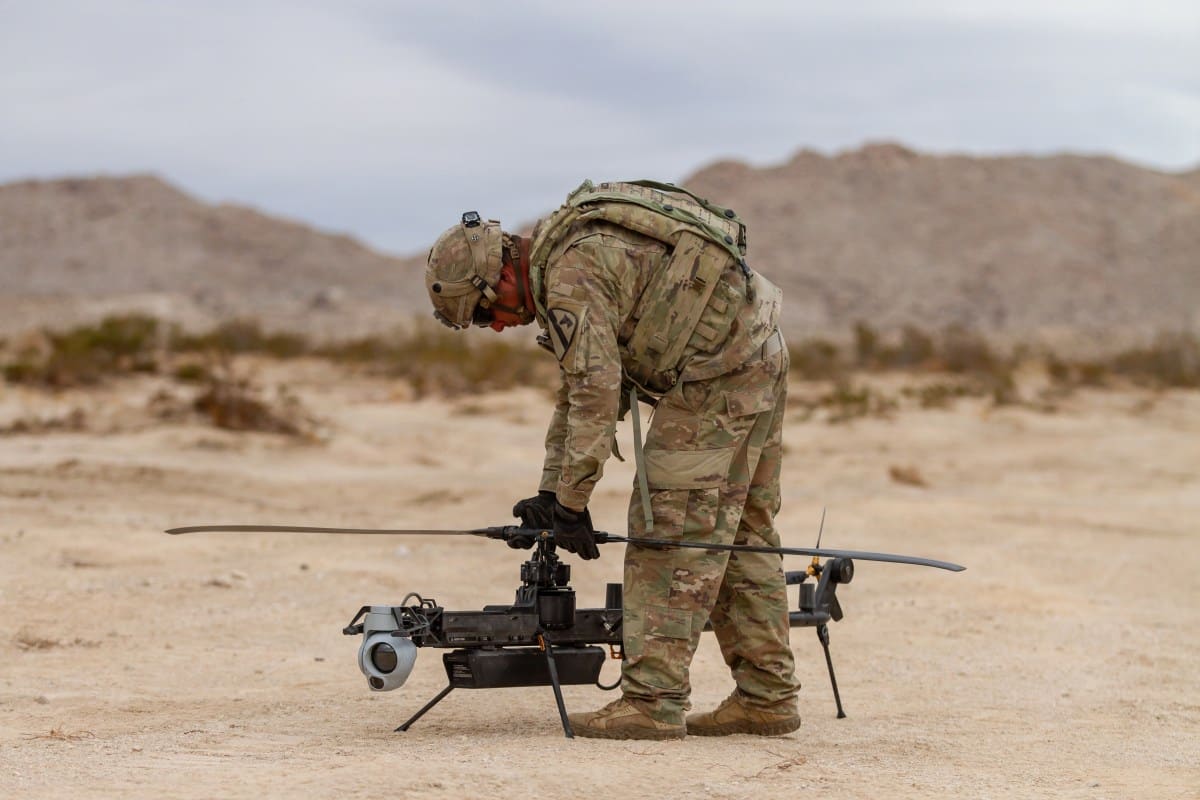
That convergence is visible in Anduril's product roadmap. The company's Lattice operating system integrates sensor data, automates threat detection, and coordinates responses across heterogeneous platforms. Its Ghost and Anvil drone families are designed for modularity and rapid iteration, characteristics borrowed from consumer electronics and enterprise SaaS rather than traditional defense programs that lock in specifications years before delivery.
What the Valuation Implies
A $100 billion valuation would place Anduril in rare company. Among private technology firms, only a handful have crossed that threshold before going public, and none in the defense sector. The valuation implies that investors are underwriting not just current revenue but a thesis that Anduril can capture a structural shift in defense procurement away from legacy primes and toward nimble, software-first contractors.
It also reflects confidence that geopolitical tensions will sustain demand for the next several years. Conflicts in Eastern Europe and the Middle East have created live testing environments for autonomous systems, and militaries worldwide are accelerating procurement timelines in response. Export controls on advanced semiconductors and AI models add a layer of complexity, but they also create moats for Western defense tech companies capable of integrating cutting-edge compute into hardened, deployable platforms.
The two-stage structure Anduril is reportedly pursuing offers a hedge for both the company and its investors. An initial tranche at a lower valuation provides downside protection if market conditions deteriorate, while the second tranche at a higher valuation rewards early participants and allows the company to capture momentum if growth continues to outpace expectations.
The Risks Beneath the Rally
For all the enthusiasm, the defense tech funding wave carries risks. Revenue concentration among a small number of government customers exposes startups to budget cycles, political shifts, and the possibility that a change in administration or strategic doctrine could freeze or cancel programs. Anduril's reliance on U.S. and NATO contracts means its fortunes are tied to Western defense policy, and any détente or shift toward arms control could dampen demand.
Operational risk is another factor. Manufacturing hardware at scale is capital-intensive and operationally complex, and startups without deep experience in supply chain management, quality assurance, and regulatory compliance face steep learning curves. The solid rocket motor bottleneck is one example; semiconductor supply, rare earth materials, and precision machining capacity are others.
Finally, there is the question of exit liquidity. Defense tech companies have historically faced a narrow set of acquirers, and public market investors have been cautious about businesses dependent on government contracts and subject to export restrictions. If Anduril and its peers cannot demonstrate paths to profitability and diversified revenue, the current valuations may prove difficult to sustain.
A Sector Transformed
The fundraising environment for defense tech today is unrecognizable from what it was three years ago. Capital that once flowed toward consumer apps, fintech, and enterprise SaaS is now competing for allocations in companies building drones, missiles, and command-and-control software. The shift is driven by geopolitics, but it is enabled by technology: artificial intelligence, edge computing, and software-defined hardware have made it possible to build defense systems that iterate like startups rather than ossify like incumbents.
Anduril's pursuit of a $100 billion valuation is both a symptom and a driver of that transformation. Whether the valuation holds will depend on execution, geopolitical continuity, and the company's ability to translate battlefield success into durable competitive advantage. For now, the defense tech sector is experiencing a moment of rare alignment between investor appetite, government demand, and technological readiness.